
AI Agent Memory Becomes Production Infrastructure
Microsoft, Neo4j, HubSpot and Alation are turning memory and context from hidden application logic into explicit infrastructure that can be scoped, retrieved, evaluated and governed.
Today in 90 Seconds
-
Microsoft made persistent memory a native context provider for Agent Framework. Agents can now store facts, summaries and profiles in Azure Cosmos DB and recall them across new sessions.
-
Neo4j brought graph based agent memory to .NET. The implementation combines short term memory, long term facts and reasoning traces while preserving provenance, temporal state and access records.
-
HubSpot formalized business context as a shared agent resource. Its updated Agent Hub documentation separates organization wide context from use case specific knowledge vaults.
-
Alation argues that enterprise agents need interpreted business context, not merely metadata. A technically correct data source can still produce the wrong answer if the agent does not understand how the organization defines and uses it.
-
New research shows that bigger memory retrieval does not necessarily mean better memory. A benchmark across eight memory systems found that some apparent performance advantages disappeared after controlling how much context each system was allowed to retrieve.
The Signal
Memory Is Becoming Part of the Agent Runtime
For years, agent memory has often meant little more than storing previous messages and retrieving similar text later.
That model is becoming insufficient.
The systems emerging now distinguish between raw conversation history, extracted facts, user profiles, business context, reasoning traces, source provenance and the rules determining what should return into a future execution.
Microsoft now exposes memory directly through its Agent Framework context lifecycle. Neo4j is representing memory as connected entities, events and reasoning paths. HubSpot is separating shared organizational context from scoped knowledge. Alation is treating context as something that must remain aligned with changing business definitions.
The structural change is important:
An agent is no longer defined only by its model, tools and prompt. What it remembers is becoming part of its operating state.
Tesseris Read
Persistent memory creates capability, but it also creates accountability requirements.
If an agent acts because of something learned three weeks earlier, the resulting execution should be able to establish what memory influenced that decision, where the information originated, when it became valid, whether it had changed, and which agent state retrieved it.
A useful memory therefore needs more than recall.
It needs provenance, scope, version, ownership, validity and evidence of use.
This becomes especially important when memory influences consequential actions such as purchasing, permissions, customer decisions or financial execution.
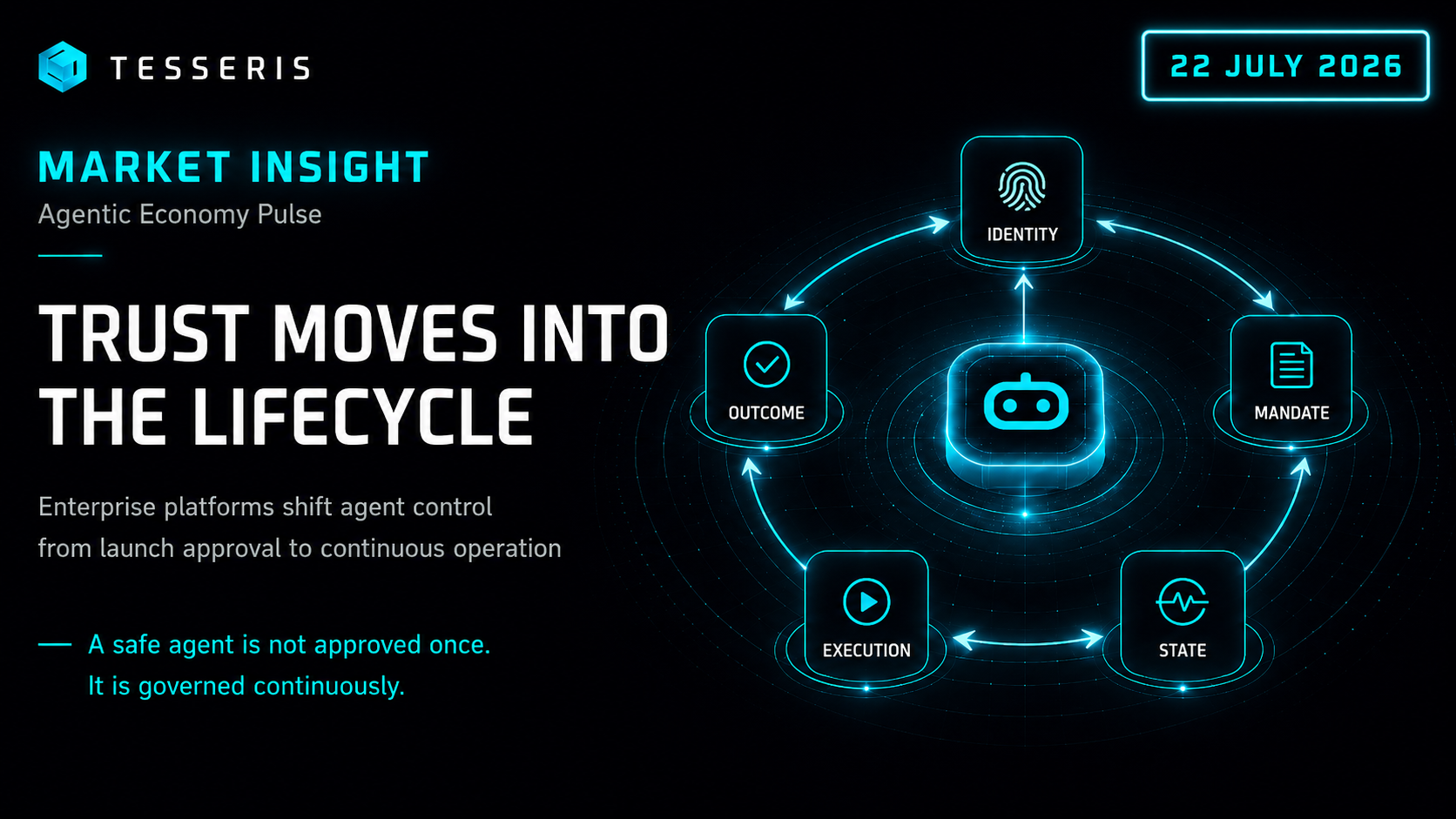
The trust chain is expanding from:
identity → execution → outcome
toward:
identity → memory state → execution → evidence → outcome
Memory is becoming part of the accountable agent state.
1. Microsoft Gives Agent Framework Persistent Memory Across Sessions
Microsoft Agent Memory announcement
Microsoft introduced
1CosmosMemoryContextProvider
The memory provider operates around each agent run. Before execution, it retrieves relevant stored context. After execution, it can extract and persist new information. Memory can be scoped to a stable user identity, and developers can customize what information the system considers worth remembering. Microsoft also treats retrieved memory as untrusted reference information rather than automatically promoting it to system instructions, reducing the risk that poisoned stored content becomes a permanent directive. The package remains in preview.
This moves memory closer to a first class runtime primitive rather than application specific glue.
2. Neo4j Extends Graph Based Agent Memory Into .NET
Neo4j published an independent .NET implementation of its agent memory model on July 25.
The architecture separates three connected forms of memory: conversation state, persistent facts and relationships, and reasoning traces describing how the agent reached a result or used tools.
More significantly for accountability, the implementation includes provenance, temporal knowledge, owner and application isolation, non destructive supersession, access auditing and memory decay. Neo4j reports that the implementation passed all 178 tests in its compatibility kit, although the project itself is an independent community implementation rather than a Neo4j core product.
The important shift is from remembering isolated text toward preserving connected state and how that state evolved.
3. HubSpot Turns Business Context Into Shared Agent Infrastructure
HubSpot AI context documentation
HubSpot updated its Agent Hub context system on July 24 around two distinct information layers.
General context contains foundational information about the organization and can influence multiple HubSpot AI tools. Knowledge vaults provide narrower information for particular agents and projects.
Administrators can define company identity, products, customer profiles, processes and custom business information, while controlling what information is shared with AI features. HubSpot explicitly says context should remain current so its AI systems reflect the latest state of the organization.
That distinction matters because production agents cannot treat every piece of organizational knowledge as equally relevant to every task.
Context is becoming scoped operating infrastructure.
4. Alation Separates Data Metadata From the Context an Agent Needs to Decide
Alation on metadata and AI context
Alation published a useful distinction on July 24 between knowing what data exists and knowing what that data means for a specific decision.
Metadata can identify tables, fields, owners, lineage and freshness. Context adds business definitions, rules, relationships and knowledge about which source an organization actually considers authoritative.
Alation argues that context also decays as businesses change. Definitions move, ownership changes and previously correct assumptions become stale. It therefore proposes continuous evaluation and feedback rather than treating context as a static document created when the agent launches.
This makes memory governance a temporal problem.
Correct information from the past can become incorrect authority in the present.
5. New Research Shows Memory Rankings Change When Retrieval Is Constrained
Beyond Memory Leaderboards research
A new research preprint evaluated eight memory and retrieval systems using full scientific papers rather than only conversational recall tasks.
Its central finding is unusually important for production agents: comparing memory systems without controlling how much context they retrieve can produce misleading rankings.
On one benchmark, Graphiti appeared to lead while retrieving approximately 2.6 million characters per query. When the researchers constrained retrieval budgets, that advantage disappeared. The authors argue that agent memory should instead be evaluated as context restoration under explicit resource constraints, including retrieval volume and modality.
The paper is a preprint and should not be treated as settled evidence.
But it introduces the right question:
A memory system should not be judged merely by whether it remembers. It should be judged by whether it restores the right evidence efficiently and reliably.
Since Yesterday
July 24 showed agents crossing an economic boundary by moving from product discovery into ordering and payment.
July 25 exposes what those agents will need if such workflows persist over time.
A purchasing agent may need to remember approved suppliers, spending preferences, contractual restrictions, previous disputes and changing company policies.
But persistent memory introduces a new failure mode: an action can be logically consistent with something the agent remembers and still be wrong because the remembered information is stale, incorrectly scoped or no longer authorized.
Yesterday the question was:
What is the agent allowed to spend?
Today the question becomes:
What remembered state is allowed to influence that decision?
Agent Economy Pulse
Memory and Provenance: Accelerating. Persistent context is moving into mainstream agent frameworks and enterprise platforms.
Runtime Governance: Building. Platforms are beginning to expose explicit controls over what information enters an agent execution.
Capability Verification: Building. Research is moving toward measuring memory quality under controlled retrieval conditions rather than accepting recall claims alone.
Enterprise Adoption: Accelerating. Microsoft, HubSpot, Neo4j and data infrastructure vendors are increasingly treating memory as deployable production architecture.
Trust and Security: Elevated. Persistent memory creates new surfaces for stale information, poisoned context and unauthorized carryover between executions.
What We Are Watching Tomorrow
Will agent platforms begin attaching provenance and expiry directly to individual memories?
Can memory systems prove which retrieved facts materially influenced a consequential action?
And will enterprises distinguish between information an agent is permitted to store, information it is permitted to retrieve, and information it is permitted to act upon?
Those three permissions are likely to become very different things.
Research Note and Sources
Microsoft's Cosmos memory integration is currently in preview. Neo4j's .NET implementation is an independent community project featured by Neo4j and validated against its compatibility kit. HubSpot's context architecture is documented product functionality, while Alation's interpretation of enterprise context represents the company's architectural perspective. The memory benchmark is an arXiv preprint and has not been treated as peer reviewed consensus.
Reported product capabilities, research findings and Tesseris interpretation are kept separate.