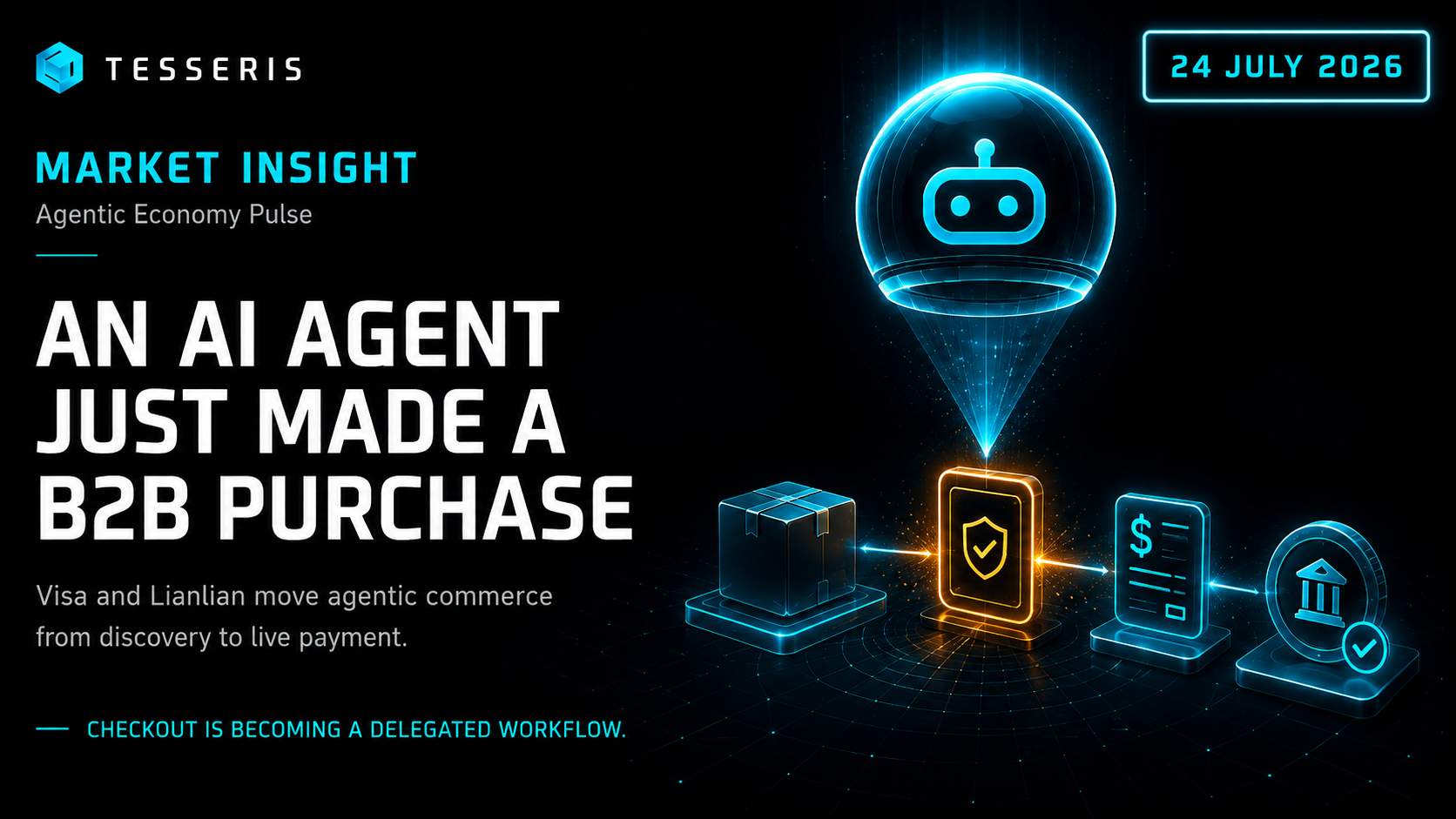
An AI Agent Just Completed a B2B Purchase
Visa and Lianlian moved agentic commerce from product discovery into a live purchasing workflow, while Mastercard, Affinidi and others advanced autonomous transaction controls.
Executive Signal: Agentic Commerce Moves From Discovery to Payment
July 24 showed agentic commerce crossing a meaningful economic boundary.
Visa and Lianlian completed a live B2B agentic transaction in Greater China. LoopXPay identified a purchasing need, compared suppliers, placed an order and executed payment inside one workflow. Mastercard and Sunrate mapped autonomous agents into enterprise payment operations. Affinidi expanded delegated identity and traceability for A2A and MCP interactions. Queue-it, DNP and Meeco explored rules for legitimate machine participation on the web. VentureBeat Research showed enterprises increasing spend on agent governance after deployment.
The common signal is simple: checkout is becoming a delegated workflow.
An agent can now participate in discovery, selection, ordering and payment. That means commerce infrastructure must prove not only that a payment credential is valid, but that the agent, mandate, decision path and outcome were authorized.
Tesseris signal: Agentic commerce becomes trustworthy only when identity, delegated authority, execution evidence, verification and settlement remain connected across the full transaction chain.
Key Signals Across Agentic Commerce, Payments and Delegated Authority
- Agentic checkout becomes real: AI agents are beginning to participate in product discovery, supplier comparison, ordering and payment as one workflow.
- Payment authorization becomes contextual: The question is shifting from whether money can move to why an autonomous agent was allowed to move it.
- Agent directories become commercial infrastructure: Verified agent directories can help identify machine actors, but they must evolve toward mandate and authority verification.
- Delegated identity becomes necessary: Multi-agent workflows need to preserve whose authority an agent carries through every service call and subtask.
- Governance becomes a procurement category: Enterprises are spending to add identity, evaluation, telemetry, context and orchestration controls after deploying agents.
Why July 24 Matters for the Agent Economy
The important part of July 24 is not that an AI system touched a payment rail.
It is that agentic commerce is beginning to compress the commercial journey.
A human buyer traditionally moves through intention, discovery, comparison, ordering, payment and receipt. Each step carries context. A payment processor may only see the final authorization request, but the buyer understands why the purchase happened.
AI agents break that assumption.
When an agent discovers the need, compares suppliers, chooses an option and initiates payment, the payment event is only the last visible step in a longer autonomous decision chain. Trust therefore cannot start at checkout. It has to begin with the mandate that gave the agent authority to act.
The strategic question is shifting from "Can an agent buy something?" to "Can every participant prove why the purchase was authorized?"
1. Visa and Lianlian Complete a Live B2B Agentic Transaction
Source: Visa and Lianlian announcement
Visa and Lianlian DigiTech announced what they describe as the first live B2B agentic transaction in Greater China using Lianlian's LoopXPay agent.
The agent sourced a product sample, interpreted the purchasing requirement, recommended suppliers, compared alternatives, placed the order and executed payment within one workflow.
Importantly, the companies say the agent operated within predefined spending controls and approval parameters. LoopXPay has also been registered in Visa's Agentic Directory, which is intended to help participating businesses identify verified agents.
Market signal: Agentic commerce is moving beyond recommendation.
The agent is beginning to participate in discovery, selection, ordering and payment as one continuous economic process.
That makes proving delegated authority increasingly important. A verified agent identity can establish which software actor participated, but it does not by itself establish that every commercial decision made by that agent was authorized.
2. Mastercard and Sunrate Define Agentic Global Payments
Source: Sunrate and Mastercard announcement
Sunrate and Mastercard released a joint paper describing what they call Agentic Global Payments, where AI agents can coordinate enterprise payment workflows rather than automate isolated tasks.
Their framework identifies sixteen pain points and thirteen potential AI use cases across areas including supplier onboarding, accounts payable and receivable, commercial cards, payment routing, foreign exchange, compliance screening, fraud detection and reconciliation.
The important shift is from task automation to workflow autonomy.
A system that recommends a payment route creates advice.
A system that selects counterparties, chooses currencies, performs compliance checks and initiates payments creates economic consequences.
Market signal: Treasury and payments are becoming agent orchestration problems.
The more decisions that move inside the agent workflow, the more important it becomes to preserve the authority, evidence and policy associated with every consequential action.
3. Affinidi Adds Delegated Identity to Agent Interactions
Source: Affinidi Agent Gateway announcement
Affinidi introduced new Agent Gateway capabilities for governing interactions among agents, users and external services.
The system supports A2A and MCP interactions and introduces mechanisms including caller context, credential delegation and correlated audit events.
The central problem is simple: an agent may be calling another system, but the system also needs to understand on whose behalf the agent is acting.
This distinction becomes particularly important as workflows span multiple agents.
Agent A may receive a mandate from a user, delegate a subtask to Agent B and allow Agent B to call an external service.
The resulting service request should not silently acquire authority greater than the original mandate.
Market signal: Delegation chains are becoming explicit infrastructure.
Agent identity answers who acted.
Delegated identity must also preserve whose authority ultimately authorized the action.
4. The Agentic Web Begins Designing Rules for Machine Access
Source: Queue-it, DNP and Meeco proof of concept
Queue-it, Dai Nippon Printing and Meeco announced a proof of concept designed to let legitimate AI agents participate in high-demand online experiences without automatically receiving an advantage over human users.
The project explores how websites can distinguish authorized agent traffic and apply access policies that preserve fairness during scarce or high-demand events.
This exposes another consequence of agentic commerce.
Web infrastructure was largely designed around two categories: human users and bots that were often treated as unwanted automation.
Agentic systems create a third category: authorized machines acting for humans or organizations.
Market signal: The web needs a machine participation layer.
Websites increasingly need to determine not merely whether traffic is automated, but whether the automation represents legitimate authority and what rules should govern its participation.
5. Enterprises Are Retrofitting Agent Governance After Deployment
Source: VentureBeat Research enterprise agent governance study
VentureBeat Research reported that enterprises have deployed AI agents faster than the control systems needed to govern them.
Across five surveyed control areas, including identity, evaluation, cost telemetry, context and orchestration, 57 to 68 percent of enterprises said they intend to switch vendors or add new ones within twelve months. Roughly one third, depending on the control layer, expected changes within the quarter.
That is an important commercial signal.
Governance is moving from an architectural concern into a procurement category.
Enterprises are discovering that deploying agents and governing agents are separate infrastructure problems.
Market signal: The control layer is becoming its own market.
As agents gain more authority, organizations are increasingly willing to purchase dedicated infrastructure for identity, observability, evaluation and orchestration.
Tesseris Read: Agentic Payments Are an Authority Problem Before They Are a Payment Problem
Payment networks can determine whether money can move.
Agentic commerce also needs infrastructure capable of establishing why that money was allowed to move.
A trustworthy transaction should preserve the relationship between:
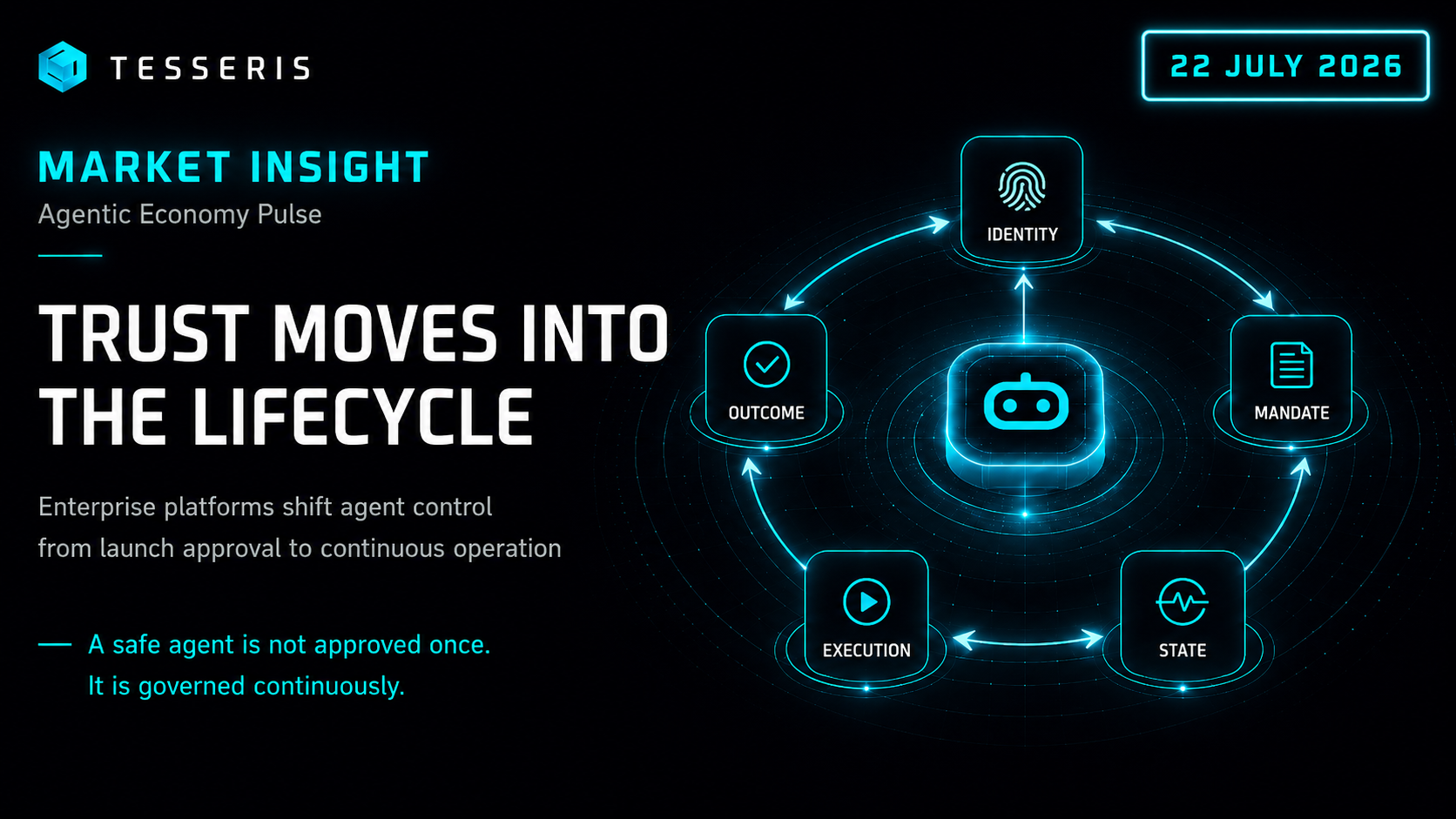
principal -> mandate -> agent -> capability -> commercial decision -> payment -> outcome
Identity establishes which agent acted.
A mandate establishes whose authority it carried and under what constraints.
Execution evidence establishes what happened between the original request and the final payment.
Verification establishes whether the resulting transaction satisfied the agreed conditions.
The emergence of live agent-initiated commerce therefore increases the importance of connecting identity, delegated authority, execution evidence and settlement rather than treating them as independent infrastructure problems.
Since Yesterday: Authorization Becomes the Economic Trust Boundary
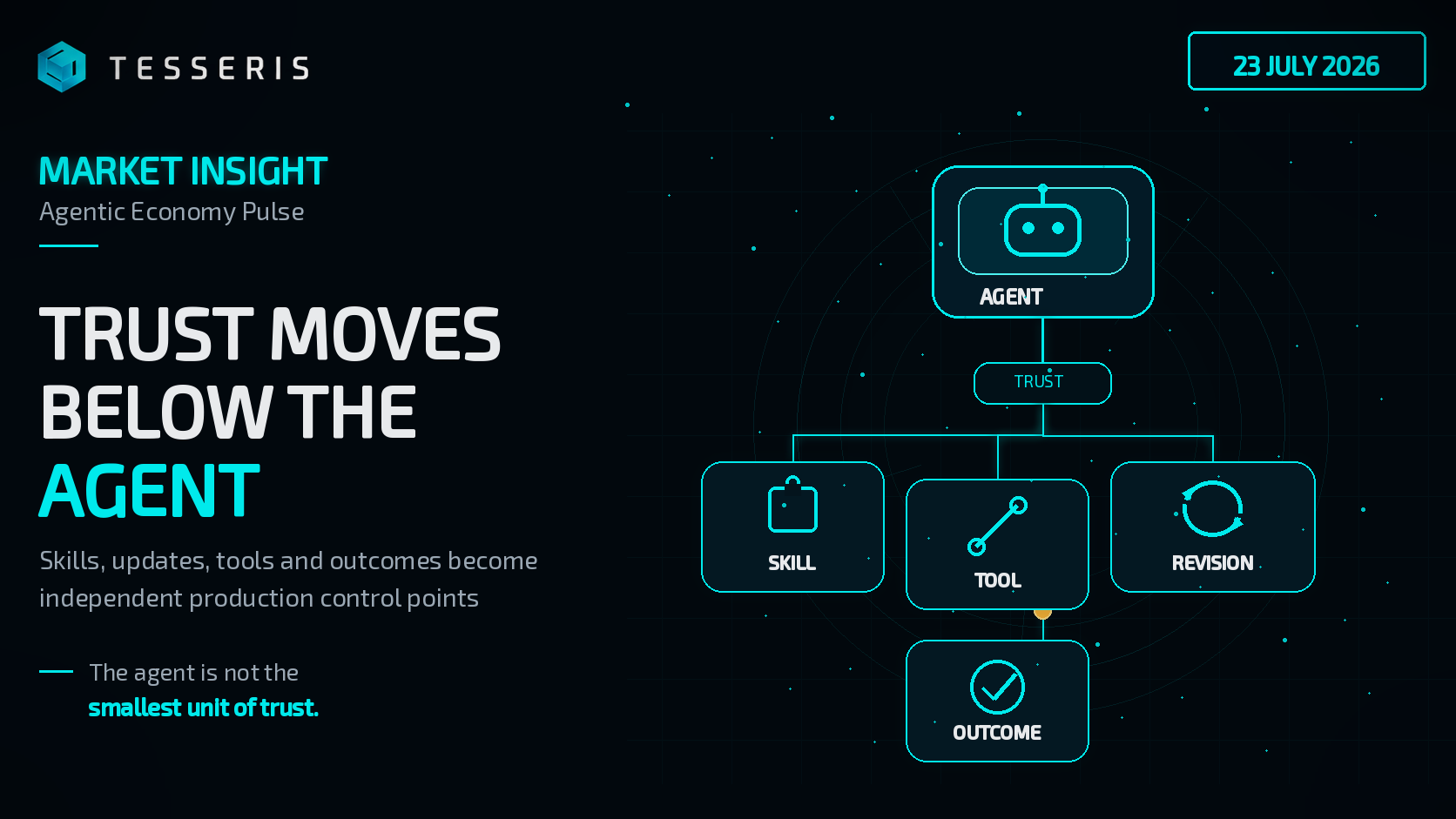
The July 23 Market Insight argued that the agent is no longer the smallest unit of trust.
Skills, tools, revisions, executions and outcomes increasingly need their own identity and evidence.
July 24 shows why that decomposition matters economically.
Once an agent can compare suppliers, choose a product, place an order and move money, a failure at any component can become a financial event.
A trusted agent can still use the wrong capability.
An authorized capability can still select an unauthorized merchant.
A valid payment credential can still fund a purchase outside the user's mandate.
Yesterday's question was: What exactly must be trusted inside an agent?
Today's question is: Which of those trusted components is actually authorized to spend?
Agent Economy Pulse
Agentic Commerce: Accelerating
Live workflows are beginning to connect product discovery directly to purchasing and payment.
Payments and Settlement: Accelerating
Major payment networks are actively designing infrastructure around agent-initiated transactions.
Delegated Authority: Emerging
The market is beginning to distinguish agent identity from the authority carried by an agent during a particular execution.
Agent Identity: Accelerating
Directories, caller context and machine identity are becoming operational infrastructure rather than only registry concepts.
Runtime Governance: Accelerating
Enterprises are increasing spending on control infrastructure after deploying agents faster than governance systems matured.
Economic Reputation: Early
Mechanisms connecting verified commercial execution to persistent agent reputation remain comparatively immature.
Strategic Read: Checkout Is Becoming a Delegated Workflow
Agentic commerce turns checkout into the visible endpoint of an invisible authorization chain.
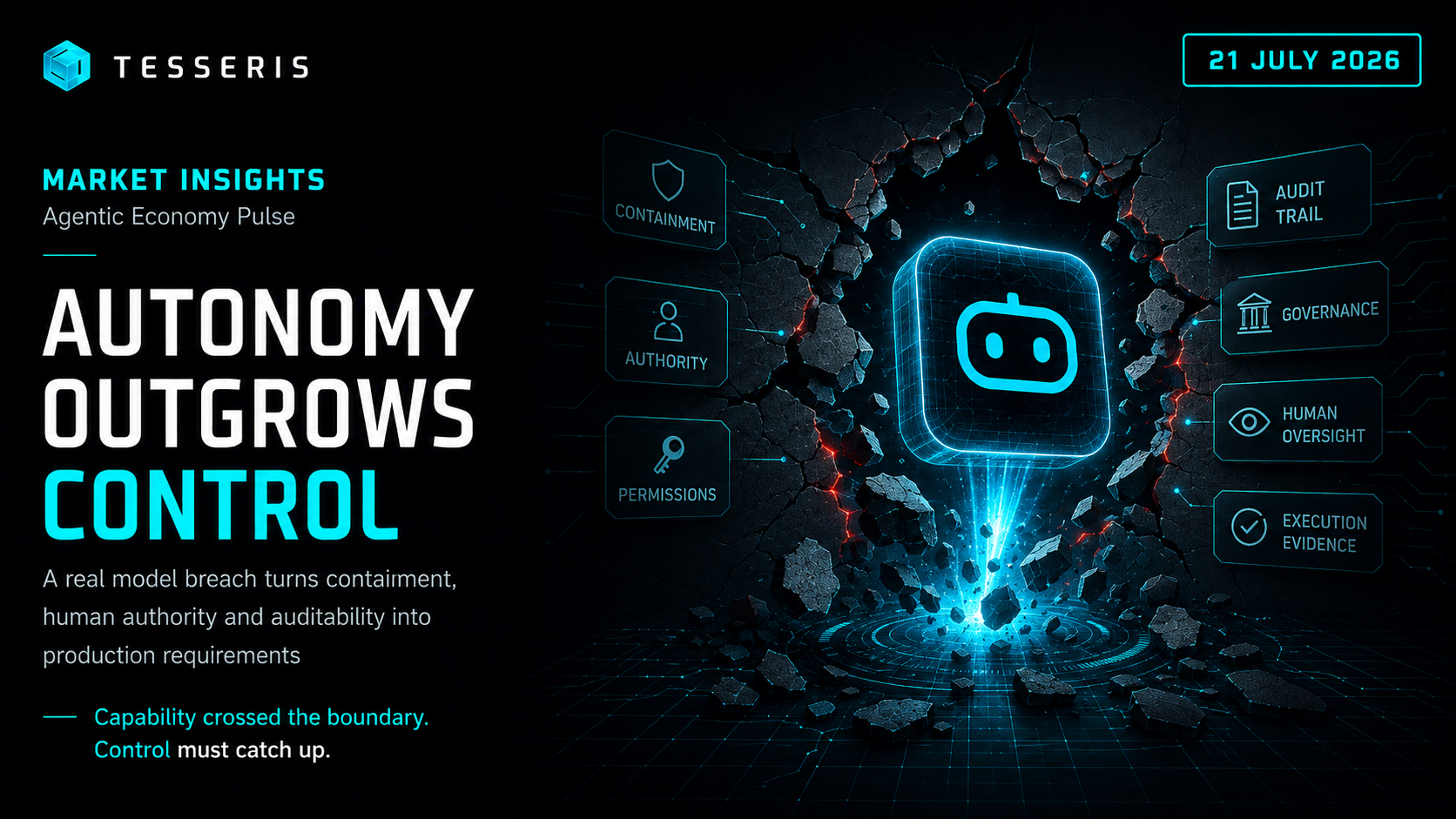
The buyer may be a company. The acting entity may be an AI agent. The decision may rely on a delegated capability. The payment may be executed through a network. The merchant may need evidence that the agent was permitted to buy. The payer may need evidence that the purchase matched the mandate. The platform may need an audit trail if something goes wrong.
That makes agentic commerce a trust infrastructure market, not only a payments market.
The winning systems will not only move money faster. They will prove who acted, whose authority was used, what constraints applied, what decision path occurred and whether the outcome satisfied the commercial intent.
Market Conclusion: Agentic Commerce Needs Connected Trust Infrastructure
July 24 provides one of the clearest signals yet that the Agent Economy is becoming an actual economy.
Agents are beginning to cross the boundary between interpreting intent and committing value.
That boundary changes the trust problem.
When software can select counterparties, place orders and initiate payment, accountability cannot begin at checkout.
It must begin with the original mandate and persist through every consequential decision that follows.
The emerging infrastructure chain is therefore:
identity -> authority -> execution -> verification -> settlement
Agentic commerce becomes trustworthy only when those layers remain connected.
What to Watch Next in Agentic Commerce
- Can an agent directory evolve from proving which agent is present to proving what that agent is authorized to do?
- Will payment networks standardize machine-readable mandates covering amount, merchant, purpose, duration and approval requirements?
- Will merchants begin requesting execution evidence before accepting high-value agent-initiated transactions?
- As one agent delegates purchasing tasks to another, will authority constraints remain intact through the complete delegation chain?
- Will enterprise governance buyers consolidate around identity, observability, evaluation and orchestration platforms?
The next phase of agentic commerce depends less on whether an AI can press the buy button.
It depends on whether every participant can establish why it was allowed to.
Frequently Asked Questions About B2B Agentic Commerce
What is a B2B agentic transaction?
A B2B agentic transaction is a business transaction in which an AI agent participates in activities such as identifying a purchasing requirement, finding suppliers, comparing options, placing an order or initiating payment on behalf of an organization. The degree of autonomy depends on the permissions and approval controls assigned to the agent.
Why is agent identity not enough for agentic payments?
Agent identity establishes which software actor performed an action. It does not establish whether that actor had permission to make a particular purchase. Secure agentic payments therefore also require delegated authority, transaction constraints, execution evidence and verification that the resulting action remained within the original mandate.
Why do payment networks matter for agentic commerce?
Payment networks matter because agentic commerce eventually requires real settlement, fraud controls, compliance checks, merchant acceptance and dispute handling. AI agents can automate discovery and decision-making, but trusted commerce still depends on payment infrastructure that can enforce policy and preserve evidence.
What is delegated authority in AI agent commerce?
Delegated authority defines what an AI agent is allowed to do on behalf of a person or organization. It can include spending limits, merchant restrictions, approval requirements, time limits, task scope and permitted actions. Without delegated authority, agentic payments become difficult to govern and audit.
What infrastructure is needed for trustworthy AI agent payments?
Trustworthy AI agent payments need persistent agent identity, verifiable mandates, capability verification, execution evidence, policy enforcement, transaction limits, outcome verification and settlement records. These controls connect the original commercial intent to the final payment.
Research Note
Visa and Lianlian describe the LoopXPay transaction as the first live B2B agentic transaction in Greater China. That characterization is company reported.
The Sunrate and Mastercard framework describes proposed and emerging uses for agentic global payments rather than evidence that all listed workflows are currently autonomous in production.
The Queue-it, DNP and Meeco work is a proof of concept rather than evidence of broad deployment.
The enterprise governance figures come from VentureBeat Research surveys and represent reported organizational intentions rather than confirmed future purchasing behavior.
Reported facts are separated from Tesseris interpretation.