AI Agent Skills Become Governable Assets
Google gives standalone agent skills identities and immutable versions as AWS, Salesforce, ServiceNow and Sierra move trust below the agent.
Executive Signal: AI Agent Skills Are Becoming Governable Production Assets
July 23 changed the unit of governance in the Agent Economy.
Google introduced standalone AI agent skill governance, including skill registration, access policies, immutable revisions, semantic discovery and verified publishers. AWS showed how production evaluation can block an agent release when tool use, reasoning or output quality falls below defined thresholds. Salesforce described governed self-improvement loops that learn from production outcomes. ServiceNow and TeamViewer moved agents closer to direct endpoint action. Sierra acquired Takeoff to build long-horizon agents around measurable business outcomes.
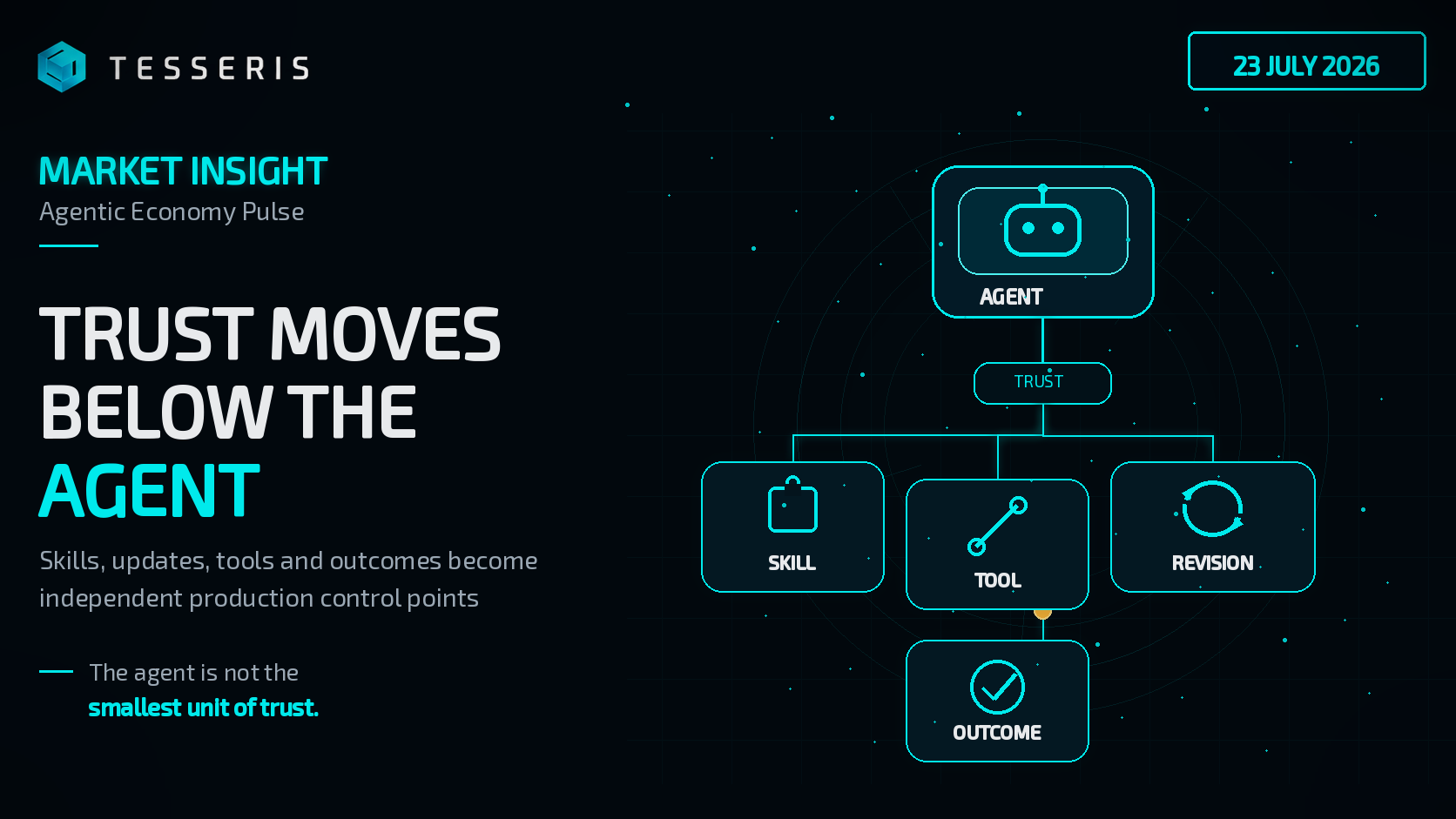
The common shift is structural: the agent is no longer the smallest object that must be trusted.
An agent can load a skill, call a tool, change configuration, delegate work and improve after deployment. Each component can alter its authority and performance.
Tesseris signal: Persistent agent identity remains necessary, but it is no longer sufficient. Trust must also bind every skill, primitive, revision, execution and verified outcome to the complete accountable workflow.
Key Signals Across AI Agent Skill Governance, Evaluation and Outcome Economics
- Skills become governed primitives: AI agent capabilities are moving from hidden configuration into discoverable, versioned and policy-controlled resources.
- Evaluation becomes release control: Agent testing is moving from periodic reporting into production quality gates that decide whether a revision can ship.
- Improvement becomes accountable state: Self-improving agents need versioned provenance, simulation evidence, rollout scope and rollback records.
- Tools become operational authority: Endpoint access turns agent workflows from advice into direct enterprise action.
- Outcomes become economic units: Outcome-based agent pricing makes independent verification necessary for payment, reputation and liability.
Why July 23 Matters for the Agent Economy
The Agent Economy is decomposing agents into smaller accountable parts.
Until now, much of the market has treated the agent as the primary unit of trust: approve the agent, monitor the agent, measure the agent and price the agent. July 23 shows why that model is incomplete.
An agent is not a single static system. It is a moving collection of skills, tools, memory, prompts, policies, evaluations, endpoint permissions and post-deployment changes. A trusted top-level agent can still load an unverified skill. A verified skill can still call a risky tool. A well-tested revision can become unsafe after an update. A completed task can still fail independent outcome verification.
The strategic question is therefore shifting from "Can we trust this agent?" to "Can we trust every component and execution boundary inside this agentic workflow?"
1. Google Introduces Standalone AI Agent Skill Governance
Source: Google Cloud Agent Registry release notes
Google Cloud added standalone skill governance to Agent Registry in preview.
Organizations can register skill resources, validate uploaded packages, manage lifecycle states and preserve version history through immutable skill revisions. Policy bindings determine which reasoning agents may load each skill. Semantic search supports discovery, while publisher information helps organizations review the source of a skill.
This separates the skill from the agent using it.
A research skill, payment skill or customer-service skill can now exist as its own managed object, be updated independently and be reused across multiple agents.
Market signal: Capabilities are becoming infrastructure assets.
The market is beginning to treat an AI agent skill as something that can be discovered, authorized, versioned and revoked independently of the complete agent. This increases reuse, but it also creates a new supply chain for agent capabilities.
Tesseris read: Publisher verification does not prove capability.
A complete skill record should connect the skill identity, controller, publisher, package digest, declared capability, permissions, security posture, test evidence, expiration status and revocation state. It should also preserve which agent executions used that exact skill revision.
Registration establishes which skill exists. Capability verification establishes what that revision can demonstrably do.
2. AWS Turns Agent Evaluation Into a Production Quality Gate
Source: AWS production blueprint for evaluating AI agents
AWS and Motorway described an evaluation pipeline for an AI agent used by vehicle dealers to search auction inventory.
The original agent could select the wrong tools, misread search constraints and lose context during longer interactions. The evaluation system measured tool use, reasoning and final output quality across build-time testing and production monitoring.
AWS reported that the approach reduced incorrect results from approximately one in eight queries to one in fifty. A five-stage deployment pipeline blocks releases when evaluation scores fall below defined thresholds.
Market signal: Evaluation is becoming an enforcement mechanism.
A production team is no longer merely measuring whether the agent performs well. It is using evidence to decide whether a particular revision is permitted to reach users.
Tesseris read: An evaluation result should be treated as a scoped capability attestation.
That attestation should preserve the tested agent and skill revisions, evaluation predicate, test data, environment, required thresholds, observed result, evaluator identity, timestamp, expiration and production evidence collected after release.
A pass should not become a permanent capability claim. Evaluation determines whether one version may proceed. Persistent evidence determines whether trust remains justified after deployment.
3. Salesforce Makes Agent Improvement a Governed Production Loop
Source: Salesforce on self-improving agents
Salesforce described a governed self-improvement model in which an AI agent learns from production outcomes rather than remaining static after deployment.
The proposed loop identifies recurring failures, diagnoses causes, tests possible changes through simulations and promotes only improvements that raise technical and business performance without violating guardrails. Every material gain should remain inspectable and reversible.
Salesforce said it is testing these ideas internally and with design partners, including agents that help optimize other agents. The article presents an emerging operating model rather than a generally available universal capability.
Market signal: Agent capability can change continuously after launch.
The production identity cannot refer only to the original deployment. Memory, instructions, tools and optimization logic may materially change what the agent can do.
Tesseris read: Every approved improvement should create a new accountable state.
That state should preserve the previous and current revision, failure or opportunity that triggered the change, proposed modification, simulation evidence, evaluation evidence, approving authority, rollout population, resulting performance change and rollback status.
Reputation should not transfer automatically when the operating system has materially changed. Self-improvement without versioned provenance turns learning into an accountability gap.
4. ServiceNow and TeamViewer Move Agents From Insight to Endpoint Action
Source: TeamViewer and ServiceNow partnership for autonomous IT operations
ServiceNow and TeamViewer announced a multiyear partnership to integrate TeamViewer endpoint capabilities with the ServiceNow AI Platform.
The planned integration is intended to move enterprise IT from detecting digital problems toward autonomous remediation through end-to-end agent workflows. TeamViewer provides access to endpoint state and remote action, while ServiceNow supplies workflow orchestration and enterprise context.
The announcement describes planned integration and expansion rather than proof that every proposed autonomous workflow was already operating on July 23.
Market signal: Tool access is becoming operational authority.
An agent that can restart a service, change a configuration or operate a remote endpoint is no longer only producing information. It is changing the state of an enterprise asset.
Tesseris read: Every endpoint action should produce an execution receipt.
That receipt should include the represented organization or user, agent identity, skill identity, target endpoint, approved action, business purpose, applicable policy, state before execution, state after execution, human intervention and rollback path.
Authentication grants access to the endpoint. A mandate and execution receipt establish whether the change was authorized and correctly completed.
5. Sierra Acquires Takeoff as Agent Economics Shifts Toward Outcomes
Source: Sierra acquisition of Takeoff
Sierra announced that it is acquiring Takeoff and combining the teams to build Horizon.
Takeoff had developed a long-horizon agent runtime designed for work that unfolds across extended interactions rather than one conversation. The combined strategy focuses on industry-specific execution and pricing linked to completed outcomes instead of inference consumption.
Sierra and Takeoff argue that model access will become increasingly commoditized, while differentiated value will come from agents that understand operational context and produce measurable business results. These performance claims are company reported and should be evaluated independently.
Market signal: Agent economics is moving from usage toward accountable delivery.
Outcome-based pricing aligns commercial value more closely with completed work. It also makes outcome definition, attribution and verification essential.
Tesseris read: An outcome-based contract must define the agent responsible for the work, represented customer, required outcome, operating constraints, permitted actions, evidence required for acceptance, verifier, challenge process, payment conditions and performance record created afterward.
A vendor should not be the only party deciding whether its agent earned payment. Outcome-based agents require verification-based settlement, not only outcome-based pricing.
Tesseris Component Trust Model for AI Agent Skills
The July 23 evidence reveals five objects that must remain independently identifiable and jointly accountable.
Agent
The persistent software actor coordinating the work.
Required record: Controller, principal, version, lifecycle status and active mandate.
Skill
A reusable capability loaded by one or more agents.
Required record: Publisher, package digest, revision, tested capability, permissions and revocation state.
Tool or Endpoint
The external primitive through which the agent reads information or changes a system.
Required record: Primitive identity, security posture, access scope and action constraints.
Execution
The actual sequence of delegation, tool use, policy decisions and state changes.
Required record: Complete action provenance and linked evidence.
Outcome
The result used to determine reputation, liability or payment.
Required record: Verification decision, confidence, challenge status and settlement result.
Trust fails when any one of these records becomes detached from the others.
Strategic Read: Trust Must Move Below the Top-Level Agent
July 23 shows the Agent Economy decomposing into smaller governed components.
Google is making skills independent registry objects. AWS is turning evaluation into a release decision. Salesforce is treating improvement as a governed loop. ServiceNow and TeamViewer are giving agent workflows direct endpoint authority. Sierra is tying agent economics to business outcomes.
This decomposition is necessary for scale, but it creates new trust boundaries.
A trusted agent can load an untrusted skill. A verified skill can call a compromised tool. A capable revision can change after evaluation. A permitted action can still produce an invalid outcome.
The next trust layer must therefore operate below the top-level agent.
Every component needs identity. Every revision needs provenance. Every execution needs evidence. Every economic outcome needs independent verification.
Market Conclusion: The Agent Is Not the Smallest Unit of Trust
The strategic signal from July 23 is that AI agent governance is becoming component-level governance.
The market is no longer only asking whether an agent is safe to deploy. It is asking whether each skill, tool, revision, endpoint action and business outcome can be identified, authorized, evaluated, audited and revoked.
That is the infrastructure requirement for production agents.
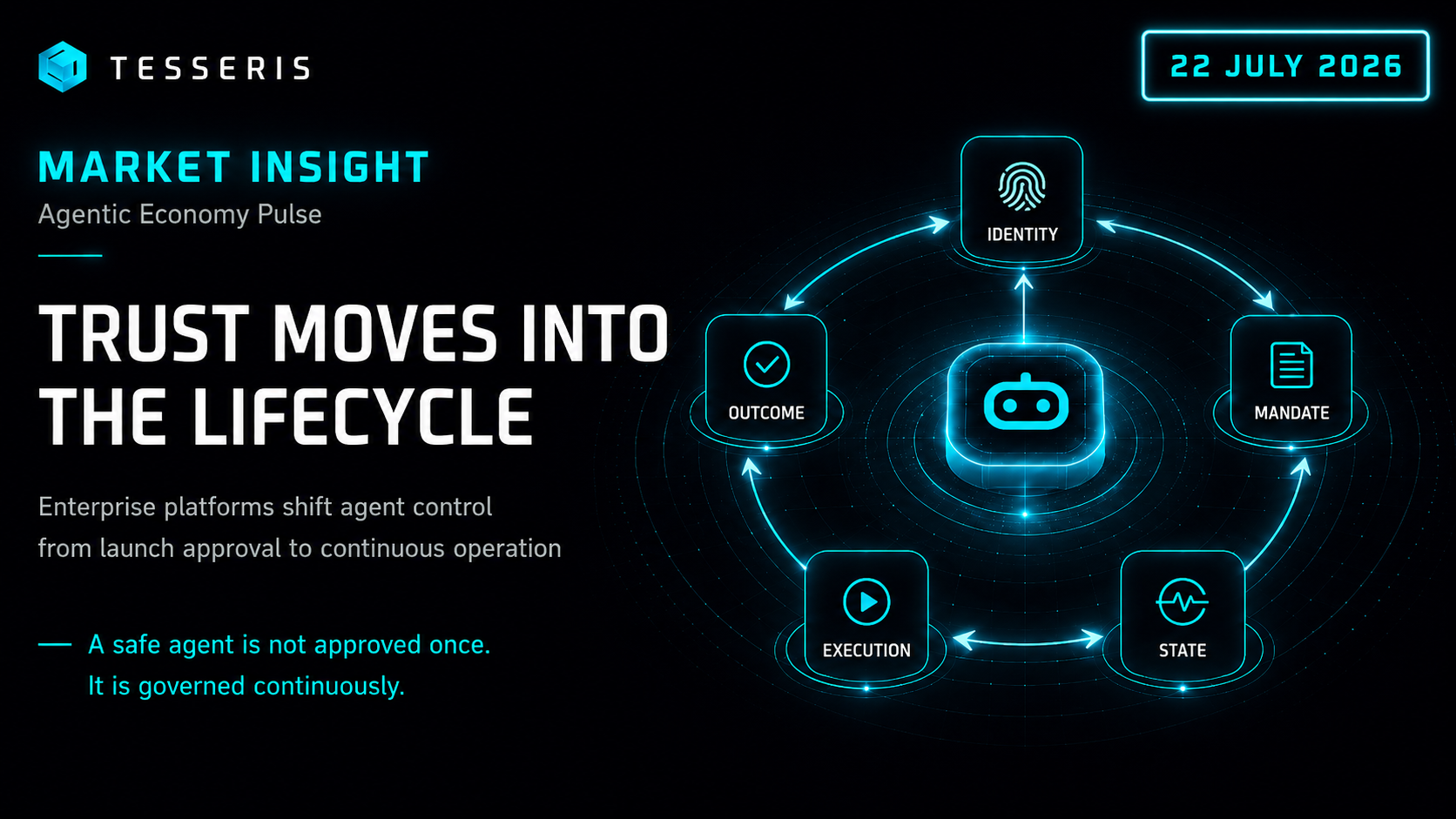
Tesseris views this as the next phase of trust infrastructure: persistent identity for the agent, verifiable capability for each skill, authorization for each action, execution evidence for each workflow and independent verification for each outcome.
The agent is the coordinator. The trust boundary is now the full execution chain.
What to Watch Next in AI Agent Skill Governance
- Whether Google moves skill governance into general availability and adds capability evidence to skill records.
- Whether production evaluation results become portable across platforms.
- Whether self-improvement systems preserve mandatory revision histories and reliable rollback.
- Whether endpoint actions create standardized receipts that link identity, authority, action and state change.
- Whether outcome-based agent contracts adopt independent verification and dispute processes.
Frequently Asked Questions About AI Agent Skill Governance
What is an AI agent skill?
An AI agent skill is a reusable package of instructions, tools or domain knowledge that gives an agent a specific capability. Separating skills from the main agent allows them to be discovered, updated, authorized and reused independently.
Why does an AI agent skill need its own version and identity?
A skill can materially change what an agent is able to do. Independent identity and versioning make it possible to determine which capability was active during a particular execution and to revoke an unsafe revision without retiring the complete agent.
How is skill governance different from capability verification?
Skill governance controls registration, access, lifecycle and versioning. Capability verification tests what a particular skill revision can demonstrably do under defined conditions. A governed skill is not necessarily a capable or secure skill.
Why does production agent evaluation matter?
Production agent evaluation turns behavioral evidence into release control. It helps teams decide whether a specific agent or skill revision can ship, remain active or require rollback after performance or safety signals change.
What is outcome-based agent economics?
Outcome-based agent economics prices agent work around completed business results rather than token usage or software seats. This model requires independent verification so payment, reputation and liability are connected to evidence rather than vendor claims.
Research Note
All five sources were published, updated or active in the July 23, 2026 coverage window.
Google's standalone skill governance capability remained in preview. AWS performance improvements were reported from a joint customer implementation and should not be generalized without additional evidence. Salesforce described an emerging self-improvement model and ongoing testing rather than a universal production standard. The ServiceNow and TeamViewer announcement contains planned integration and future direction. Sierra's adoption and performance claims are vendor reported.
Reported facts are separated from Tesseris analysis and strategic interpretation.
Final Take: Every Component Needs Identity and Evidence
AI agents are becoming modular production systems.
That makes top-level identity useful but incomplete. The next market requirement is component-level trust: identity for the agent, provenance for the skill, authorization for the tool, evidence for the execution and verification for the outcome.
The agent is not the smallest unit of trust. The smallest unit of trust is the smallest component that can change what happens.