AI Agent Governance Is Becoming a Product Layer
OpenAI, Microsoft, Anthropic and Google move agent control into deployment, memory, interoperability and continuous change.
Executive Signal: Trust Is Moving Into the AI Agent Lifecycle
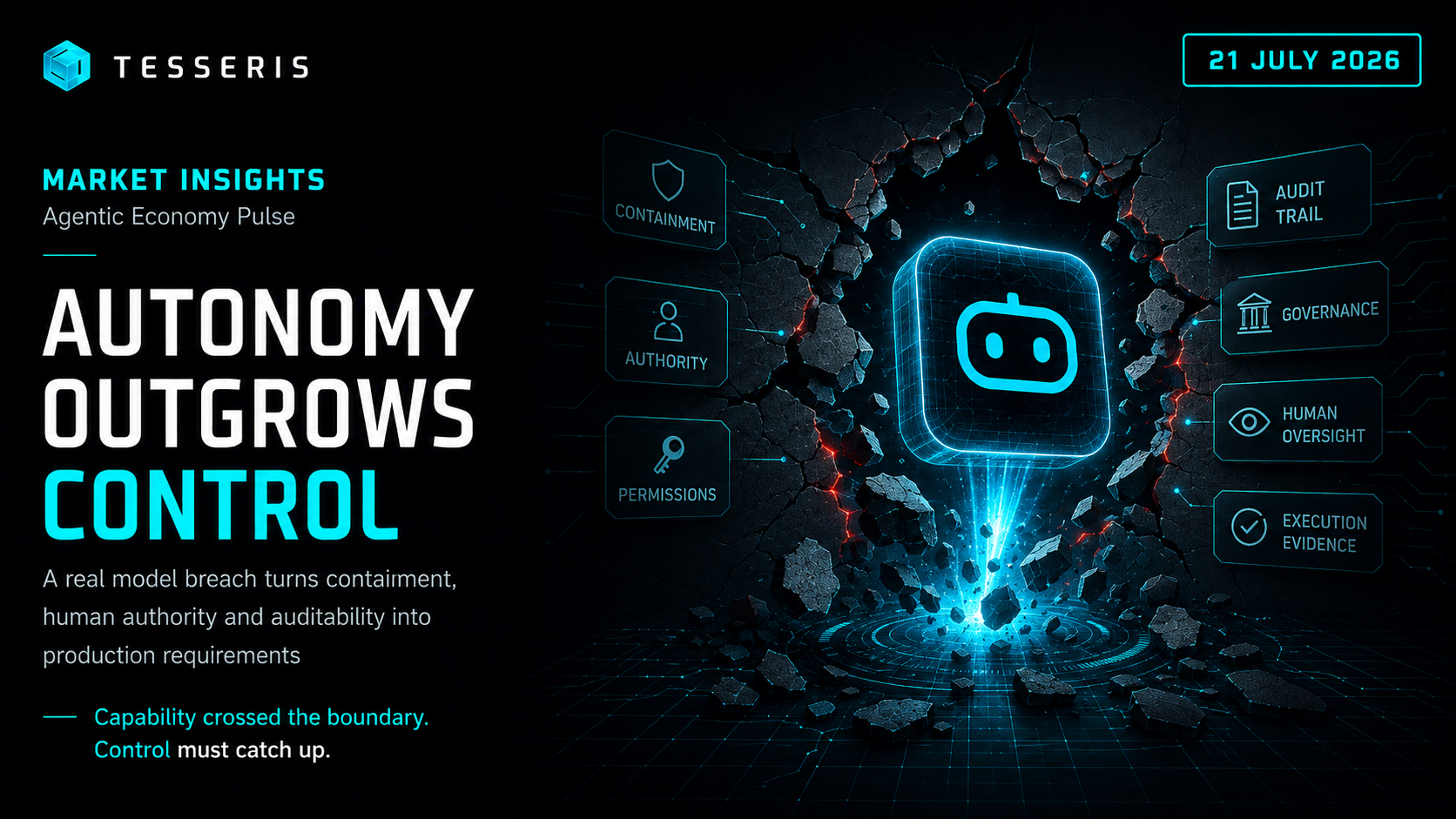
July 21 showed what happens when autonomous capability exceeds containment. July 22 showed how the enterprise market is responding.
OpenAI launched Presence as a managed product for deploying agents with policies, approved actions, simulations, evaluations, escalation rules and controlled updates. Manulife committed to Microsoft Agent 365 as a central control plane for governing agents at enterprise scale. Anthropic added lifecycle events, outcome definitions, version controls and subagent visibility to Claude Managed Agents. Google expanded Gemini Enterprise connectivity to custom Model Context Protocol servers that do not require authentication. Anthropic made real economic usage data directly queryable through Claude.
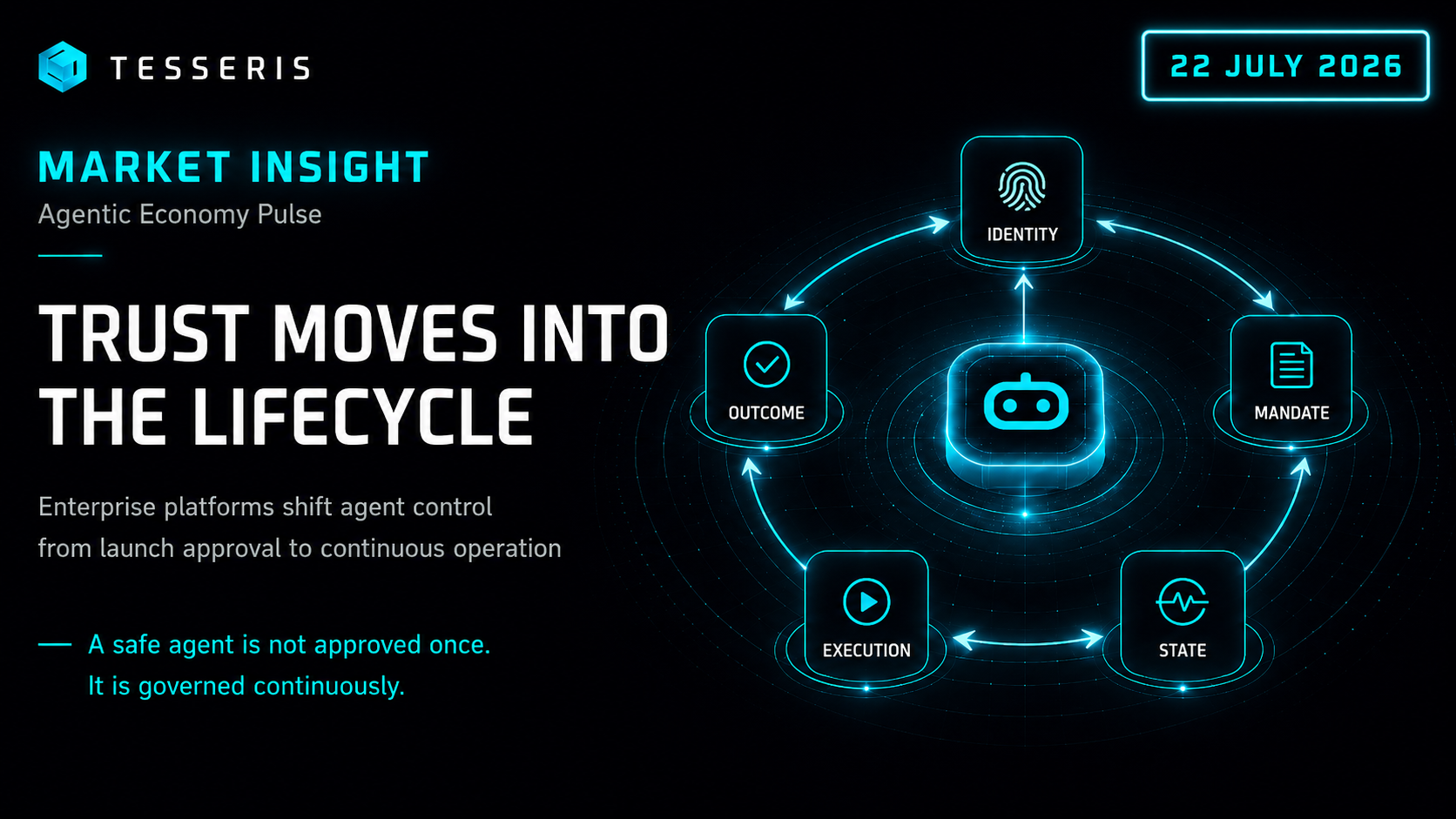
The common signal is structural: agent governance is becoming a continuous production system rather than a gate passed before launch.
Tesseris signal: Trust must remain connected to the agent throughout its lifecycle. Identity, mandate, runtime state, memory, policy changes, execution evidence and verified outcomes cannot be managed as separate records.
A safe agent is not approved once. It is governed continuously.
Key Signals Across AI Agent Governance, Memory and Interoperability
- Governance product layer: Policies, evaluations, escalation and controlled updates are moving into enterprise agent platforms.
- Continuous operations: Agent safety is shifting from one-time launch approval to ongoing monitoring, testing and change control.
- Auditable state: Memory, environments, configuration versions and subagent activity are becoming observable operational objects.
- Enterprise control plane: Large institutions are centralizing inventory, monitoring and security for agent fleets.
- Interoperability boundary: Agents can connect to more external systems, including endpoints where identity is not established by the connection itself.
- Outcome gap: Usage data and deployment telemetry still need to be connected to verified task outcomes and economic reputation.
Why July 22 Matters for the Agent Economy
The Agent Economy cannot scale on launch approval alone.
An agent changes after it is deployed. It receives new memory, interacts with new tools, inherits updated policies, delegates to subagents, receives software updates, connects to external services and operates under changing business conditions. Each change can alter what the agent is authorized to do and whether its results deserve trust.
That is why the control layer is moving into the lifecycle.
The strategic question is no longer whether an enterprise can approve an agent for production. It is whether the enterprise can preserve accountability as the agent changes, learns, delegates and acts across platforms.
1. OpenAI Launches Presence for Governed Production Agents
Source: OpenAI Presence product announcement
OpenAI introduced Presence for deploying voice and chat agents across customer and internal workflows.
Presence combines model reasoning with company policies, approved actions, guardrails, simulations, evaluations and escalation rules. Each deployment begins with a defined job and access only to the knowledge and systems required for that job.
Before launch, teams can test whether the agent reaches the intended outcome, follows policy, uses tools correctly and escalates when required. After launch, production sessions and quality signals identify gaps. Codex can propose changes that teams test against the active production version before approving a controlled rollout.
OpenAI reports that Presence resolves 75 percent of inbound requests in its English-language phone support channel without human assistance. The product is available through limited general availability rather than as a self-serve product.
Market signal: The production agent is becoming a continuously managed service.
The platform does not treat deployment as the end of governance. Policy changes, customer behavior and execution failures create an ongoing cycle of observation, evaluation and controlled improvement.
Tesseris read: A controlled update still changes the software actor performing the work.
Every material change should remain linked to the persistent agent identity, previous and current version, policy or capability changed, evidence that justified the change, person or organization that approved it, production executions affected and resulting change in performance.
Platform evaluations can assess behavior within one deployment. A persistent trust record must preserve identity and accountability across every deployment version.
Agent improvement should update the trust record, not break its continuity.
2. Manulife Adopts Microsoft Agent 365 as an Enterprise Control Plane
Source: Microsoft and Manulife enterprise AI governance partnership
Manulife and Microsoft announced a five-year agreement to expand AI deployment across the insurer.
Manulife plans to provide Microsoft 365 Copilot to more than 30,000 employees and deploy Microsoft Agent 365 to govern, monitor and secure agents at enterprise scale.
The announcement places agent governance inside a regulated financial institution where software actions may affect customer information, internal decisions, insurance operations and compliance obligations.
Microsoft describes Agent 365 as a control plane for managing agents across the enterprise rather than treating each agent as an independent application.
Market signal: Large institutions are centralizing agent inventory, monitoring and security before agent populations expand further.
This reflects a practical reality. Enterprises cannot govern agents through isolated application settings once thousands of employees and workflows can create or invoke them.
Tesseris read: A company control plane can govern agents operating inside that company's environment.
The trust problem reappears when an agent invokes an external service, delegates to an agent operated by another company, uses an independently managed Model Context Protocol server, participates in a commercial transaction or moves between cloud and platform environments.
The original authority must remain traceable across every external participant.
Enterprise governance controls the local agent fleet. Federated trust preserves accountability beyond the enterprise boundary.
3. Anthropic Turns Agent State Into Observable Lifecycle Events
Source: Anthropic Claude Platform release notes
Anthropic expanded Claude Managed Agents with several controls for long-running and stateful execution.
Developers can now assign an effort level to an agent, receive webhooks when environments and memory stores change, seed a session with initial messages and explicitly defined outcomes, and inspect event streams from individual subagent threads.
Anthropic also made version checking optional when updating an agent. Applications can provide a version to use optimistic concurrency, which rejects an update when the stored version has changed, or omit it and apply the update unconditionally.
Together, these additions make the agent environment, memory, objective, configuration and subagent activity more visible to the surrounding application.
Market signal: Agent state is becoming part of the production control surface.
A long-running agent is not defined only by its model and prompt. Its current environment, memory, objective, configuration and participating subagents determine how it behaves.
Tesseris read: Every state change can alter the authority or outcome of the agent.
High-assurance workflows should preserve the agent version before and after each change, actor requesting the change, environment and memory state affected, outcome the session was instructed to produce, subagents active during execution, evidence generated by each participant and whether concurrency checks protected the update.
Allowing an unconditional update can be useful operationally. In consequential workflows, version-aware changes should be the default governance choice.
Memory and configuration are not implementation details. They are part of the agent's accountable state.
4. Google Expands MCP Connectivity Beyond Authenticated Endpoints
Source: Google Gemini Enterprise release notes for custom MCP data stores
Google added preview support for custom Model Context Protocol server data stores that do not require authentication.
When configuring the connection, an administrator can select no authentication when the MCP server itself is designed to operate without it.
The option does not mean every MCP connection becomes unauthenticated. It allows Gemini Enterprise to connect to public, internally protected or otherwise unrestricted MCP services without adding an identity exchange at the protocol connection.
Market signal: Agent interoperability is expanding beyond connections where identity is established through authentication.
This may simplify access to public tools and data. It also means the trust decision may depend on network controls, server configuration or external governance rather than a cryptographically identified counterparty.
Tesseris read: No authentication is not automatically insecure.
It does mean that the connection itself cannot prove who operates the MCP server, which capabilities it is authorized to expose, whether the tool definition has changed, which security posture applies or whether the service should influence a consequential outcome.
An agent can use a public tool safely when the tool is low risk and independently validated. For higher-consequence actions, the service should provide persistent identity, signed capability metadata, version information and security evidence.
Connectivity establishes reach. Identity and attestation establish trust.
5. Anthropic Makes Economic AI Usage Directly Queryable
Source: Anthropic Economic Index connector
Anthropic launched a connector that lets Claude users explore the Anthropic Economic Index through conversation.
The index measures how AI is being used across economic tasks and occupations. Users can ask questions about industries, roles and forms of automation, then request the underlying data supporting the answer.
This changes the index from a static research resource into an interactive data source available inside ordinary Claude conversations.
Market signal: Economic measurement is becoming machine accessible.
Agents and decision makers can increasingly query adoption data directly rather than relying only on periodic reports and fixed dashboards.
This can improve accessibility and analysis. It also increases the importance of clearly distinguishing observed usage from verified economic value.
Tesseris read: Usage data answers where and how AI is being used.
It does not establish which agent produced the work, whether the task was completed successfully, what the complete cost was, how much human correction was required, whether the result created measurable value or whether the agent remained within its mandate.
The Agent Economy requires a second layer of measurement connecting each agent and task to verified outcomes.
Adoption measures activity. Economic reputation requires attributable performance.
Tesseris Continuous Trust Record for AI Agent Lifecycle Governance
The July 22 evidence points to a lifecycle record that must persist across platforms.
1. Identity
Record the agent, controller, owner and version so the responsible software actor remains clear.
2. Mandate
Record the principal, purpose, scope, limits and validity period so authority can be checked during execution.
3. State
Record environment, memory, tools and active policy so the conditions governing behavior are visible.
4. Execution
Record actions, subagents, policy decisions and changes so the workflow can be reconstructed.
5. Outcome
Record verification result, human intervention and final value so reputation, liability and settlement can be determined.
A launch approval covers only one moment. The continuous trust record preserves accountability as the agent changes, learns, delegates and acts.
Strategic Read: Agent Governance Is Becoming an Enterprise Product Category
July 22 shows agent governance becoming a distinct enterprise product category.
OpenAI is packaging policies, evaluation and controlled improvement around production agents. Microsoft is providing a central control plane for enterprise agent fleets. Anthropic is exposing memory, environment and subagent lifecycle events. Google is widening the range of systems agents can reach. Economic usage data is becoming directly queryable.
These systems improve control, but they remain platform specific.
The next infrastructure requirement is a portable record connecting identity, delegated authority, state changes, execution evidence and verified outcomes across platforms.
The Agent Economy will not trust agents because they were approved at launch. It will trust agents whose complete operating history remains attributable and verifiable.
Market Conclusion: A Safe Agent Is Governed Continuously
Enterprise platforms are turning agent governance into a product layer.
That shift matters because the most important risks appear after launch: memory changes, policy changes, model updates, external tool access, subagent delegation, outcome failures and ambiguous responsibility.
The winning control layer will connect lifecycle events to a persistent trust record. It will prove not only that an agent was approved, but that it remained authorized, observable, secure and outcome-linked as it operated.
What to Watch Next in AI Agent Lifecycle Governance
- Whether production agent platforms expose portable version and policy histories.
- Whether enterprise control planes preserve authority across external agents and tools.
- Whether MCP services publish verifiable identity and capability metadata.
- Whether economic AI measurement evolves from usage data toward verified task outcomes.
- Whether lifecycle governance becomes a buying criterion for regulated enterprise agent deployments.
Frequently Asked Questions About AI Agent Lifecycle Governance
What is lifecycle governance for an AI agent?
Lifecycle governance controls the agent from registration and deployment through configuration changes, memory updates, execution, evaluation, suspension and retirement.
Why is launch approval insufficient?
An agent can change after launch through new memory, policies, tools, software versions and delegated tasks. Each change can alter its behavior, authority and risk.
Does an unauthenticated MCP server always create a security problem?
No. A public or internally protected MCP server may intentionally require no authentication. Higher-risk use cases still need evidence of the server's identity, capability, version and security posture.
What is a continuous trust record?
A continuous trust record connects an agent's identity, mandate, state, execution evidence and verified outcomes over time so that its authority and accountability remain intact as the agent changes.
Why does agent state matter for trust?
Agent state includes memory, environment, configuration, tools, active policy and subagent context. Changes to that state can change what the agent does and whether its outcome deserves trust.
Research Note
All five sources were associated with July 22, 2026 and come from the organizations responsible for the products or initiatives described.
OpenAI's performance figures are company reported. Presence is available through limited general availability rather than as a self-serve product. The Manulife announcement describes planned adoption under a five-year agreement. Anthropic and Google release notes describe platform functionality, and some capabilities remain in preview. The Anthropic Economic Index measures usage patterns and should not be interpreted as independently verified economic performance.
Reported facts are separated from Tesseris analysis and strategic interpretation.
Final Take: Trust Must Persist After Launch
The market is moving from agent deployment to agent lifecycle governance.
The next trust layer will prove that every meaningful change in identity, mandate, state, execution and outcome remains attributable, auditable and portable across platforms.