AI Agents Enter the Real Economy
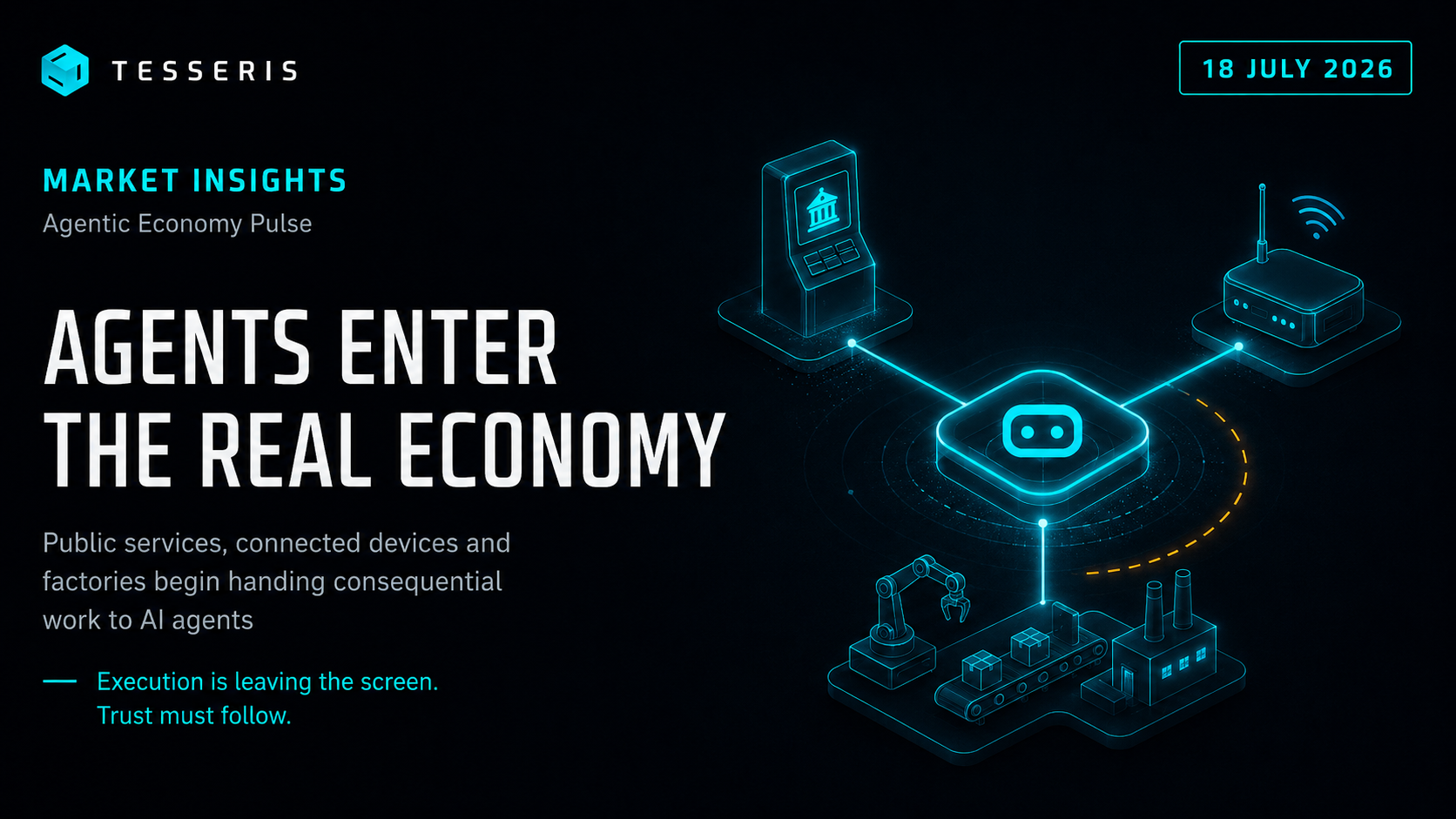
WAIC 2026 moves AI agents into public services, edge devices and factory operations, making accountable execution a practical infrastructure requirement.
Executive Signal: AI Agents Are Moving Into Public Services, Edge Devices and Industrial Operations
The July 18 evidence set marks a shift in where agentic systems are operating.
The dominant developments were no longer limited to research, document creation, customer support or enterprise software workflows. WAIC 2026 showed AI agents moving into public service terminals, connected devices, factory decisions, automation engineering and coordinated fleets of enterprise agents.
That changes the trust requirement.
A mistake inside a document can often be corrected before publication. A mistake inside a public service workflow, connected device or factory system can expose personal data, interrupt production, damage equipment or create a safety risk.
Tesseris signal: As agent execution moves into the real economy, identity, authority, policy and evidence must become part of the action itself. Logs produced after execution are not enough.
Execution is leaving the screen. Trust must follow.
Key Signals Across Physical Agency, Industrial AI and Runtime Governance
- Physical execution: AI agents are beginning to perceive environments, call devices and complete tasks beyond a conventional software interface.
- Public services: Agent interfaces are moving from answering questions toward completing administrative workflows.
- Industrial authority: Agents are entering decisions that affect production cost, quality, capacity and delivery.
- Automation engineering: Agents are beginning to generate and validate software that can influence industrial control systems.
- Runtime governance: Agent operating systems and cloud platforms are placing permissions, observability and coordination inside the execution layer.
- Trust gap: Identity, authority, consent, execution evidence and outcome verification still need to travel with the agent action, not remain trapped in isolated platform logs.
Why July 18 Matters for the Agent Economy
The Agent Economy becomes materially different when agents stop operating only inside screens.
In a software workflow, the agent may draft a message, summarize a document or recommend the next action. In the real economy, the agent may help a citizen complete a government service, trigger a connected device, change a factory schedule, generate control logic or delegate work across an enterprise agent fleet.
These actions are economically useful because they compress human coordination time. They are also risky because they connect software decisions to institutional processes, devices and physical operations.
The market therefore needs a new standard for accountable agency. Every consequential action should be tied to a known agent, a represented person or organization, a permitted scope, a policy decision, execution evidence and a verifiable outcome.
Without that chain, physical and institutional agents create a gap between who instructed the system, what the system did and who is accountable for the result.
1. iFLYTEK Launches GuideX for Public Service Task Completion
Source: iFLYTEK GuideX public service agent announcement
iFLYTEK launched GuideX, an interaction agent designed for public service environments.
Unlike a conventional digital assistant that answers questions, GuideX is designed to infer the user's actual objective and complete the corresponding service workflow. The system combines voice, visual, positional and spatial information to understand interactions in crowded environments.
GuideX supports more than 30 languages and connects to SkillHub, which iFLYTEK says contains more than 10,000 skills. Routine requests can follow predetermined policies, while more complex requests can use adaptive reasoning. With user consent, the system can also retain service context and preferences across interactions.
iFLYTEK said GuideX can operate through public terminals, displays, websites and mobile applications across government services, transportation, tourism, hospitality and commerce.
Market signal: Public service agents are moving from information delivery into administrative action.
The value of the system no longer depends only on whether it gives the correct answer. It depends on whether it identifies the correct person, interprets the request accurately and completes the permitted service without crossing legal, procedural or consent boundaries.
Tesseris read: A public service agent requires a verifiable chain connecting the person requesting the service, the agent performing the action, the service or institution represented, the user's consent, the applicable policy, the evidence supporting the decision and the completed outcome.
Persistent memory must also remain separated between people, purposes and service contexts.
A public service interaction should produce a decision receipt, not only a conversation transcript.
2. ThunderSoft Extends Agent OS From Vehicles to Connected Devices
Source: ThunderSoft AquaClaw for IoT Agent OS announcement
ThunderSoft launched AquaClaw for IoT, extending its agent operating system from connected vehicles to AI glasses, robots, smart homes, meeting systems and industrial devices.
The architecture organizes agent execution around perception, understanding, action and governance. It combines visual, voice and device-state information with long-term memory and organizational knowledge. It can invoke devices, business systems and software tools to turn an instruction into an executable task.
AquaClaw can choose between local execution, cloud reasoning or an approval process according to the complexity and risk of the task. The platform also includes capability authorization, isolated execution, tool controls, execution records and a mechanism for converting frequently repeated tasks into reusable local skills.
Market signal: The device operating system is becoming an authority boundary for AI agents.
Once an agent can activate a device, change its state or coordinate several connected systems, runtime permissions become as important as model capability.
Tesseris read: Every device action should preserve the identity of the agent, the identity of the device, the represented user or organization, the approved skill and version, the authority granted to that skill, whether execution occurred locally or through the cloud, the policy decision applied before execution and the resulting device state.
A reusable skill should not inherit unlimited authority merely because it was approved for an earlier task.
The Agent OS should verify the right to act before it converts intent into physical execution.
3. Black Lake Moves Industrial Agents Into Factory Decision-Making
Source: Black Lake industrial AI agents at WAIC 2026
Black Lake presented industrial AI agents covering order decomposition, process planning, pricing, procurement, production scheduling, quality inspection and order tracking.
These are decisions that have traditionally depended on experienced engineers and production workers interpreting drawings, equipment limits, material availability, quality requirements and delivery commitments.
Black Lake said its CAD-to-Process Agent can read an engineering drawing, account for the factory's equipment and operating practices, and generate manufacturing processes with corresponding technical requirements. The company reported that drawing analysis that previously took hours can be completed in approximately one minute, with accuracy above 95 percent in deployed environments.
Black Lake said its industrial agents are moving into larger-scale deployment across design, scheduling, production and quality workflows.
Market signal: Industrial agents are entering decisions that directly affect cost, quality and delivery.
This is more consequential than automating data entry or generating operational summaries. The agent is beginning to influence how physical goods are produced.
Tesseris read: An industrial agent should not carry one generic capability claim such as "manufacturing expert."
Its capabilities should be verified against defined operating conditions, including supported drawing formats, equipment classes, material constraints, production processes, quality thresholds, permitted decision scope, required human approvals and measured error rates.
Economic reputation should then be based on verified production outcomes, including quality, rework, delivery performance and constraint compliance.
Industrial capability must be proven under operating conditions, not inferred from a general model benchmark.
4. Siemens Brings Autonomous Execution Into Automation Engineering
Source: ARC Advisory Group report on Siemens Eigen Engineering Agent at WAIC 2026
Siemens introduced the Eigen Engineering Agent to the Chinese market at WAIC 2026.
The agent is designed to plan, execute and validate industrial automation engineering tasks rather than only provide recommendations. It can interpret natural language project requirements, write programmable logic controller code, create human-machine interfaces, configure equipment and refine its work until defined project requirements are met.
Siemens previously reported deployments with more than 100 enterprises across 19 countries. At the WAIC event, industrial participants discussed applications in production line engineering, automotive manufacturing, energy equipment and precision inspection.
The importance of the product lies in its connection to real industrial control systems. Its output can influence the software that operates machinery and production environments.
Market signal: Software agents are beginning to create and validate the control logic used by physical systems.
This can reduce repetitive engineering work, but it also raises the consequence of incorrect code, incomplete requirements or weak approval processes.
Tesseris read: Before agent-generated control logic reaches a production environment, the execution record should establish which agent and version produced the output, which project context it received, which standards and constraints applied, which tests it performed, which validation results were produced, which engineer reviewed the work, who approved deployment and which rollback path remains available.
The agent generating the work and the system verifying it should not be treated as the same source of trust.
Industrial execution requires independent verification before software authority becomes physical authority.
5. Alibaba Cloud Introduces Infrastructure Designed Around Agent Fleets
Source: Alibaba Cloud agent-native cloud innovations at WAIC 2026
Alibaba Cloud introduced an Agent Native Cloud suite designed to build, operate and govern enterprise agents.
The architecture combines three principal systems: AgentRun for agent development, deployment and lifecycle management; AgentLoop for tracing, evaluation and performance optimization; and AgentTeams for coordination and governance across multiple agents.
The broader stack includes identity integration, gateways, policy controls, asset registration, isolated execution and inference infrastructure. The design reflects a shift from treating an agent as a temporary application request toward treating it as a persistent operational actor that must be managed over time.
Multi-agent coordination is especially important because one agent may delegate work to several specialist agents before a final result is produced.
Market signal: Cloud infrastructure is being rebuilt around persistent and coordinated agents.
The competitive cloud layer is moving beyond compute and model access toward agent identity, orchestration, observability, policy and lifecycle control.
Tesseris read: A platform can record which internal agent performed a task. The harder problem begins when that agent delegates to a participant outside the platform.
A multi-agent workflow should preserve the original principal, the initial mandate, every delegated agent identity, the authority passed at each stage, any reduction or expansion in scope, the evidence produced by each participant, the final outcome and the responsible actor.
Platform logs may explain what happened inside one cloud. Federated execution receipts are required to preserve accountability across platform boundaries.
Tesseris Physical Agency Framework for Accountable AI Agents
The July 18 developments reveal five distinct forms of consequential agency.
1. Public Agency
The agent completes a service on behalf of an institution.
Required proof: Person identity, consent, applicable policy and decision outcome.
2. Device Agency
The agent changes the state of a connected device.
Required proof: Device identity, skill authority, execution path and action receipt.
3. Production Agency
The agent influences manufacturing plans, schedules or quality decisions.
Required proof: Verified capability, operating constraints and measured production outcome.
4. Engineering Agency
The agent creates software that controls industrial systems.
Required proof: Agent version, test evidence, independent review, approval and rollback.
5. Delegated Agency
One agent assigns work to other agents across an operational platform.
Required proof: Complete actor chain, mandate propagation and evidence from every participant.
Strategic Read: Consequential AI Agents Need Execution-Time Trust
July 18 matters because the Agent Economy is beginning to affect the physical and institutional world.
Agents are no longer confined to answering questions, preparing documents or recommending actions. They are beginning to complete public services, invoke devices, make factory decisions, generate automation logic and coordinate other agents.
This transition changes the meaning of trust.
Authentication alone is insufficient because a valid credential does not prove that the agent held the correct mandate. Permission alone is insufficient because a permitted action can still violate the user's purpose. Logging alone is insufficient because an event record does not prove that the final outcome was correct.
The required infrastructure must bind persistent identity, the represented principal, delegated authority, verified capability, runtime policy, execution evidence, independent outcome verification and accountability.
The next stage of the Agent Economy will be measured by more than how much work agents can perform. It will be measured by how safely consequential work can be attributed, verified and trusted.
Market Conclusion: Execution Is Leaving the Screen
AI agents are crossing from digital assistance into public and industrial execution.
That movement creates a larger market than chat interfaces or workflow automation alone. It also raises the standard for trust. Public agencies, device manufacturers, industrial platforms and cloud providers will need evidence systems that can prove who acted, on whose behalf, under what authority, against which policy and with what result.
The commercial winners will not only be the systems that execute more work. They will be the systems that make consequential execution auditable, revocable, interoperable and economically trustworthy.
What to Watch Next in Physical AI Agents and Industrial Trust Infrastructure
- Whether public service agents publish clear consent, appeal and decision-trace mechanisms.
- Whether Agent OS platforms expose interoperable formats for permissions and execution receipts.
- Whether industrial agents are evaluated through independent production outcomes rather than vendor benchmarks.
- Whether cloud agent platforms preserve delegated authority across external agents and services.
- Whether regulators treat public and industrial AI agents as ordinary software tools or as accountable operational actors.
Frequently Asked Questions About AI Agents Entering the Real Economy
What does it mean for an AI agent to enter the real economy?
It means the agent is no longer limited to generating information. It can complete public services, control devices, influence production decisions, create industrial software or coordinate work that affects physical and economic outcomes.
Why do physical and industrial agents need persistent identity?
A credential may show which account accessed a system. Persistent agent identity shows which software actor, version, controller and capability set produced the action. This is necessary for investigation, liability, reputation and revocation.
What is an agent operating system?
An agent operating system manages the runtime around an agent, including perception, memory, skills, tools, permissions, policy decisions, isolation and action records. It determines how an agent can translate an instruction into execution.
How should industrial agent performance be measured?
Industrial agent performance should be measured through verified operational results. Relevant measures include quality, error rates, rework, delivery reliability, downtime, constraint compliance and the complete cost of producing an accepted outcome.
Why does WAIC 2026 matter for AI agent adoption?
WAIC 2026 matters because the event showed agent systems moving from prototype and interface layers into public services, connected devices, industrial engineering, manufacturing workflows and cloud-native agent operations.
Research Note
This bulletin covers developments associated with July 18, 2026 and the WAIC 2026 program.
The iFLYTEK, ThunderSoft and Black Lake descriptions rely primarily on company announcements. Their technical and deployment claims should be treated as vendor reported unless independently verified.
The Siemens launch event occurred on July 18. The detailed supporting report used here was published after the event. Alibaba Cloud's official event summary was also published after the July 18 announcement.
Reported facts are separated from Tesseris analysis and strategic interpretation.
Final Take: Physical Agency Requires Verifiable Trust
AI agents are entering environments where execution has operational consequences.
The market question is no longer whether agents can perform useful work. It is whether public agencies, enterprises, device platforms and industrial operators can prove that every consequential action was authorized, bounded, attributable and correct.