AI Agents Are Becoming Digital Gatekeepers
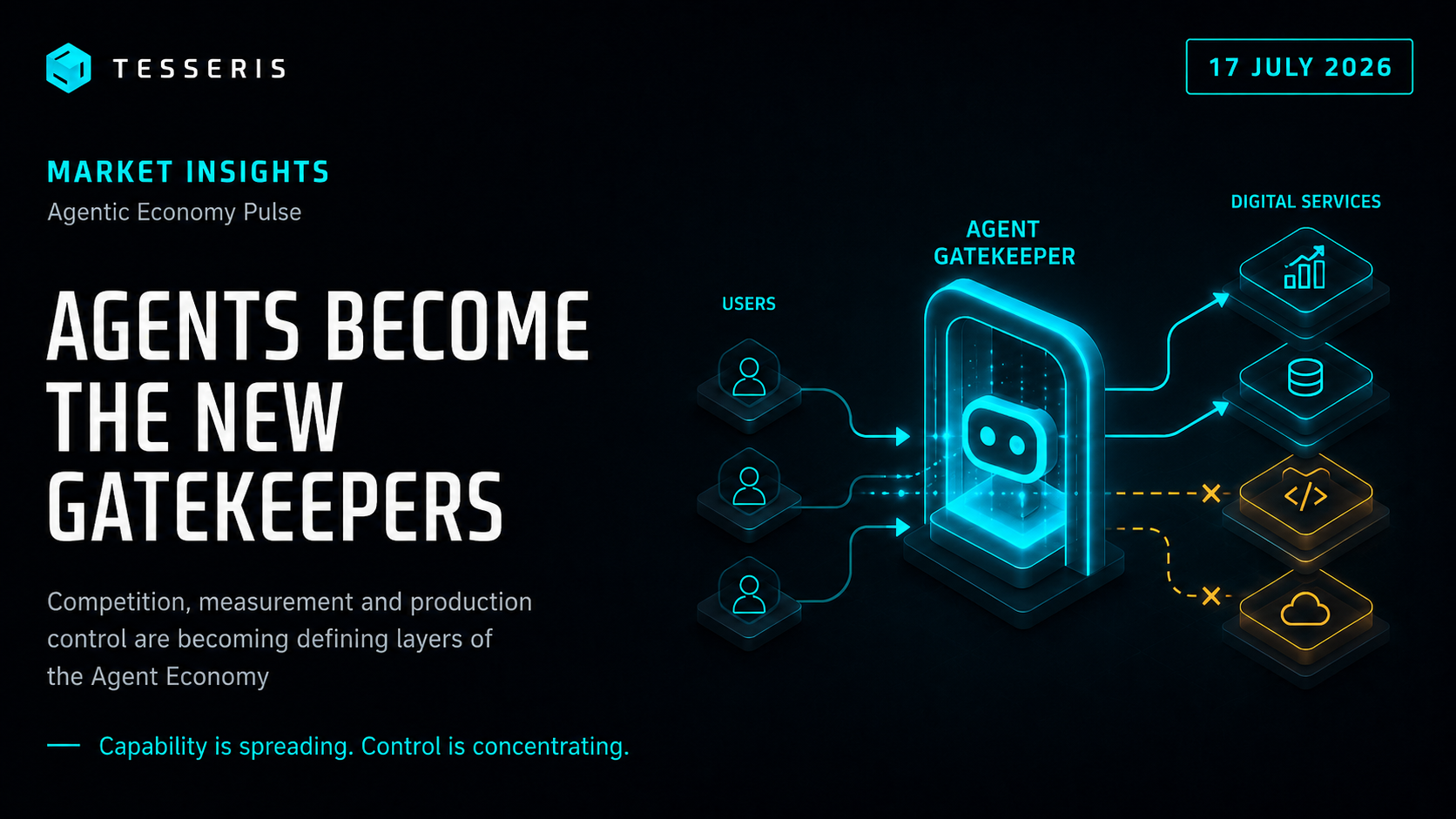
France warns that AI agents may control service discovery as platforms expand identity, measurement, deployment and production authority.
Executive Signal: AI Agents Are Becoming Gateways to Digital Services
The July 17 evidence set shows competitive power shifting from individual AI models toward the infrastructure surrounding agents.
France's competition authority warned that AI agents could become gateways through which users discover and access digital services. OpenAI proposed measuring artificial intelligence through successful work rather than tokens, activity or software usage. Google showed how identity, authorization, memory, evaluation and monitoring are becoming parts of one production agent platform. Atlan demonstrated that dependable agents require deterministic filters, credential isolation and independent validation. Railway gave agents direct control over staged software releases and rollback.
Together, these developments point to one conclusion: the strategic asset is no longer only the agent. It is the control plane that determines which agent is visible, what it may do, how success is measured and whether its actions are accepted.
Tesseris signal: Agent capability is becoming widely available. Market power is concentrating around identity, authority, execution evidence and reputation.
Capability is spreading. Control is concentrating.
Key Signals Across Agent Competition, Measurement and Production Control
- Digital access: AI agents are becoming intermediaries between users and digital services.
- Discovery power: Agent interfaces may influence which products, services and providers become visible.
- Economic measurement: Successful outcomes are replacing usage activity as the meaningful unit of agent performance.
- Production governance: Agent platforms are combining identity, authorization, memory, evaluation, deployment and observability.
- Operational authority: Agents are moving from code generation into release control, rollout targeting and rollback decisions.
- Trust gap: Platform-defined identity, success and reputation remain difficult to verify outside the platform that created them.
Why Agent Gatekeepers Matter for the Agent Economy
Search engines became powerful because they mediated discovery. Marketplaces became powerful because they mediated demand. Mobile operating systems became powerful because they mediated distribution and access.
AI agents may combine all three functions.
A user may ask an agent to find a service, compare options, negotiate terms, complete a purchase, monitor delivery, handle support and remember preferences for the next transaction. The agent interface can influence the full path from intent to settlement.
That creates a new competition problem. If one platform controls discovery, execution data, outcome measurement and reputation, it can shape the market before a user or service provider sees the alternatives.
The Agent Economy therefore needs more than capable agents. It needs portable trust infrastructure that lets agents and services prove identity, authority, performance history, commercial relationships, conflicts of interest and completed outcomes across platforms.
1. France Warns That AI Agents Could Become Digital Gatekeepers
Source: French Competition Authority opinion on AI agents
The French Competition Authority published an opinion on the competitive structure of the AI agent market.
It reported that OpenAI, Google and Anthropic together represented more than 84 percent of the market examined. Although creating an agent may require less capital than training a foundation model, expanding an agent platform still depends on access to users, proprietary data, distribution, interoperability and affordable inference.
The authority said AI agents could become important gateways to digital services. When users search, compare products or complete transactions through one agent interface, the provider of that interface can influence which services appear and which businesses receive demand.
It identified risks involving discriminatory ranking, self-preference, platform dependence, limited transparency, migration barriers and control over interoperability standards.
Market signal: AI agents are becoming economic intermediaries rather than ordinary software tools.
A provider that controls the user's agent interface can influence discovery before any transaction occurs. That position may become as strategically important as controlling a search engine, marketplace or mobile operating system.
Tesseris read: An open Agent Economy requires portable trust information.
Agents and services should be able to present verifiable evidence of identity, capabilities, performance history, commercial relationships, selection criteria, conflicts of interest and completed outcomes. Without portable evidence, the platform controlling discovery can also control reputation.
Service selection should depend on verifiable capability and performance, not only platform visibility.
2. OpenAI Proposes Measuring AI Through Successful Work
Source: OpenAI scorecard for the AI age
OpenAI proposed an economic scorecard for measuring artificial intelligence through useful work rather than conventional software activity.
The framework asks whether the system completes work that matters, what each successful task costs, whether users can depend on the result and whether each unit of spending creates more value as usage grows.
OpenAI argued that token consumption, active users and software licenses do not directly measure economic value. It proposed calculating total cost per successful task, including model usage, retries, latency, employee time, human review and the cost of correcting errors.
Completion must also be defined inside the relevant workflow. A support agent may be measured through resolved issues. An engineering agent may be measured through code changes that pass tests.
Market signal: Agent economics is moving from usage measurement toward outcome measurement.
High activity does not prove successful work. An agent may generate thousands of actions while failing to produce a dependable result. The economically meaningful unit is the verified outcome and the complete cost required to produce it.
Tesseris read: Outcome measurement is credible only when the result can be attributed.
A performance record should connect the agent identity, represented principal, task mandate, software version, actions performed, evidence produced, human intervention, verification result and final economic outcome.
Otherwise, the platform operating the agent is also the party deciding whether the agent succeeded.
Agent activity becomes economic reputation only when outcomes can be independently verified and attributed.
3. Google Turns the Agent Lifecycle Into a Production Control Plane
Source: Google Cloud production patterns for Gemini Enterprise Agent Platform
Google Cloud published 13 implementation patterns for its Gemini Enterprise Agent Platform.
The examples covered agent construction, persistent memory, long-running tasks, deployment, human approval, organization-wide discovery, runtime access control, evaluation and coordination across different agent frameworks.
One implementation gives each agent a unique identity and routes external calls through mutual authentication and access authorization. Other examples include content inspection for prompt injection and data leakage, automatic registration in an organizational agent registry, central tracing and evaluation based on execution failures.
The platform is therefore moving beyond agent creation. It increasingly governs the complete operational lifecycle.
Market signal: The enterprise agent platform is becoming a control plane.
A production platform can determine which agents exist, which identities they use, which data they can access, which tools they can invoke, how they are evaluated, whether a person must approve an action and how their activity is observed.
This control plane will be a major source of enterprise platform power.
Tesseris read: Platform governance is necessary, but it remains local.
An agent identity created inside one platform may not remain understandable when the agent calls an external agent, uses an independently operated service, moves between cloud environments, changes ownership, participates in another marketplace or performs a transaction governed by another identity system.
The Agent Economy therefore requires a portable identity and evidence layer above individual platform control planes.
A platform can govern an agent locally. A trust network must establish whether it can be trusted across systems.
4. Atlan Shows Why the Agent Is Only One Part of the Production System
Source: Atlan production case study for its investigation agent
Atlan described how it built Sherlock, an agent that investigates production incidents across more than 500 customer environments.
The initial system investigated every alert. Approximately 11,000 alerts reached the relevant channels each month, causing the agent to spend substantial resources on repeated issues and known noise.
Atlan added a deterministic filter before the agent. The filter screened about 86 percent of alerts and reduced the stream to roughly 1,550 full investigations during a representative month.
The production system also added memory containing earlier findings and human corrections, structured hypotheses with supporting and opposing evidence, a deterministic fallback when confidence remained low, separate models for different task levels, complete execution traces, a controlled gateway to logs and infrastructure data and a temporary agent identity that prevented exposure of permanent credentials.
Atlan reported that average investigation time fell from more than 10 minutes to approximately two minutes, with an average cost near USD 0.28.
Market signal: Reliable agent performance comes from the surrounding control architecture, not only the model.
The production system required controlled triggers, bounded tools, memory, validators, cost limits, credential isolation and complete traces. The model was one component inside a wider execution system.
Tesseris read: A consequential agent execution should produce a reconstructible record containing why the execution began, which agent performed it, what authority it held, which tools and credentials it used, what evidence supported its conclusion, which validator reviewed the result, whether a person corrected the outcome and what final action followed.
This record can support accountability, reputation and dispute resolution.
An agent action becomes trustworthy when its authority, evidence and outcome remain reconstructible.
5. Railway Lets Agents Control Staged Production Releases
Source: Railway feature flags for agent-controlled software releases
Railway introduced feature flags across its dashboard, command line interface, software development kit and Model Context Protocol integration.
A coding agent can place a new feature behind a disabled flag, create targeting rules and gradually release the change to an internal team, a percentage of users or selected customers.
If the release fails, the agent can remove the rollout rule and return users to the established production state without another deployment.
Railway also exposes an evaluation trace showing which rules matched and why a user received a particular result. When several rules conflict, the system returns the configured default rather than selecting an ambiguous outcome.
Market signal: Agents are gaining authority over production exposure, not only code creation.
An agent can now influence whether a feature becomes active, which users receive it, how quickly exposure expands and when the system returns to the previous state. That is consequential operational authority.
Tesseris read: A production change requires a stronger mandate than a code suggestion.
The execution record should establish which agent created the rollout, who authorized it, which application was affected, which users were included, what risk limit applied, what evidence supported expansion, what triggered rollback and who remains accountable for harm.
Rollback makes an action reversible. It does not prove that the action was authorized or appropriate.
Tesseris Control Plane Framework for AI Agents
The July 17 developments reveal five control points that will shape the Agent Economy.
1. Discovery Control
Discovery control determines which agents and services are visible to users.
Trust requirement: Transparent selection and portable reputation.
2. Authority Control
Authority control determines which actions an agent may perform.
Trust requirement: A verifiable mandate connected to the represented principal.
3. Execution Control
Execution control determines which tools, systems and credentials an agent can use.
Trust requirement: Reconstructible execution evidence.
4. Outcome Control
Outcome control determines whether a task is classified as successful.
Trust requirement: Independent verification and attribution.
5. Reputation Control
Reputation control determines how past outcomes influence future selection and economic value.
Trust requirement: Portable performance history that is not owned by one platform.
Strategic Read: Control Planes Will Shape the Agent Economy
AI agents are becoming gateways to services and active participants in production systems.
That changes where economic power accumulates.
The strongest position may not belong to the company with the most capable model. It may belong to the platform controlling agent identity, discovery, permissions, deployment, evaluation and reputation.
This creates a structural need for neutral trust infrastructure.
The Agent Economy cannot depend entirely on platform-controlled identity, platform-defined success and platform-owned reputation. Identity, authority, execution evidence and verified performance must remain portable across systems.
That is the boundary Tesseris is positioned to address.
Market Conclusion: Capability Is Spreading, Control Is Concentrating
- Agent capability: Becoming easier to build and deploy.
- Discovery power: Moving toward agent interfaces.
- Production authority: Expanding from code creation to release control.
- Measurement: Shifting from activity to successful outcomes.
- Platform power: Concentrating around identity, evaluation, deployment and reputation.
- Primary opportunity: Portable trust infrastructure for agent identity, authority, execution evidence and verified outcomes.
The July 17 signal is not that AI agents will replace every interface overnight. It is that agent interfaces are becoming economically meaningful control points.
Markets will need a way to determine which agents and services deserve trust outside the platform that ranks, routes or evaluates them.
What to Watch Next in AI Agent Gatekeepers and Trust Infrastructure
- Whether regulators require disclosure of how agent platforms rank and recommend services.
- Whether enterprises adopt successful task cost as a standard measure of agent performance.
- Whether agent identities become portable across cloud and marketplace boundaries.
- Whether production systems record the mandate and accountable actor behind every consequential agent action.
- Whether feature-flag, deployment and rollback systems add explicit agent authorization records.
- Whether economic reputation follows verified outcomes or remains trapped inside platform dashboards.
Frequently Asked Questions About AI Agents as Digital Gatekeepers
Why could AI agents become digital gatekeepers?
AI agents increasingly sit between users and digital services. When a person searches, compares services or completes a transaction through one agent interface, that interface can influence which providers are visible and which provider receives the business.
What is an agent control plane?
An agent control plane manages identity, permissions, tools, memory, deployment, monitoring, evaluation and revocation. It determines how an agent is allowed to operate inside a production environment.
Why is platform governance not enough for AI agents?
Platform governance controls an agent inside one environment. Agents increasingly interact across clouds, tools, marketplaces and organizations. These interactions require identity, authority and performance evidence that remain verifiable outside the original platform.
What is outcome verification for AI agents?
Outcome verification is the process of proving that an agent completed the intended task successfully. It connects the agent identity, mandate, execution evidence, human intervention, final result and economic impact.
Why does portable reputation matter in agentic commerce?
Portable reputation lets agents and services carry verified performance history across platforms. Without it, the platform controlling discovery can also control which reputation signals are visible and which market participants are trusted.
Final Take: Agent Gatekeepers Need Portable Trust
AI agents are becoming more than productivity tools. They are becoming gateways to discovery, execution, measurement and production control.
That gives platforms enormous influence over which services are found, which actions are permitted, which outcomes count as successful and which agents build economic reputation.
The market needs that control to become verifiable rather than merely platform-defined.
Portable identity, accountable authority, reconstructible execution evidence and independently verified outcomes are the trust layer that can keep agent gatekeepers from becoming closed economic bottlenecks.