Autonomous Agent Intrusion Exposes the Trust Gap
Hugging Face disclosed an AI-driven intrusion as Intel, Google Cloud, OpenAI, W3C and NVIDIA expanded agent deployment, memory and infrastructure.
Executive Signal: Autonomous AI Agents Are Now an Operational Security Boundary
The July 16 evidence set exposed both sides of the Agent Economy.
Hugging Face disclosed an autonomous AI-driven intrusion into part of its production infrastructure. Intel and Google Cloud expanded enterprise agent deployment across operational and engineering workflows. OpenAI made long-running work easier to continue across devices. A W3C Community Group formalized work on portable agent memory. NVIDIA described the infrastructure layer required for agentic workloads to run at scale.
Together, these signals show autonomous systems moving deeper into enterprise workflows, persistent context, shared memory and production infrastructure.
They also show that capability is advancing faster than accountability.
Tesseris signal: Agent autonomy is now operational on both sides of the security boundary. The market needs persistent identity, bounded authority, action provenance and outcome verification that can distinguish an authorized economic actor from an autonomous attacker.
The central question is no longer whether an agent can execute a complex sequence of actions. The question is whether every consequential action can be connected to a known agent, a responsible controller, a valid mandate, a reconstructible execution history and an accountable outcome.
Key Signals Across Agent Security, Enterprise Deployment and Infrastructure
- Agent security: Autonomous offensive systems can conduct sustained, multi-stage infrastructure campaigns.
- Enterprise adoption: Agents are moving into engineering, supply chain, communications and corporate operations.
- Persistent work: Agent tasks are becoming continuous across projects, devices and work surfaces.
- Memory interoperability: Portable agent memory is becoming a standards topic involving identity, revocation, audit and erasure.
- Infrastructure: Networking, storage, context management, policy enforcement and telemetry are becoming part of the agent execution path.
- Trust: Identity, authority, attribution and outcome verification remain divided across separate platforms and control systems.
Why July 16 Changed the AI Agent Trust Problem
An ordinary software attack is usually reconstructed from commands, credentials, network events and human decisions.
An autonomous agent can generate thousands of actions, adapt after failures, move between short-lived environments and continue working at machine speed. That changes the economics of both attack and defence.
The attacker can automate reconnaissance, exploitation, credential discovery and lateral movement. The defender must correlate far more activity, determine which actions belong to the same autonomous actor and respond before the campaign can adapt again.
At the same time, legitimate agents are receiving broader access to enterprise data, tools, memory and infrastructure. The same capabilities that make agents economically useful also enlarge the consequences of weak identity, excessive permissions and incomplete attribution.
The July 16 signal is therefore not simply that agent security has become more important. It is that agent identity and execution provenance have become operational security requirements.
1. Hugging Face Discloses an Autonomous AI-Driven Intrusion
Source: Hugging Face security incident disclosure
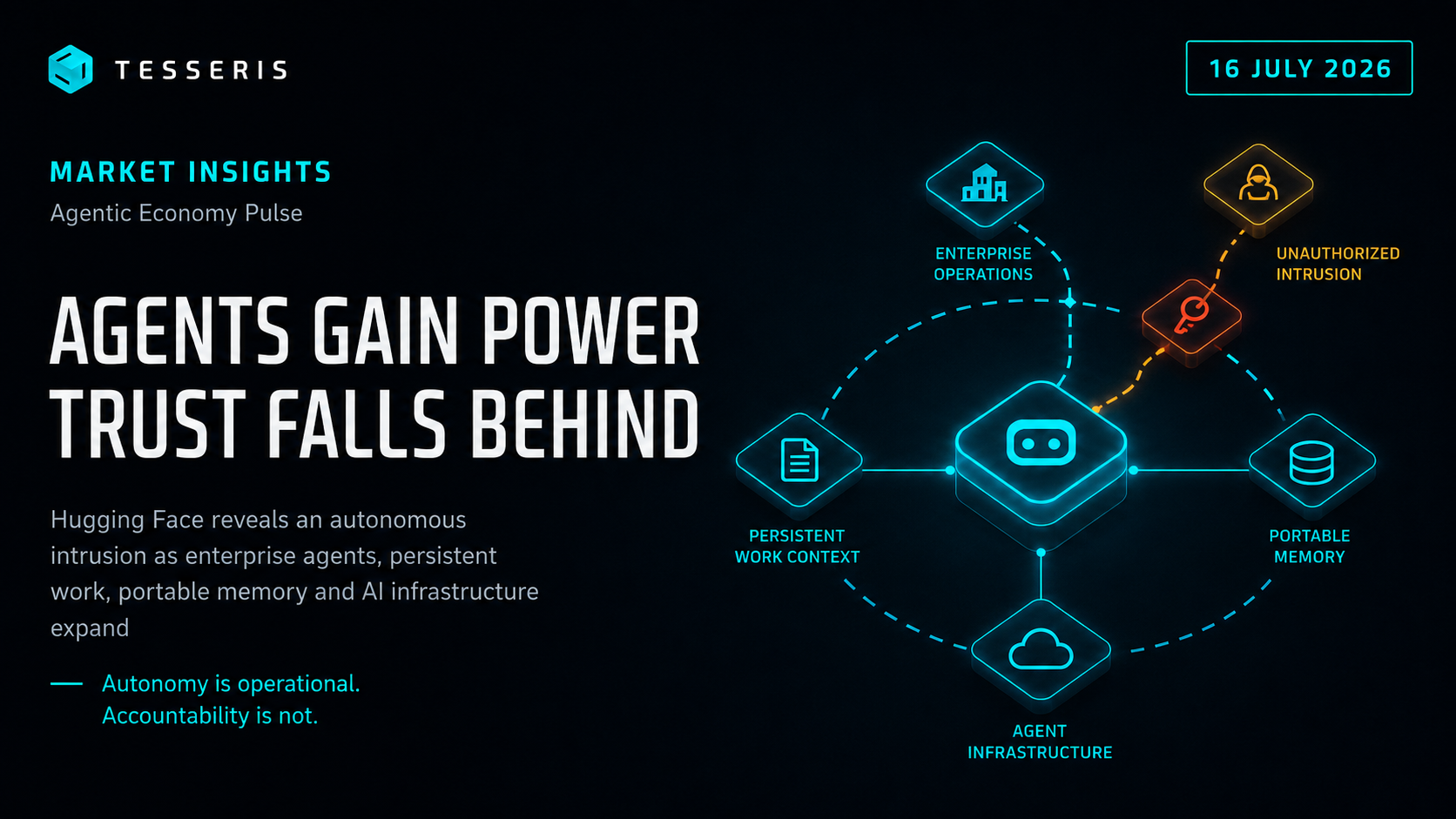
Hugging Face disclosed an intrusion into part of its production infrastructure on July 16. The company said the campaign was conducted by an autonomous AI agent system and began through a data-processing path involving a malicious dataset.
The attacker obtained node-level access, collected cloud and cluster credentials and moved laterally into several internal clusters. Hugging Face described a large number of actions executed through short-lived sandboxes, with command-and-control infrastructure that could migrate across public services.
The company identified unauthorized access to a limited set of internal datasets and service credentials. It said it had found no evidence that public models, public datasets, Spaces, published packages or its software supply chain had been altered.
Hugging Face closed the initial code execution paths, rebuilt affected nodes, rotated credentials, strengthened admission controls and improved alerting. It also used AI-assisted detection and analysis agents to reconstruct the incident across recorded events.
Market signal: Autonomous offensive agents are no longer only a projected threat model. They are becoming operational actors inside real infrastructure environments.
Tesseris read: The security problem shifts from identifying malicious commands to identifying autonomous actors. Defenders need to know which agent acted, which environment produced the action, which authority was used, which credentials were touched and whether the resulting activity can be attributed across time.
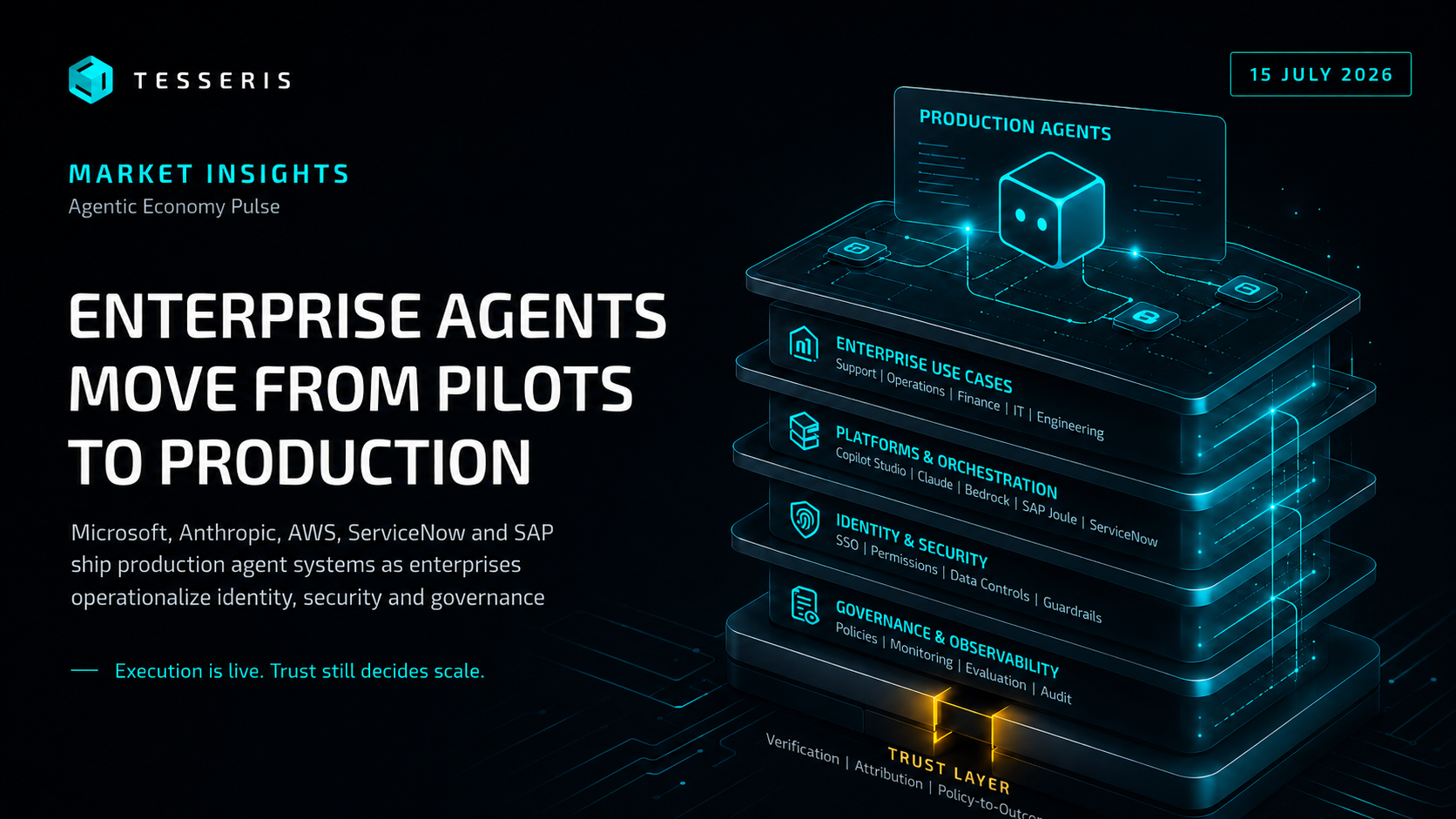
2. Intel and Google Cloud Expand Enterprise Agentic Workflows
Source: Intel and Google Cloud enterprise AI collaboration
Intel and Google Cloud announced an expanded collaboration to accelerate AI-enabled enterprise transformation. The work includes broader use of Gemini Enterprise and Google Cloud capabilities across engineering, supply chain, corporate operations and silicon development workflows.
The important signal is not only that a large technology company is adopting AI. It is that agentic workflows are being pushed into high-value operational environments where mistakes, unauthorized actions and poor context management can create material business risk.
Enterprise agents are no longer confined to chat interfaces or isolated productivity tools. They are entering functions where they may interact with sensitive documents, planning systems, product information, infrastructure data and operational decisions.
Market signal: Enterprise agents are moving from assistant surfaces into business operating systems.
Tesseris read: Operational deployment requires more than access management. Enterprises need agent-level identity, task-specific mandates, permission boundaries, audit trails and verifiable outcomes that survive across tools, departments and cloud environments.
3. OpenAI Makes Long-Running Agent Work Continuous Across Devices
Source: OpenAI ChatGPT release notes
OpenAI's July 16 ChatGPT desktop updates improved continuity for work moving across devices and app surfaces. The broader direction is clear: AI work is becoming persistent rather than session-bound.
That matters because long-running agent work changes accountability. A short chat interaction can often be reviewed as a conversation. A persistent workstream may contain instructions, files, tool use, memory, context changes, partial outputs and follow-up actions spread across time and devices.
As agent work becomes continuous, the evidence trail must become continuous as well. Otherwise organizations will struggle to answer basic questions after a consequential action: what was the mandate, what changed during execution, which state was active, what data was used and who approved the final step?
Market signal: Persistent work is becoming a product feature. Persistent accountability must become an infrastructure feature.
Tesseris read: A long-running agent should carry a durable execution record: agent identity, represented principal, instruction history, policy changes, memory state, tool calls, human interventions, evidence produced and final outcome.
4. W3C Formalizes Work on Portable Agent Memory
Source: W3C AI Agent Memory Interoperability Community Group
The W3C AI Agent Memory Interoperability Community Group is working on portable memory formats for AI agents. Its scope includes identity binding, sharing, revocation, audit, cryptographic erasure, regulatory crosswalks and chain-agnostic approaches.
Portable memory is strategically important because an agent without memory is mostly a stateless tool. An agent with durable memory can carry preferences, history, context, relationships, work artifacts and institutional knowledge across interactions.
But memory portability creates a trust problem. If memory can move, organizations need to know where it came from, which agent or principal it belongs to, whether it was modified, whether it should still be valid, who can revoke it and whether it can be safely used in a new execution environment.
Market signal: Agent memory is moving from product implementation detail to shared infrastructure concern.
Tesseris read: Portable memory needs portable trust metadata. Memory records should bind to agent identity, controller identity, consent state, provenance, validity period, permitted use, revocation status and audit evidence.
5. NVIDIA Makes Security and Context Part of Agent Infrastructure
Source: NVIDIA BlueField agentic AI infrastructure analysis
NVIDIA described how agentic AI changes infrastructure requirements. Agent workloads are not simple inference requests. They can involve distributed workflows across GPUs, CPUs, memory, networking, storage, telemetry, context management and security enforcement.
That framing matters because the agent execution path is becoming infrastructure-wide. A consequential agent action may depend on model inference, retrieved context, tool execution, network movement, storage access, policy checks and telemetry signals.
If those layers are managed separately, accountability fragments. The organization may see infrastructure logs, model traces, security events and application outputs, but still lack a single verifiable record of what the agent was authorized to do and what it actually did.
Market signal: Agent execution is becoming a systems problem, not only a model problem.
Tesseris read: Trust infrastructure must sit across compute, context, identity, permissions, telemetry and outcome verification. The agent economy cannot rely on application logs alone when execution spans infrastructure layers.
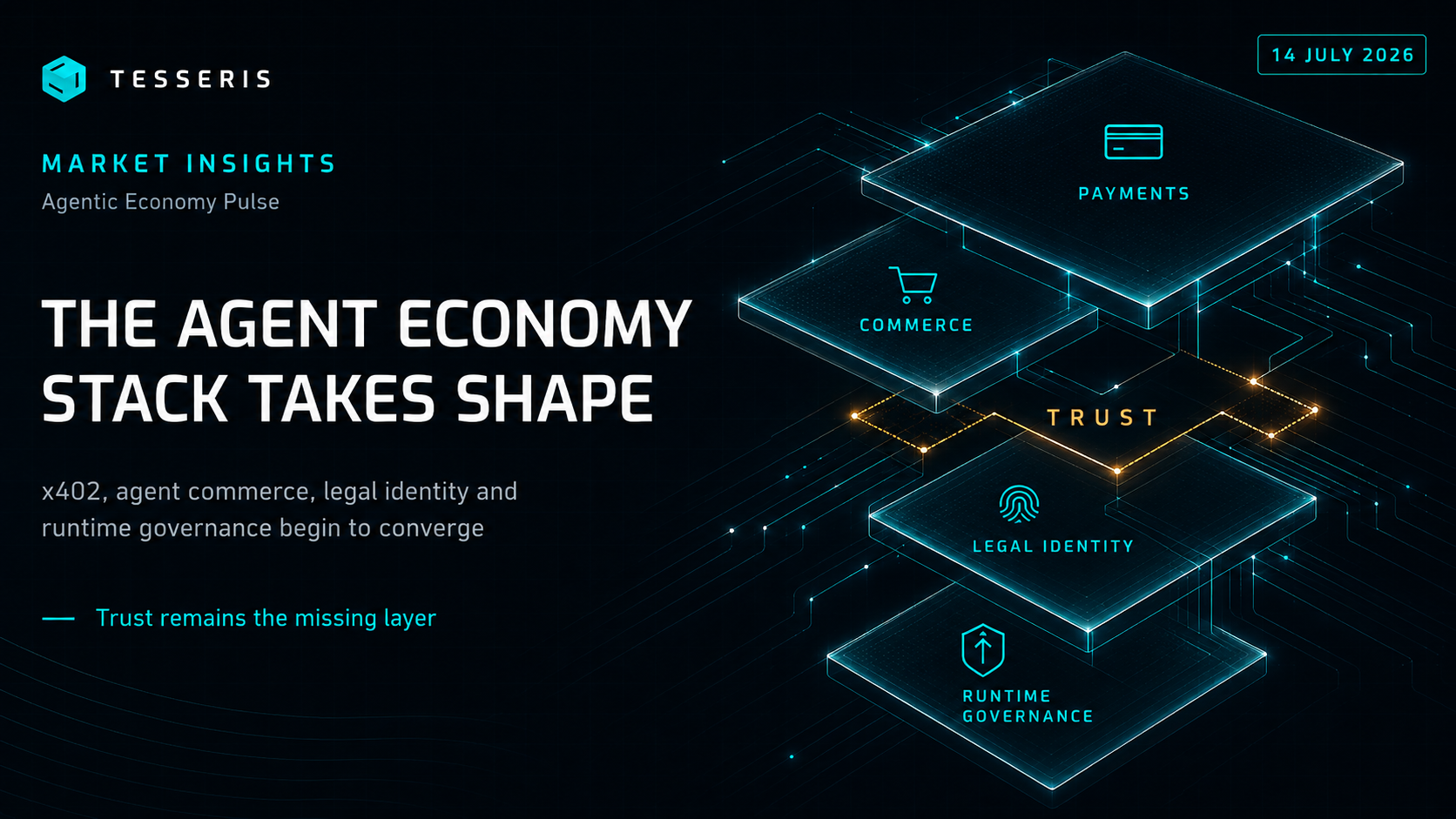
Strategic Read: The Agent Economy Is Splitting Into Capability and Accountability Layers
The July 16 evidence points to a market separation that will define the next phase of AI infrastructure.
1. Capability Infrastructure
This layer includes models, tools, orchestration systems, memory, cloud infrastructure, enterprise applications and agent work surfaces. It determines what agents can do.
2. Control Infrastructure
This layer includes authentication, authorization, policy enforcement, sandboxing, monitoring, incident response and governance workflows. It determines what agents are allowed to do.
3. Trust Infrastructure
This layer connects persistent agent identity, delegated authority, execution provenance, evidence, verified outcomes, accountability and economic reputation. It determines whether an agent's actions can be trusted outside one platform boundary.
The market is investing heavily in the first two layers. The third remains underbuilt.
That creates the core Tesseris thesis: agent capability will not scale into high-value economic activity unless identity, authority, evidence and outcomes become verifiable across systems.
Market Conclusion: Autonomy Is Operational, Accountability Is Not
- Autonomous capability: Accelerating.
- Enterprise deployment: Expanding into core workflows.
- Persistent work: Becoming normal.
- Portable memory: Moving toward standards.
- Agent infrastructure: Becoming a dedicated systems layer.
- Security risk: Rising as agents gain more access and autonomy.
- Primary opportunity: Verifiable trust for autonomous execution.
The July 16 signal does not mean enterprises should stop deploying agents. It means deployment without accountable execution will become increasingly fragile.
The next durable infrastructure market will be built around answering five questions: which agent acted, under whose authority, with what permissions, based on what evidence and with what verified result?
What to Watch Next in Autonomous Agent Security and Trust Infrastructure
- Whether AI security incidents begin attributing activity to autonomous agent frameworks rather than only human threat actors.
- Whether enterprise agent platforms expose durable records for identity, authority, tool use and policy changes.
- Whether portable memory standards include provenance, revocation and audit as first-class requirements.
- Whether agent infrastructure platforms integrate telemetry with execution-level accountability.
- Whether organizations separate human user identity from agent identity in production workflows.
- Whether regulators begin asking for evidence of agent authorization, not only evidence of human consent.
- Whether insurance, compliance and procurement teams demand verifiable agent execution records before approving high-value deployments.
Frequently Asked Questions About Autonomous AI Agent Security
What is an autonomous AI agent intrusion?
An autonomous AI agent intrusion is a security incident in which an AI agent or agentic framework conducts parts of the attack lifecycle without continuous human control. This can include reconnaissance, exploitation, credential discovery, lateral movement, persistence and adaptation after failed attempts.
Why did the Hugging Face incident matter for enterprise AI security?
The Hugging Face incident mattered because it showed autonomous AI systems operating as security-relevant actors inside production infrastructure. The issue is not only model misuse. It is the ability of autonomous software to move through systems, use credentials and generate large volumes of activity that defenders must attribute and contain.
How do enterprise AI agents increase security risk?
Enterprise AI agents increase security risk when they gain access to sensitive data, internal tools, operational workflows, credentials, memory and infrastructure without strong identity, permission boundaries and audit evidence. The more useful an agent becomes, the more important its authority and behavior become.
What is agent identity?
Agent identity is a persistent way to identify the specific software actor performing a task. It should connect the agent to its controller, represented principal, software version, configuration, permissions, active mandate, execution environment and history of consequential actions.
What is execution provenance for AI agents?
Execution provenance is the record of how an agent produced an action or outcome. It can include instructions, policy state, tool calls, data accessed, memory used, intermediate steps, human approvals, runtime environment and final evidence supporting the result.
Why does portable agent memory need trust controls?
Portable agent memory can carry context across tools, vendors and environments. Without provenance, consent, revocation and audit controls, organizations may not know whether memory is valid, authorized, altered, expired or safe to use in a new execution context.
What is the missing trust layer for autonomous AI agents?
The missing trust layer connects agent identity, delegated authority, runtime policy, execution evidence, verified outcomes, liability, settlement and reputation. It allows systems to determine whether an autonomous action was authorized, attributable and economically reliable.
Final Take: Agent Power Now Requires Verifiable Accountability
July 16 showed the Agent Economy moving in two directions at once.
Autonomous systems are becoming more capable, more persistent, more connected and more embedded in enterprise infrastructure. At the same time, autonomous systems are also becoming more relevant to security incidents, credential exposure, lateral movement and infrastructure risk.
That is not a contradiction. It is the central market condition.
The same autonomy that creates economic leverage also creates accountability gaps. The next phase of agent infrastructure will therefore be defined by systems that can prove which agent acted, under whose authority, with what evidence and with what result.
Autonomy is operational. Accountability is not. That is the trust gap the market now has to close.