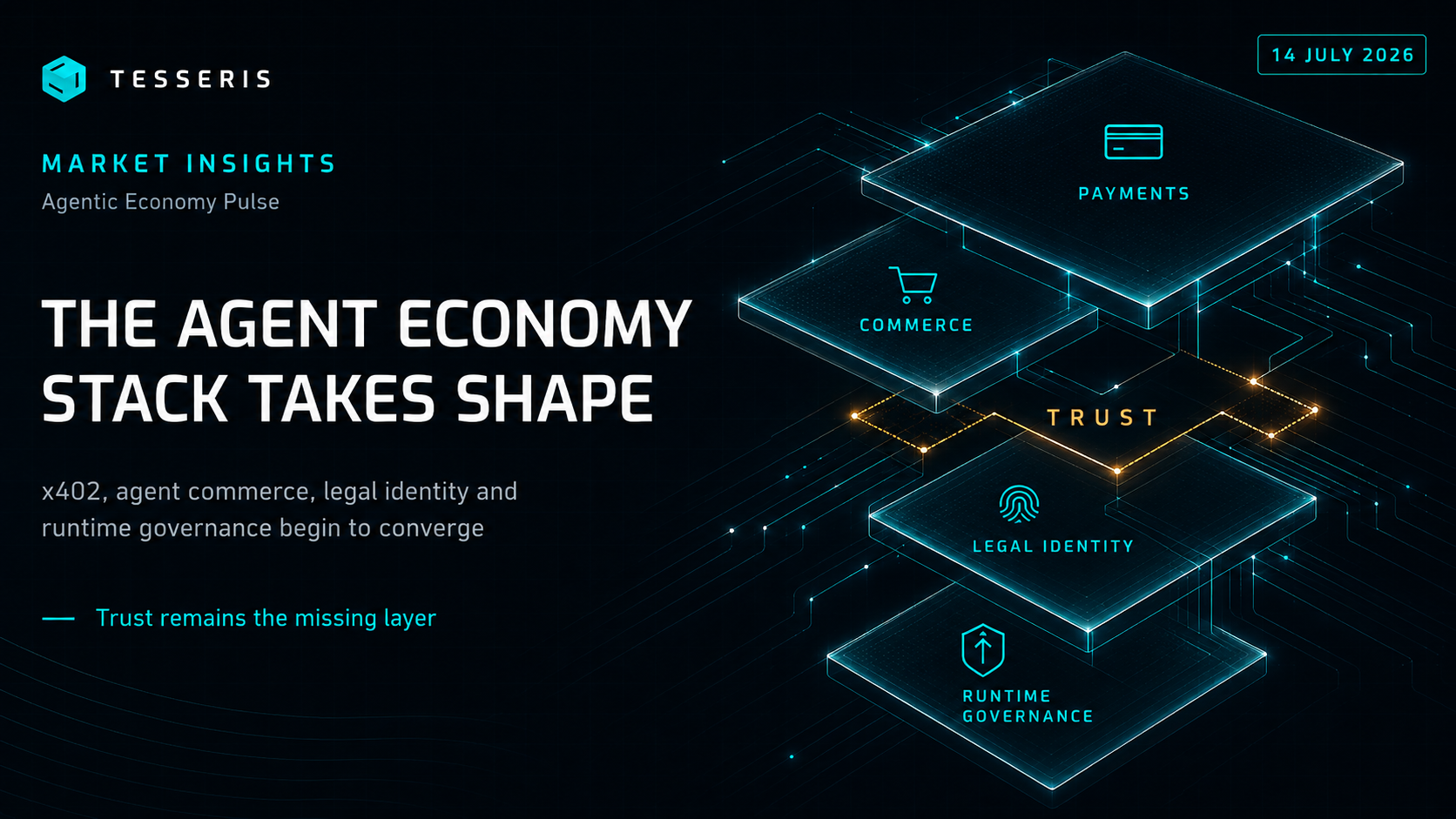
The Agent Economy Stack Takes Shape
AI agent payments, agent commerce, legal identity and runtime governance are converging around x402. The missing layer is verifiable trust infrastructure.
Executive Signal: AI Agent Payments Are Becoming Infrastructure
The July 14 evidence set combines the operational launch of the x402 Foundation, Visa's measurement of live agent payments, Delaware's proposed Artificial Intelligence Company structure, Alipay's merchant agent platform and Credo AI's runtime governance preview.
Together, these developments show payments, commerce, legal identity and runtime control becoming connected parts of an emerging Agent Economy stack.
Tesseris signal: The infrastructure enabling autonomous agents to transact is advancing faster than the trust infrastructure required to bind identity, authority, execution evidence, liability and settlement.
The unresolved question is no longer whether AI agents can transact. The question is whether every transaction can be connected to a persistent agent identity, an authorized mandate, verified execution, accountable liability and a valid settlement decision.
Key Signals Across Payments, Commerce, Identity and Governance
- Payments: Agent payments are moving from proprietary products toward shared infrastructure.
- Adoption: Real payment activity exists, but transaction volume remains an unreliable measure of genuine economic adoption.
- Legal identity: Autonomous agent identity is moving from theoretical discussion toward supervised regulatory experimentation.
- Agent commerce: Merchant products and services are becoming discoverable and callable by AI agents.
- Governance: Organizational controls are moving into the runtime, before consequential agent actions occur.
- Trust: Identity, authorization, execution evidence and settlement remain fragmented across separate systems.
Why This Matters for the Agent Economy
Five distinct developments are pointing in the same direction.
Payment is becoming native to agent interactions. Merchant services are being exposed in machine-callable formats. Legal systems are considering accountable entities operated by AI agents. Enterprise controls are moving into the software environments where agents act.
The Agent Economy is therefore moving beyond isolated demonstrations and toward coordinated infrastructure.
What remains incomplete is the mechanism that proves which agent acted, who authorized it, what it was permitted to do, whether it completed the promised work and whether payment should become final.
1. x402 Foundation Launches as Open Payment Infrastructure for AI Agents
Source: Linux Foundation announcement
The Linux Foundation announced the operational launch of the x402 Foundation on July 14. Coinbase completed the contribution of the x402 protocol, placing its continued development under formal open governance.
x402 embeds payment into web requests so AI agents, applications and APIs can send and receive value while interacting online. The protocol supports multiple payment methods, including conventional payment systems and stablecoins.
Forty organizations had joined the foundation at launch. Premier members included American Express, Amazon Web Services, Circle, Cloudflare, Coinbase, Google, Mastercard, Shopify, Stripe and Visa.
Market signal: Agent payments are becoming shared industry infrastructure.
The significance is not another isolated payment product. It is the convergence of payment networks, cloud providers, stablecoin companies, commerce platforms and blockchain ecosystems around a common interface for internet-native payments.
Tesseris read: x402 determines how value can move. Verification determines whether the payment was authorized, earned and ready for settlement.
Payment transport does not, by itself, answer who initiated the transaction, who authorized it, what limits applied, whether the service was delivered correctly, what evidence supports completion, who resolves a dispute and when payment should become final.
2. Visa Data Shows Live AI Agent Payments, But Adoption Measurement Is Weak
Sources: Visa and Artemis agentic payments research | Academic preprint on x402 settlement activity
Visa and Artemis published research examining live agent payment protocols. Their adjusted data showed that x402 had processed approximately USD 15 million across 109.6 million transactions since May 2025, implying an average value of roughly USD 0.14 per transaction.
The research separated agentic commerce into two emerging categories: agents purchasing conventional products and services for people, and software paying software for APIs, data, compute and other digital resources.
A separate academic preprint published on July 14 warned that x402 settlement counts should not automatically be treated as evidence of genuine adoption. The researchers classified large portions of the activity they studied as fictitious or internal settlement.
Market signal: Agent payments have moved beyond demonstration, but the market lacks dependable adoption metrics.
Raw payment volume measures the movement of value. It does not necessarily measure successful economic activity. A useful agent reputation system should connect each economic event to a verified mandate, known agent identity, identifiable counterparty, evidence of execution, verified outcome and final settlement result.
3. Delaware Tests Legal Identity for AI Agents
Source: Delaware Artificial Intelligence Company proposal
Delaware proposed testing a new legal structure called the Artificial Intelligence Company, or AIC, inside a regulatory sandbox.
Under the proposal, an AIC would be a separate legal entity whose daily affairs could be managed by an AI agent. It could hold property, incur obligations, sue and be sued. Each AIC would have one human or organizational member responsible for adequate capitalization.
Market signal: Legal identity for autonomous agents is moving from theory toward supervised experimentation.
Tesseris read: A legal entity and a technical agent identity solve related but different problems. The legal entity identifies the accountable commercial wrapper. The technical identity must identify the actual system that acted, including its version, operator, principal, capabilities, tools, assets, authorization state and execution history.
The emerging requirement is a binding between legal identity, agent identity, mandate and execution record.
4. Alipay Opens Merchant Services to AI Agents
Source: Alipay AI Open Platform coverage
Reporting published for the July 14 coverage period said Alipay had launched an AI Open Platform through which merchants could package their services as plug-ins, skills or agents. Those services could then be invoked by AI assistants operating across phones, vehicles and other smart terminals.
Early participating services reportedly included KFC, Mixue Bingcheng, Luckin Coffee, Amap and Didi. The platform's trust model included delegation authority, traceable operations, intent verification and secure payment.
Market signal: The supply side of commerce is becoming agent-callable.
Most discussions of agent commerce focus on the intelligence that selects or purchases a product. Alipay is addressing the other side of the market: making merchant inventory and services available in formats that an agent can discover, compare and invoke.
Tesseris read: Agent-callable commerce introduces a new discovery and trust problem. Merchants will need to prove what services they offer, which actions those services can perform, what permissions they require, what commercial terms apply and whether previous transactions were completed reliably.
The strategic opportunity is not only helping agents find services. It is helping agents determine which services can be trusted.
5. Credo AI Moves Runtime Governance Into AI Agent Workflows
Source: Credo AI Agent Governor announcement
Credo AI launched Agent Governor as a research preview on July 14. The product converts approved organizational policy into machine-readable controls installed inside the software harness that runs an agent.
At meaningful points in an agent workflow, actions can be allowed, blocked, escalated to a person or accompanied by guidance. Each decision creates a structured record containing the active policy version, session initiator, tool call, supplied arguments, governance decision and reason.
Market signal: Agent governance is moving from documentation and monitoring into runtime enforcement.
Tesseris read: Runtime policy determines whether an agent may perform an action. It does not, by itself, establish whether the complete task produced the promised result.
That distinction separates two trust functions: action governance and outcome verification. The first protects systems during execution. The second determines reputation, liability and payment.
Strategic Read: Trust Infrastructure Is the Missing Layer
The July 14 evidence set reveals an Agent Economy stack separating into distinct layers:
- Payment transport: x402 and other agent payment protocols.
- Commerce access: Merchant services exposed to agents.
- Legal accountability: Proposed entities such as the Delaware Artificial Intelligence Company.
- Runtime control: Policy enforcement inside agent harnesses.
- Execution trust: Identity, authorization, evidence, verification and settlement.
The first four layers are attracting serious institutional participation. The fifth remains fragmented.
That produces the central Tesseris thesis: the Agent Economy does not only need agents that can act and payment rails that can move money. It needs proof that the correct agent acted under valid authority, completed the required work and earned settlement.
Market Conclusion: Constructive Infrastructure, Weak Trust Readiness
- Infrastructure outlook: Constructive.
- Commercial adoption: Emerging.
- Measurement quality: Weak.
- Trust readiness: Underdeveloped.
- Primary opportunity: Verification-backed identity and settlement.
The July 14 evidence does not show that the Agent Economy has matured. It shows that its payment, commerce, legal and governance layers are beginning to converge.
The companies controlling payment transport may process agent transactions. The companies controlling merchant access may distribute agent commerce. The infrastructure that verifies identity, authority and outcomes can determine which transactions deserve trust.
What to Watch Next in Agent Payments and Trust
- Whether x402 expands beyond payment transport into standardized authorization, mandates, identity or dispute processes.
- Whether independent data providers can separate genuine economic activity from testing, internal transfers and manufactured volume.
- Whether Delaware publishes formal Artificial Intelligence Company legislation or admits initial sandbox participants.
- Whether Alipay merchant services become interoperable with agents outside its own ecosystem.
- Whether runtime governance products demonstrate production adoption beyond controlled previews.
- Whether payment systems begin attaching execution evidence to settlement and dispute processes.
- Whether agent reputation systems measure verified outcomes rather than raw transaction volume.
Frequently Asked Questions About x402 and AI Agent Payments
What is x402 and how does it support AI agent payments?
x402 is an open protocol that places payment inside an HTTP interaction. A service can request payment, and an application or AI agent can provide payment before receiving the requested resource. The protocol is governed through the x402 Foundation under the Linux Foundation.
Are AI agents already making real payments?
Yes, particularly for digital resources such as APIs, data and compute. Visa and Artemis reported approximately USD 15 million in adjusted x402 volume across 109.6 million transactions. However, independent research indicates that raw settlement counts can include fictitious, internal or experimental activity.
How reliable are x402 transaction counts?
Raw x402 transaction counts show activity, but they do not necessarily show independent commercial demand. More reliable adoption measures would include independent counterparties, repeat commercial relationships, verified service delivery, retained revenue and dispute outcomes.
What is Delaware's proposed Artificial Intelligence Company?
The proposed Artificial Intelligence Company is a separate legal entity whose daily operations could be managed by an AI agent inside a supervised regulatory sandbox. The framework remained a proposal on July 14, 2026 and had not become Delaware law.
What is runtime governance for AI agents?
Runtime governance applies organizational policies while an agent is acting. It can allow, block or escalate actions before they affect production systems, data, assets or external services.
What trust infrastructure is still missing from the Agent Economy?
The market still lacks a widely adopted method for connecting agent identity, human or organizational authority, mandates, runtime actions, execution evidence, outcome verification, liability, dispute resolution and settlement.
Final Take: Agent Transactions Need Verifiable Trust
The Agent Economy stack is beginning to take shape.
Payment standards are becoming open infrastructure. Merchant services are becoming callable by agents. Legal systems are experimenting with accountable agent-operated entities. Governance controls are moving into the runtime.
These systems remain fragmented.
The next phase of the Agent Economy will not be defined only by which agents can transact. It will be defined by which transactions can be trusted.
That requires persistent identity, authorized mandates, execution evidence, outcome verification and settlement decisions that remain connected throughout the complete economic interaction.