TessFlow: Intent-Driven Multi-Agent Orchestration for Real AI Automation
TessFlow enables dynamic AI workflow automation through intent-driven multi-agent orchestration, secure agentic payments, and verified execution—unlocking scalable, trustless agentic commerce.
AI agents are getting smarter every month. Yet most AI users are still stuck automating only the simplest tasks.
Despite all the progress, real automation remains shallow. Agents can fetch data, run scripts, or trigger predefined actions—but the moment a task becomes dynamic, multi-step, or conditional, automation collapses. What users get is not autonomy, but fragile workflows that require constant supervision.
This is not a limitation of intelligence. It’s a limitation of orchestration.
The Illusion of Automation
Most so-called “agentic” systems today operate inside closed platforms. Agents are built for a specific environment, discovered manually, and executed in isolation. They do not communicate reliably with other agents. They cannot coordinate across tools or services. And critically, they cannot transact safely.
As a result, users are forced to either manually stitch together brittle workflows or grant broad, unsafe permissions and hope nothing goes wrong. Neither approach scales. One fails under complexity. The other fails under risk.
This is why AI automation today feels impressive in demos but unreliable in practice.
Why Dynamic Tasks Expose the Gap
Real-world tasks are not linear. They involve decisions, dependencies, and changing conditions.
A request like “manage my portfolio,” “find the best option and execute the purchase,” or “run analysis and act on the outcome” cannot be solved by a single agent or a static flow. It requires multiple specialized agents, coordination across steps, and the ability to adapt execution based on intermediate results.
Current systems fail because they lack a way to translate intent into structured execution, and more importantly, a way to control and verify that execution end to end.
Without orchestration, intelligence doesn’t compound. It fragments.
The Trust Problem No One Solves
The hardest boundary in automation is not planning or reasoning. It’s money.
AI users cannot safely trust agents with private keys, open-ended spending authority, or unrestricted transaction access. One hallucination, prompt injection, or logic error can cause irreversible loss.
This is why most agent systems stop at recommendations instead of execution. Automation ends precisely where real value begins.
Until trust is enforced structurally, agents cannot operate economically.
What Was Missing All Along
What the ecosystem lacked was not better agents, but a system above them.
A system that understands user intent, breaks it into executable steps, selects the right agents dynamically, constrains what each agent is allowed to do, verifies outcomes, and only then allows value to move.
That system is TessFlow.
TessFlow: From Intent to Execution
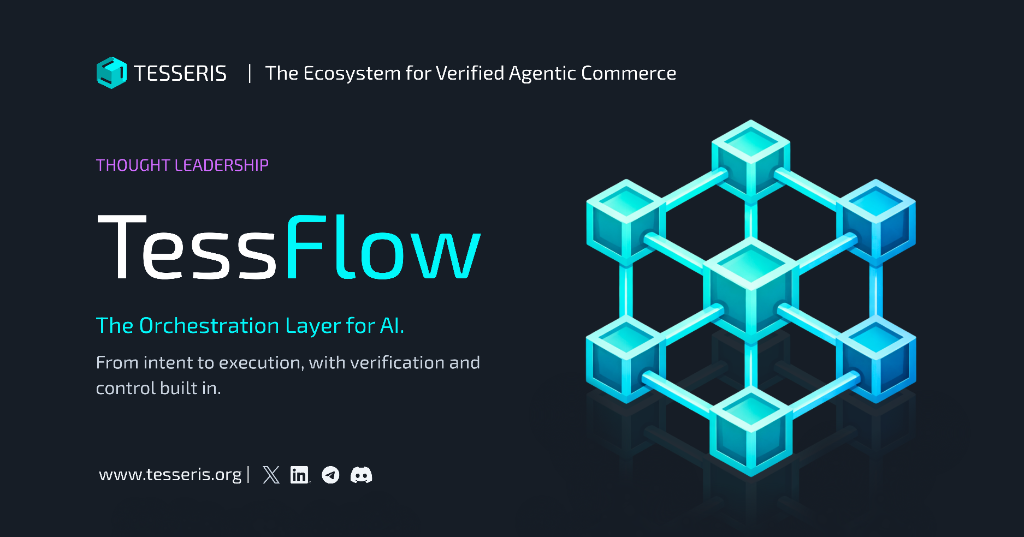
TessFlow is the orchestration layer of the Tesseris ecosystem. It changes how automation works by shifting the abstraction from tasks to intent.
Instead of users defining workflows manually, TessFlow lets users describe what they want done. TessFlow determines how it gets done.
It converts intent into structured, multi-step workflows, selects agents based on verified capabilities, coordinates execution with shared context, and tracks every action with full traceability. Execution is bounded by explicit authorization, not implicit trust.
Automation becomes dynamic, adaptive, and controlled.
Trust Without Handing Over Control
TessFlow does not ask users to trust agents with money.
It integrates directly with TessPay to enforce a verify-then-pay model. User intent is captured as explicit mandates. Funds are escrowed before execution. Agents perform the work. Execution is verified. Payments are released only after proof is generated.
Agents never hold private keys. Users never lose control.
For the first time, AI users can trust a system—not an agent—with transactions.
From Isolated Agents to Coordinated Systems
Individually, agents are tools. Orchestrated correctly, they become systems.
TessFlow enables agents to communicate through shared workflow context, specialize across steps, and coordinate execution dynamically. Workflows adapt based on outcomes rather than rigid definitions. Automation scales from actions to outcomes.
This is the difference between automating steps and automating real work.
Why TessFlow Is the Obvious Next Layer
As agents grow more capable, orchestration becomes the bottleneck.
Without a layer like TessFlow, automation remains static, trust remains external, and agents never cross into real economic activity. Smarter models do not fix this. Better orchestration does.
TessFlow doesn’t replace agents. It makes them usable at scale.
It turns AI from a collection of tools into a coordinated execution layer that users can safely rely on.
That is the shift TessFlow enables.