CLARITY Act 2026: What the Senate Vote Means for Crypto and Stablecoins
The CLARITY Act failed to advance in the US Senate. What does that mean for Bitcoin, crypto regulation, stablecoins, the GENIUS Act, the SEC, the CFTC and global digital finance?
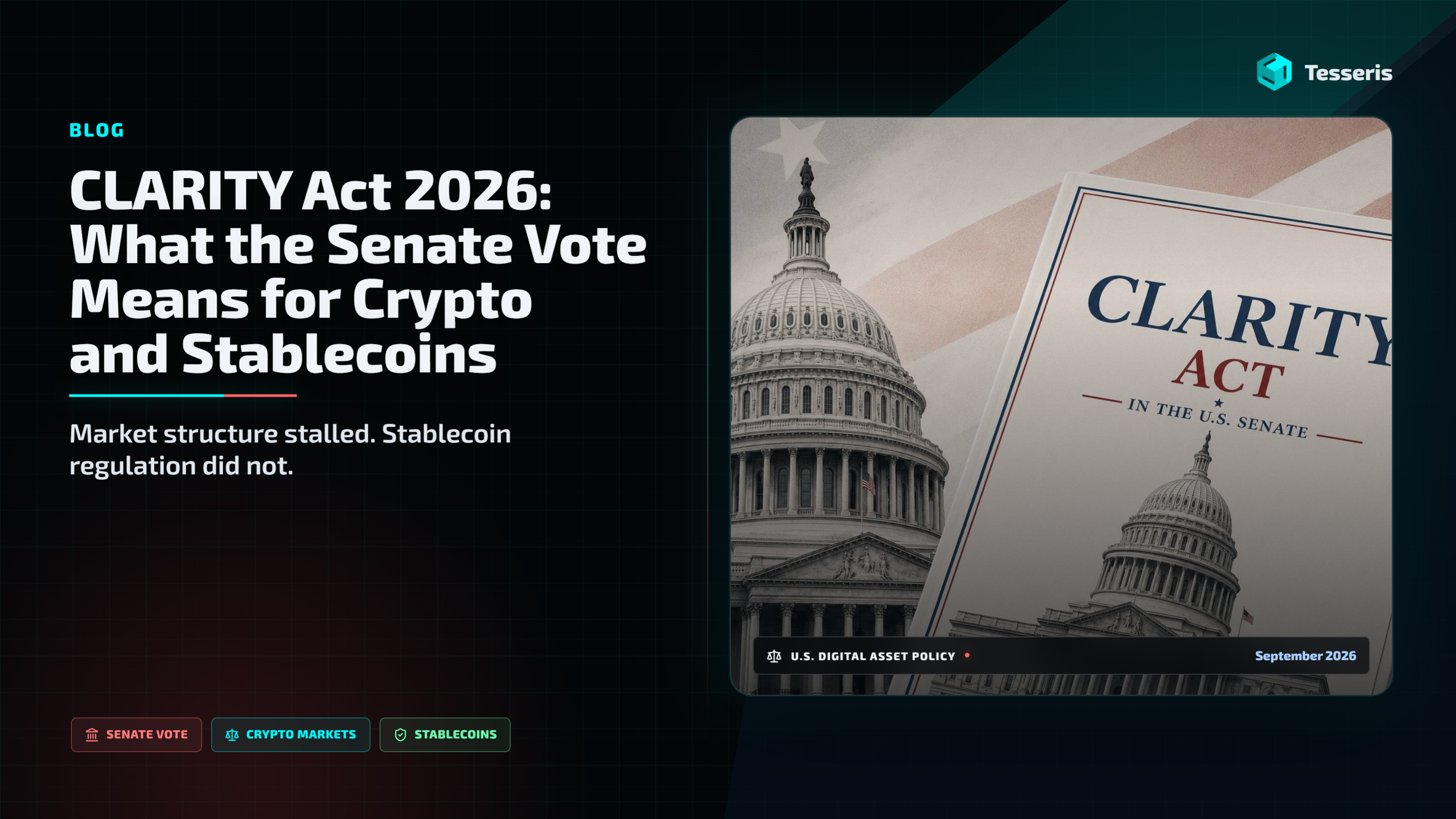
The US Senate failed to advance the CLARITY Act on September 15, 2026, delivering a significant setback to efforts to establish a comprehensive federal market structure for digital assets.
But the most important conclusion is not that US crypto regulation has failed.
The CLARITY Act addressed the regulatory structure of the broader digital asset market. It is separate from the GENIUS Act, which became law in July 2025 and already created a federal framework for payment stablecoins.
That distinction changes the long term interpretation of the vote.
The United States still lacks durable congressional rules governing much of the crypto market. Stablecoins, however, are already entering a different phase: regulated issuance, institutional adoption and increasing use as digital payment and settlement infrastructure.
What Happened to the CLARITY Act?
On September 15, the Senate considered cloture on the motion to proceed to H.R. 3633. The motion received 49 votes in favor and 50 against. It required three fifths of the Senate to advance.
The motion therefore failed, preventing the Senate from proceeding to full consideration of the legislation. The official Senate record describes the result as "Cloture on the Motion to Proceed Rejected."
This was not a final vote rejecting every provision of the CLARITY Act. It was a procedural failure to advance the legislation.
A procedural path for reconsideration was preserved, but the immediate consequence is clear: comprehensive US digital asset market structure legislation remains unresolved. Reuters reported that the failed vote leaves regulators such as the Securities and Exchange Commission and Commodity Futures Trading Commission carrying much of the responsibility for near term crypto policy.
What Was the CLARITY Act Trying to Solve?
The core problem is jurisdiction.
For years, one of the largest uncertainties in US crypto markets has been determining which digital assets fall within securities law, which belong within commodities regulation, and which rules apply to exchanges, intermediaries and token issuers.
The CLARITY Act sought to create a more explicit federal market structure involving both the SEC and the CFTC.
This matters because regulatory ambiguity affects much more than enforcement. It affects token issuance, capital formation, exchange registration, custody, institutional participation and whether companies choose to build financial infrastructure inside or outside the United States.
The SEC itself has acknowledged the limits of relying exclusively on agency action. SEC Chairman Paul Atkins stated in August that legislation remained essential for creating durable rules that could survive future changes in regulatory leadership.
The Senate vote therefore delayed something the crypto industry has been seeking for years: statutory certainty.
How Did Crypto Markets React?
The reaction was immediate.
Bitcoin fell roughly 3 percent following the vote. Ether declined approximately 4.5 percent, Solana about 5.4 percent and XRP approximately 9.2 percent. The broader GMCI 30 crypto index declined more than 4 percent.
The reaction was considerably larger among companies whose economics are directly connected to US digital asset regulation.
Coinbase closed more than 10 percent lower. Circle fell 11.4 percent. Strategy declined about 5.4 percent.
The pattern is informative.
Bitcoin was affected by the loss of regulatory optimism, but companies operating regulated exchanges, stablecoin infrastructure and other crypto financial services experienced larger repricing.
The market was not simply repricing blockchain technology. It was repricing the expected value of US regulatory certainty.
Did the CLARITY Act Cause the US Stock Market to Fall?
Only partly.
The S&P 500 fell 0.45 percent on September 15, while the Dow declined 0.63 percent and the Nasdaq fell 0.78 percent.
But CLARITY was not the primary driver of the broader equity market.
US stocks were simultaneously responding to rising oil prices, higher Treasury yields, renewed inflation concerns and expectations surrounding Federal Reserve policy. The US 10 year Treasury yield moved above 5 percent during the session.
The cleanest CLARITY reaction was therefore visible in crypto assets and crypto linked equities rather than across the entire US stock market.
This distinction matters when interpreting the event. The Senate vote created a regulatory shock inside digital assets. The broader market was dealing with a much larger macroeconomic environment.
CLARITY Is Not the US Stablecoin Law
This is the most important distinction in the entire debate.
The CLARITY Act did not create the existing US stablecoin framework.
That framework comes from the GENIUS Act.
President Donald Trump signed the GENIUS Act into law on July 18, 2025. It established the first federal regulatory framework specifically for payment stablecoins.
Among other requirements, regulated issuers must maintain reserves backing payment stablecoins on at least a one to one basis using permitted liquid assets. The framework also includes reserve disclosures, compliance obligations and rules governing issuer representations to consumers.
The failure of CLARITY therefore does not reverse stablecoin regulation.
The United States now has an unusual regulatory asymmetry.
Payment stablecoins have a congressional framework.
The broader crypto market still does not.
What Happens to US Crypto Regulation Now?
Agency regulation becomes substantially more important.
The SEC has already begun constructing a crypto framework using its existing authority. In August 2026, it proposed Regulation Crypto Assets, including tailored rules for certain crypto related investment contracts and pathways for capital formation under federal securities law.
The Commission has also developed interpretations addressing when federal securities laws apply to crypto assets and transactions.
That means US crypto regulation will not simply stop because CLARITY stalled.
But there is an important difference between legislation and regulation.
Congress can establish durable statutory boundaries between agencies and asset categories. Regulators operate within existing statutes and can change interpretations, exemptions and rules over time.
The immediate future of US crypto may therefore involve increasing regulatory clarity without equivalent legislative certainty.
For financial infrastructure companies, that difference is material.
Stablecoins Are Moving on a Different Trajectory
Stablecoins have already become a market exceeding $300 billion.
Research published by the Bank for International Settlements in 2026 found that approximately 98 percent of stablecoin value is denominated in US dollars.
That makes stablecoins more than a crypto market phenomenon.
They are increasingly becoming part of the international monetary system.
The World Trade Organization highlighted this transition in September 2026. Its research found that stablecoins are increasingly being used for payments, remittances, treasury operations and business to business transactions. Real payment volumes remain a relatively small share of total stablecoin activity, but they are growing.
Their attraction is straightforward.
Stablecoins can transfer value continuously across borders without depending on conventional banking settlement windows. For some transactions they can reduce settlement time, improve transparency and reduce payment friction.
The WTO also makes an important distinction: stablecoins can improve payment and settlement, but they do not replace the credit, guarantees and risk management functions of traditional trade finance.
Stablecoin adoption should therefore be understood as a transformation of payment infrastructure, not simply the replacement of banking.
Stablecoins Could Strengthen the Digital Dollar
The dominance of dollar denominated stablecoins has larger geopolitical implications.
If users around the world hold USDT, USDC or other dollar backed stablecoins, they are effectively holding digital representations of dollar value.
The BIS argues that because approximately 98 percent of stablecoins are denominated in dollars, increased adoption could initially reinforce the existing hierarchy of global currencies.
The GENIUS Act strengthens this connection by requiring eligible reserve assets such as US dollars and short term US Treasuries.
As stablecoin supply expands, regulated issuers can therefore become another source of demand for dollar assets.
There is also a risk on the other side.
The BIS identifies the possibility of digital dollarisation, particularly in emerging economies where individuals and businesses may prefer dollar stablecoins over less stable domestic currencies. Large scale currency substitution could affect monetary sovereignty and the effectiveness of domestic monetary policy.
The global stablecoin debate is therefore becoming inseparable from the future of the dollar itself.
The Next Stablecoin Battle Is Yield
One major unresolved question is whether stablecoin holders should be able to earn yield or rewards.
The GENIUS Act prevents stablecoin issuers themselves from paying interest or yield directly to holders. But the law does not explicitly eliminate every arrangement involving affiliates or third parties providing rewards.
That matters because yield changes the economic character of stablecoins.
A zero yield payment token primarily competes with payment infrastructure and transactional balances.
A yield bearing stablecoin can begin competing much more directly with bank deposits, money market products and other savings instruments.
Banks have consequently argued that large scale stablecoin rewards could shift deposits away from the traditional banking system.
This issue became part of the wider CLARITY negotiations and is likely to remain one of the most consequential questions in future US digital asset legislation.
What Does the Vote Mean for the Trump Administration?
The failed vote represents a legislative setback for one part of the Trump administration's digital asset agenda, but it does not reverse the broader policy direction already established.
The GENIUS Act remains law. The SEC continues developing crypto specific rules. The administration's Working Group on Digital Asset Markets has also explicitly supported greater regulatory clarity for custody, tokenization, stablecoins and digital asset markets.
At the same time, the CLARITY negotiations demonstrated that crypto legislation has become connected to wider political questions.
Reuters reported that opposition to the legislation included Democratic concerns regarding President Trump's financial interests in crypto as well as opposition from banking interests concerned about stablecoin competition.
Future attempts to create bipartisan crypto market structure legislation may therefore have to resolve not only technical questions about securities and commodities law, but also questions involving ethics, financial conflicts, banking competition and stablecoin economics.
The Bigger Signal: Crypto Is Becoming Financial Infrastructure
The most important development may be happening underneath the legislative debate.
Digital assets are gradually moving from a single question, "Is crypto regulated?", toward a much larger set of infrastructure questions.
Who can issue an asset?
Who can hold it?
How is identity established?
What capabilities and counterparties can be trusted?
Who is authorized to execute a transaction?
How is an outcome verified?
How is value settled?
How do systems operate across institutions and jurisdictions?
These questions become even more important as software agents begin interacting with financial systems and initiating economic activity on behalf of users.
Stablecoins can provide programmable value transfer. They do not by themselves solve identity, authorization, execution, verification or accountability.
The next generation of digital financial infrastructure therefore requires more than assets and payment rails. It requires trust infrastructure around them.
This is where the broader transition becomes important.
Crypto regulation is increasingly moving away from debating whether digital assets should exist and toward determining the conditions under which digital economic activity can operate safely, predictably and at scale.
What Comes After CLARITY?
The CLARITY Act vote delayed comprehensive US crypto market structure legislation. It did not reverse crypto adoption, invalidate the GENIUS Act or stop regulatory activity.
Three developments can now occur simultaneously.
The SEC and CFTC can continue defining digital asset rules using existing authority.
Congress can return to market structure legislation with different compromises.
And stablecoin adoption can continue expanding independently as regulated payment infrastructure.
That is why the long term consequence of the September vote is more nuanced than the immediate market reaction suggests.
The United States still has unfinished work on digital asset market structure.
But stablecoins have already crossed an important regulatory threshold.
The larger transformation of payments, settlement and programmable financial infrastructure continues.
Frequently Asked Questions
Did the CLARITY Act become law in 2026?
No. On September 15, 2026, the Senate failed to invoke cloture on the motion to proceed to H.R. 3633. The vote was 49 in favor and 50 against, below the required three fifths threshold.
Did the CLARITY Act failure affect the GENIUS Act?
No. The GENIUS Act is separate legislation and has been US law since July 18, 2025. It establishes the federal framework for regulated payment stablecoins.
Are stablecoins still legal and regulated in the United States?
Yes. Payment stablecoins can operate within the regulatory framework established by the GENIUS Act, subject to its requirements and implementing regulation.
Does the SEC still regulate crypto after the CLARITY vote?
Yes. The SEC continues exercising its existing statutory authority and has already proposed crypto specific regulatory frameworks in 2026. The CFTC also retains its existing authority. CLARITY would have provided a broader congressional market structure rather than replacing the agencies entirely.
Will the CLARITY Act failure stop global stablecoin adoption?
There is no direct mechanism through which the failed vote would stop global adoption. Stablecoin usage, particularly in dollar denominated instruments, continues to develop across crypto markets, payments, remittances and cross border settlement. The ultimate scale of adoption will depend on regulation, interoperability, trust and integration with existing financial infrastructure.