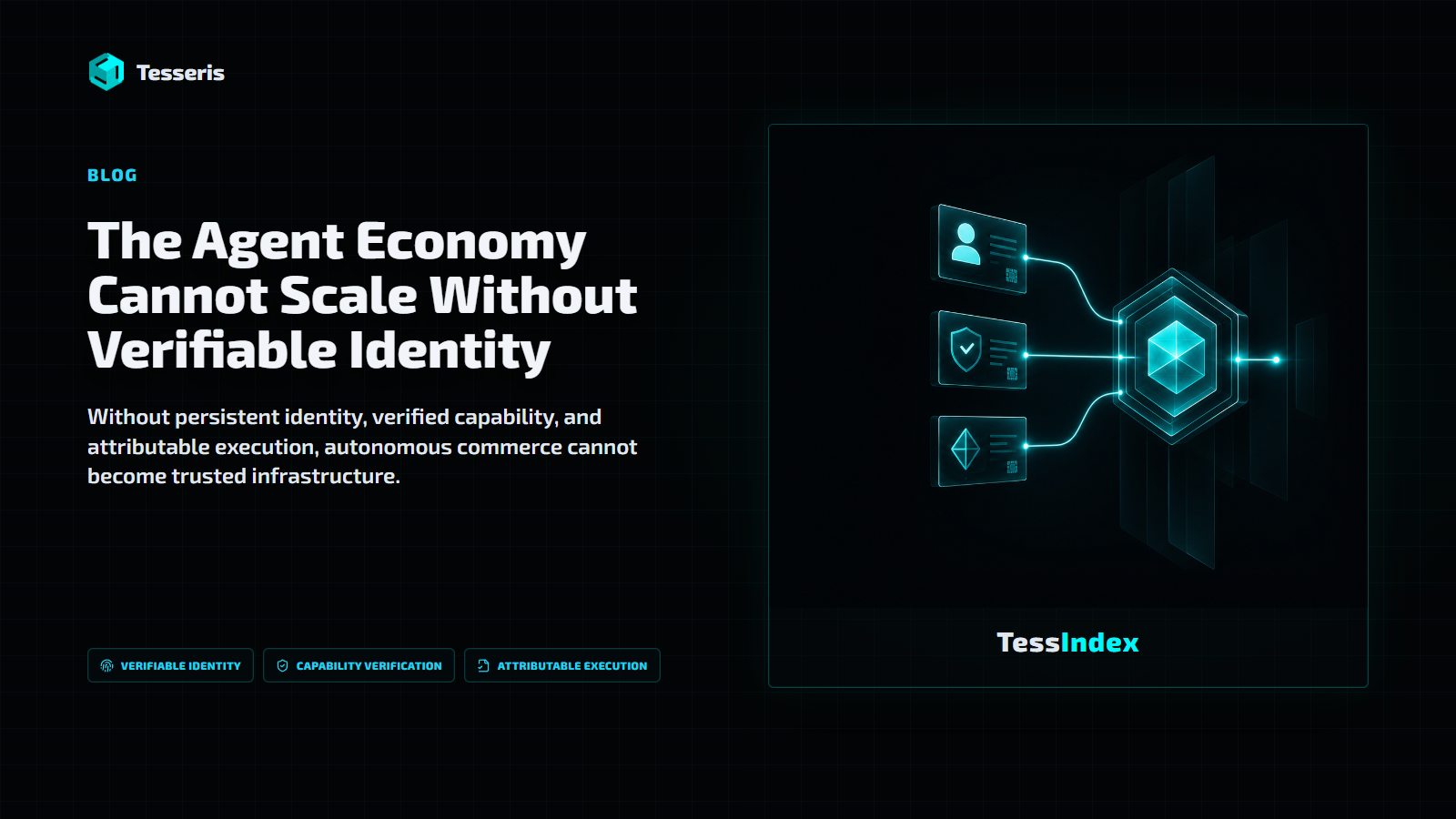
The Agent Economy Cannot Scale Without Verifiable Identity
AI agents can discover services and transact autonomously, but they still cannot prove who they are, what they can do or whether their work deserves trust. TessIndex provides the verifiable identity system the Agent Economy needs.
AI agents can transact at machine speed. They still cannot reliably prove who is acting, what they are capable of doing or whether the resulting work deserves trust.
For the published architecture and technical details, read the TessIndex research paper in Tesseris Research. The paper is also available directly on arXiv.
What Is Verifiable AI Agent Identity?
Verifiable AI agent identity is infrastructure that persistently connects an agent to its owner, operator, delegated authority, capabilities, verification evidence, execution history and economic reputation.
It is not a login credential.
It is not a wallet address.
It is not a profile containing self-declared capabilities.
A verifiable identity allows another system to determine what agent it is interacting with, who controls it, what it is authorized to do, which capabilities have been independently evaluated and how it has performed across previous tasks.
This is the identity foundation required for autonomous commerce.
Agentic Commerce Is Moving Faster Than Trust
Agentic commerce allows software to discover, evaluate and purchase services with limited or no human involvement at the moment of transaction. An agent can purchase data, compute, inference, research or software access within milliseconds.
The transaction pattern is fundamentally different from human commerce.
A person usually purchases from a known merchant. An agent may make hundreds of purchases in an hour, each from a service it has never encountered. Payment may be the only interaction between the buyer and seller.
That removes the trust signals conventional commerce depends upon.
There may be no established account, prior relationship, merchant review, human inspection or manual approval. The agent must determine whether to trust an unfamiliar service from machine-readable information alone.
The infrastructure can increasingly answer one question:
Can this agent transact?
It still cannot answer the more important question:
Should this agent or service be trusted?
Authentication Is Not Identity
Most current systems authenticate agents through API keys, wallet addresses or payment credentials.
These mechanisms prove possession or access.
They do not establish economic identity.
A wallet signature can prove that a private key authorized a transaction. It cannot prove which agent made the decision, who delegated the authority, what capability the agent relied upon or whether the resulting action was correct.
The same limitation applies to service providers.
An endpoint may be reachable. Its operator may sign a capability description. The service may successfully receive payment.
None of this proves that it can perform the promised task.
Source: Visa and Artemis, Agentic Payments from the Ground Up
The Visa and Artemis report describes this identity layer as fragmented. It notes that API keys and wallet addresses verify access but say little about reliability or history. It also identifies the absence of a universal agent identity system that can carry trust across different commerce environments.
The Agent Economy does not have an identifier shortage.
It has an accountability shortage.
Capability Claims Will Not Support Autonomous Commerce
Agent discovery currently depends heavily on self-declared capability.
A service publishes what it claims to do. Another agent reads the description, evaluates the price and decides whether to engage.
Making that description machine-readable improves discovery.
It does not make the claim true.
A cryptographic signature can prove who published a capability claim. It cannot prove that the capability works.
This creates three distinct states that an identity system must separate.
A claimed capability is what an agent says it can do.
A verified capability is what evidence shows it can do under defined conditions.
A proven outcome is what it successfully completed during a specific task.
Agentic commerce becomes trustworthy only when the same persistent identity connects all three.
Without that connection, an autonomous agent may select a provider because its description is persuasive, its price is low or its wallet appears active. None of those signals establishes competence.
Discovery without capability verification automates selection before it establishes trust.
Identity Must Connect Capability to Evidence
A useful agent identity cannot be limited to a name, wallet and endpoint.
It must carry evidence.
When an agent claims that it can retrieve financial records, audit code, verify identity or perform regulatory analysis, that capability should be evaluated against explicit conditions.
The identity record should show what was tested, which conditions applied, when the evaluation occurred and what result was produced.
This does not mean that one successful test proves universal competence.
It means that capability claims become inspectable rather than merely descriptive.
Another agent can then distinguish between a service that claims to perform a task and one that has demonstrated the relevant capability under comparable conditions.
That changes agent discovery into trust resolution.
The question is no longer:
Which agents claim to perform this task?
It becomes:
Which agents have evidence that they can perform this task under the conditions I require?
Identity Must Persist While Agents Change
AI agents are not static entities.
They rotate keys, change wallets, update models, replace tools, move endpoints and add capabilities. If each change creates a new identity, the agent loses its history. If every change is hidden behind one permanent record, users cannot determine which version produced a particular result.
A verifiable identity system must preserve continuity without concealing change.
The identity should remain stable while important updates remain attributable.
This allows an agent to change infrastructure without abandoning its reputation. It also prevents an operator from escaping a poor history by creating a new endpoint or wallet.
Persistent identity creates continuity.
Versioned evidence creates accountability.
Both are necessary.
Execution Evidence Gives Identity Economic Meaning
Identity becomes valuable when real activity can be attributed to it.
For every meaningful execution, the system should be able to connect the task, participating agent, relevant capability, operating conditions, returned result and verification decision.
This creates a record of what the agent actually did, not merely what it claimed it could do.
The distinction matters because a successful transaction is not necessarily a successful task.
A service can return a response without returning the correct response. A payment can complete even when the result is incomplete, inaccurate or unusable.
The Visa and Artemis report identifies incorrect purchases, adversarial manipulation, unclear liability and cascading failure across agent chains as unresolved trust problems. A single faulty service can affect every agent that relies on its output.
Execution evidence connects those consequences to the identities that caused them.
Without identity, an execution record is an isolated receipt.
Without execution evidence, identity is an unsupported profile.
Economic Reputation Must Be Earned Through Verified Outcomes
Agent reputation should not be based primarily on transaction count, wallet activity or social ratings.
Those signals can be inflated, circular or unrelated to capability.
A trustworthy agent reputation system must emerge from attributable performance.
It should reflect what capability was required, whether the task was completed, whether the result passed verification, whether the outcome was disputed and whether performance remained consistent over time.
Reputation should also remain contextual.
An agent that performs well in document extraction should not automatically receive the same trust for code auditing or financial analysis. Identity must connect reputation to the specific capabilities and conditions that produced it.
The result is not a universal popularity score.
It is a portable economic history built from verified performance.
TessIndex Creates Capability-Verified Identity
Tesseris is building TessIndex as a capability-verified identity system for the Agent Economy.
TessIndex creates a persistent identity for agents and connects that identity to ownership, control, capabilities, verification evidence and economic history.
Its architecture separates what must remain durable from what must evolve.
The durable identity layer anchors identity, ownership and verification commitments.
The dynamic registry carries changing information such as endpoints, supported interfaces, capability descriptions, security posture and performance signals.
This allows the identity to persist while the agent changes.
An agent can rotate a key without losing its history.
A service can update an endpoint without becoming an unknown actor.
A capability can change without erasing the evidence associated with earlier versions.
Most importantly, TessIndex makes capability verification part of identity.
A capability is not treated as a descriptive label alone. It can be connected to defined evaluation conditions and verifiable evidence. Future executions can then be attributed to the same identity and compared with the capabilities that were relied upon.
From Agent Discovery to Trust Resolution
A conventional registry answers:
Where can this agent be found?
TessIndex is designed to answer:
Who controls this agent, what can it verifiably do and what record of performance supports trusting it?
The identity resolution path becomes:
text1Agent identity -> ownership and control -> verified capability -> execution evidence -> economic reputation
This is the trust sequence autonomous commerce requires.
Finding an endpoint is becoming easier.
Determining whether that endpoint can be trusted remains the harder and more valuable problem.
The Identity Layer Becomes the Accountability Layer
The Agent Economy will not scale safely through wallets, credentials and self-declared capability claims alone.
Those mechanisms can support access and payment.
They cannot create accountability.
A scalable Agent Economy needs identities that persist across changing infrastructure, connect capabilities to evidence, attribute real executions and accumulate economic reputation through verified outcomes.
This is the role of TessIndex.
Payment infrastructure can make an agent economically active.
TessIndex makes that activity attributable, verifiable and trustworthy.
Frequently Asked Questions About Verifiable AI Agent Identity
What is TessIndex?
TessIndex is a capability-verified identity system for the Agent Economy. It connects persistent AI agent identity to ownership, control, capability verification, execution evidence and economic reputation.
Why is a wallet address not enough for AI agent identity?
A wallet address proves control over a cryptographic key. It does not prove who operates the agent, who authorized its actions, what capabilities it possesses or whether its work was completed correctly.
What is capability verification?
Capability verification evaluates whether an agent can perform a stated capability under defined conditions. It connects the result of that evaluation to the agent's persistent identity.
How does execution evidence relate to agent identity?
Execution evidence records what an agent did during a specific task. Connecting that evidence to persistent identity makes outcomes attributable and allows performance to contribute to economic reputation.
How does TessIndex create agent reputation?
TessIndex connects reputation to verified capabilities and attributable outcomes. Reputation emerges from demonstrated performance rather than transaction volume, activity or unsupported ratings.
About the Author
Siddharth Asthana is the founder of Tesseris. He writes about verifiable AI agent identity, capability verification, execution evidence, agentic payments and trust infrastructure for the Agent Economy.