Stablecoin Payments: Why the $35T Transaction Volume Misleads
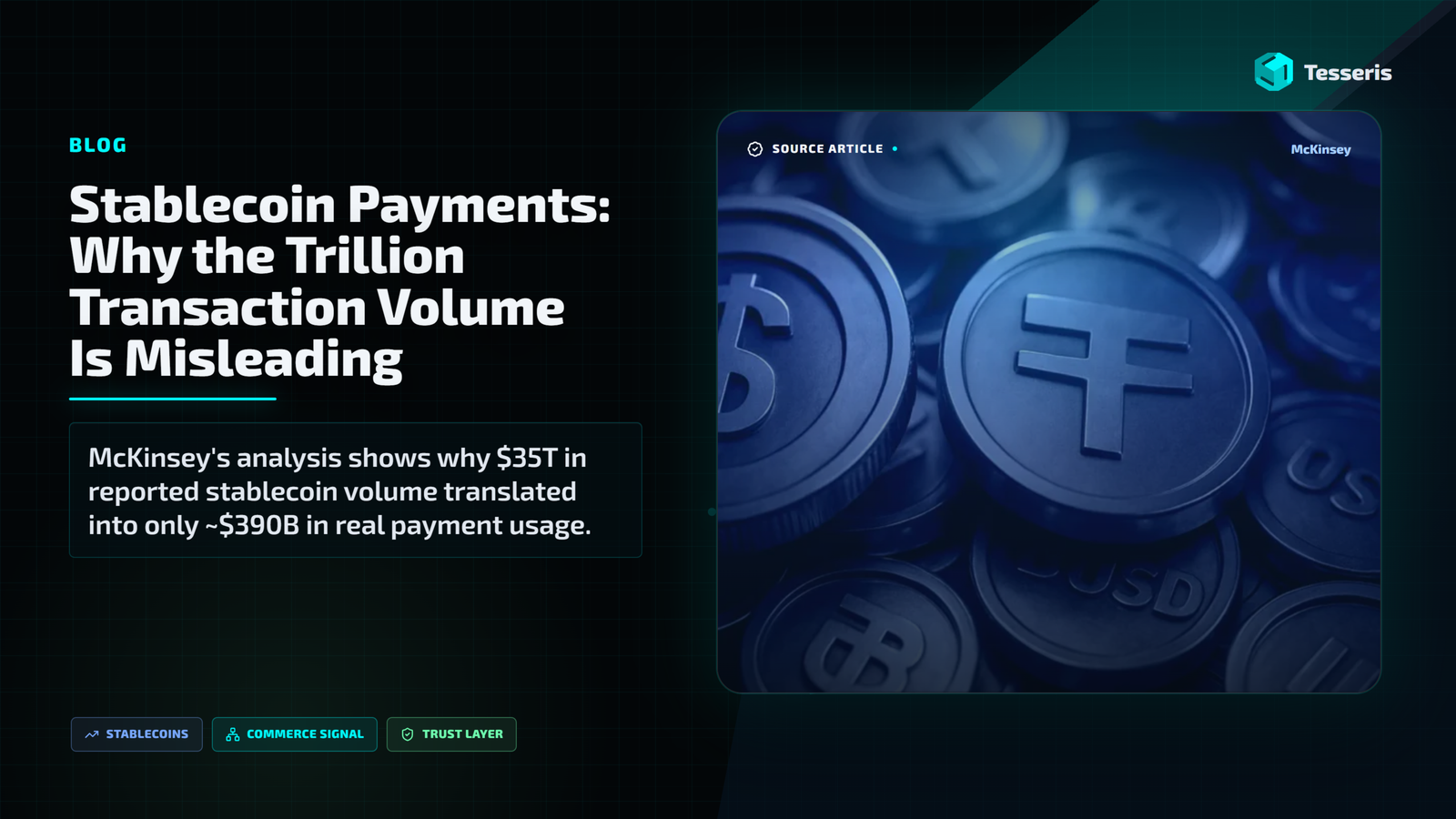
McKinsey estimates only ~$390B of the $35T in annual stablecoin transaction volume represents real payments. Learn what this means for stablecoin adoption, B2B payments, AI-driven commerce, and why trust infrastructure is the next layer of digital finance.
The rapid growth of stablecoin payments has sparked a fundamental debate about the future of global financial infrastructure. For many, the headline number of $35 trillion in annual on-chain transaction volume is proof that stablecoins have already become one of the world's largest payment networks. On the surface, the conclusion appears obvious. If stablecoins process more value than Visa and Mastercard combined, then mainstream adoption must already be here.
According to McKinsey, that conclusion is misleading.
The issue is not that the number is inaccurate. The issue is that it measures the wrong thing. Transaction volume tells us how much value moved across blockchain networks. It does not tell us how much of that movement represented genuine economic activity.
Confusing transaction volume with payment volume has led the industry to overestimate where adoption exists today and underestimate where it is actually emerging. Understanding that distinction is critical not only for evaluating stablecoins, but for understanding how the next generation of digital commerce will evolve.
Transaction Volume Is Not the Same as Payment Volume
Every stablecoin transfer looks identical on a blockchain. Whether a multinational corporation settles an invoice, an employee receives payroll, an exchange moves funds between wallets, a market maker executes arbitrage, or a DeFi protocol rebalances liquidity, each event is recorded as a transfer of digital assets.
The blockchain captures the movement of value with remarkable precision, but it has no understanding of economic intent.
This distinction matters more than most people realize. A payment to a supplier creates economic value because it facilitates commerce. An exchange transferring assets between internal wallets does not. An arbitrage bot moving millions of dollars across markets improves price efficiency, but it does not represent someone buying goods, paying salaries, or settling invoices.
Yet all of these activities contribute equally to headline transaction volume.
As a result, stablecoin transaction volume measures financial activity, not necessarily commercial activity. Treating these two concepts as interchangeable has created one of the biggest misconceptions in digital payments.
McKinsey's Research Changes the Conversation
Recognizing this gap, McKinsey analyzed stablecoin usage by separating genuine payment activity from what it describes as market plumbing: the operational activity required to keep digital asset markets functioning. This includes trading, arbitrage, exchange operations, liquidity management, and other non-commercial transfers that inflate transaction volume without representing real-world payments.
The findings fundamentally reshape the stablecoin narrative.
After removing these operational flows, McKinsey estimates that annual stablecoin payment volume falls from more than 390 billion. At first glance, the adjustment appears dramatic. However, it does not weaken the long-term case for stablecoins. It strengthens it.
Unlike speculative market activity, the remaining payment volume represents businesses settling invoices, employers paying distributed workforces, consumers sending remittances, and institutions moving capital across borders. These transactions reflect genuine economic demand rather than financial market mechanics.
For the first time, they provide a clearer picture of where stablecoins are creating measurable value in the real economy.
The implication is profound. The future of stablecoins should not be measured by how much money moves. It should be measured by how much commerce they enable.
Where Stablecoin Adoption Is Actually Happening
Perhaps the most valuable insight from McKinsey's research is not the reduction in volume. It is where commercial adoption is accelerating.
Of the estimated 226 billion came from B2B payments, making enterprise settlement the largest commercial use case for stablecoins today. Another $90 billion originated from payroll and remittances, while B2B payment volume expanded by an extraordinary 733% year over year.
These numbers reveal a much more important story than the headline $35 trillion ever could.
Stablecoins are not achieving mainstream relevance because traders continue to move capital between exchanges. They are achieving mainstream relevance because businesses increasingly recognize them as superior payment infrastructure.
Global enterprises want faster settlement, lower cross-border costs, always-on availability, and programmable money that can integrate directly into software-driven financial operations. Stablecoins deliver all four.
This represents a fundamental shift in adoption. The strongest signal is not speculative volume. It is enterprise usage. Businesses do not adopt new payment infrastructure because it is technologically interesting. They adopt it because it solves measurable operational problems.
Stablecoins Are Evolving into Global Settlement Infrastructure
Every major financial innovation follows a similar trajectory. It begins by serving financial markets before gradually becoming infrastructure for the broader economy. Electronic payments followed this path. Cloud computing followed this path. Artificial intelligence is following this path today.
Stablecoins are no different.
The conversation is gradually moving beyond digital assets and toward digital payments. Increasingly, stablecoins are being viewed not as investment instruments, but as programmable settlement infrastructure capable of supporting cross-border commerce, treasury management, supply chains, and enterprise payments.
This transition marks the beginning of a much larger opportunity.
The internet has already transformed how information moves around the world. Stablecoins are transforming how value moves.
The next transformation will focus on how commerce itself is coordinated.
The Next Wave of Stablecoin Payments Will Be Machine-to-Machine
Today's payment infrastructure assumes that humans initiate transactions. Tomorrow's infrastructure will increasingly assume the opposite.
AI agents are rapidly evolving beyond assistants that answer questions or automate workflows. They are becoming economic participants capable of negotiating contracts, procuring services, coordinating supply chains, purchasing digital resources, and managing financial operations with minimal human involvement.
As these systems mature, they will increasingly initiate and settle payments autonomously.
Stablecoins are uniquely positioned to support this transition. Their programmability, global accessibility, near-instant settlement, and interoperability make them the natural financial rail for autonomous commerce.
But this evolution introduces a challenge that existing payment infrastructure was never designed to solve.
Sending money has become relatively easy.
Determining whether money should be sent has not.
The Missing Layer Is Trust
Imagine an AI agent hiring another AI agent to generate software, analyze legal documents, execute financial trades, or conduct market research. Before payment is released, several questions must be answered with certainty.
Was the agreed task completed? Did the delivered output satisfy the requested objective? Can execution be independently verified? Is the receiving agent authentic? Has payment already been claimed elsewhere?
Traditional commerce relies on contracts, auditors, intermediaries, and human judgment to answer these questions. Autonomous commerce cannot.
As software becomes an economic participant, trust itself must become programmable. Verification must occur before settlement. Identity must be cryptographically provable. Reputation must become portable. Payment conditions must be enforced automatically rather than interpreted manually after disputes arise.
This represents the next infrastructure challenge for digital commerce.
The bottleneck is no longer transferring value across the internet. The bottleneck is establishing trust before value moves.
The Next Financial Primitive Is Programmable Trust
Stablecoins solved one of the internet's most significant infrastructure problems by making money programmable. The next challenge is making trust programmable.
Just as payment networks abstracted away the complexity of moving money, trust infrastructure will abstract away the complexity of verifying economic activity between autonomous participants. It will establish identity, prove execution, validate outcomes, and enable conditional settlement based on cryptographic evidence rather than assumptions.
This is the missing layer between stablecoin payments and autonomous commerce.
The companies that define the next decade will not simply move money faster. They will enable businesses, software, and AI agents to transact with confidence, knowing that payment follows verified value creation rather than unverified promises.
Building the Trust Infrastructure for the Agent Economy
Stablecoins are rapidly becoming the settlement layer for a digital-first economy. But settlement alone does not create commerce. Commerce requires confidence that obligations have been fulfilled before value changes hands.
At Tesseris, we believe the next evolution of digital payments lies in bridging that gap. As AI agents become buyers, sellers, service providers, and autonomous economic actors, they require infrastructure that establishes verifiable identity, proves that work has been completed through Proof of Task Execution (PoTE), and enables Verify-then-Pay settlement so payments are released only after agreed conditions have been independently verified.
The conversation around stablecoins is shifting from transaction volume to payment volume. The next shift will be even more significant: from payment infrastructure to trust infrastructure.
Stablecoins will move money.
Tesseris ensures money moves only after trust has been established.
Frequently Asked Questions
What are stablecoins?
Stablecoins are digital assets pegged to a stable asset, typically the US dollar. They enable fast, low-cost, and programmable payments, making them ideal for cross-border transfers, B2B payments, and digital commerce.
What are stablecoins primarily used for today?
McKinsey estimates that B2B payments (90B) account for the majority of real-world stablecoin payments. Businesses are increasingly using stablecoins for faster, lower-cost, and programmable settlement.
What are the benefits of using stablecoins for payments?
Stablecoins enable near-instant settlement, lower transaction costs, global accessibility, and programmable payments. These advantages make them increasingly attractive for businesses, financial institutions, and digital commerce.
Why are businesses adopting stablecoins?
Businesses are adopting stablecoins to reduce cross-border payment costs, improve cash flow through faster settlement, and automate financial operations with programmable money. Enterprise adoption is now one of the fastest-growing segments of the stablecoin market.
Are stablecoins replacing traditional payment systems?
Not entirely. Stablecoins are complementing traditional payment rails by offering faster settlement, lower costs, and 24/7 global transfers, particularly for cross-border payments and enterprise settlements.