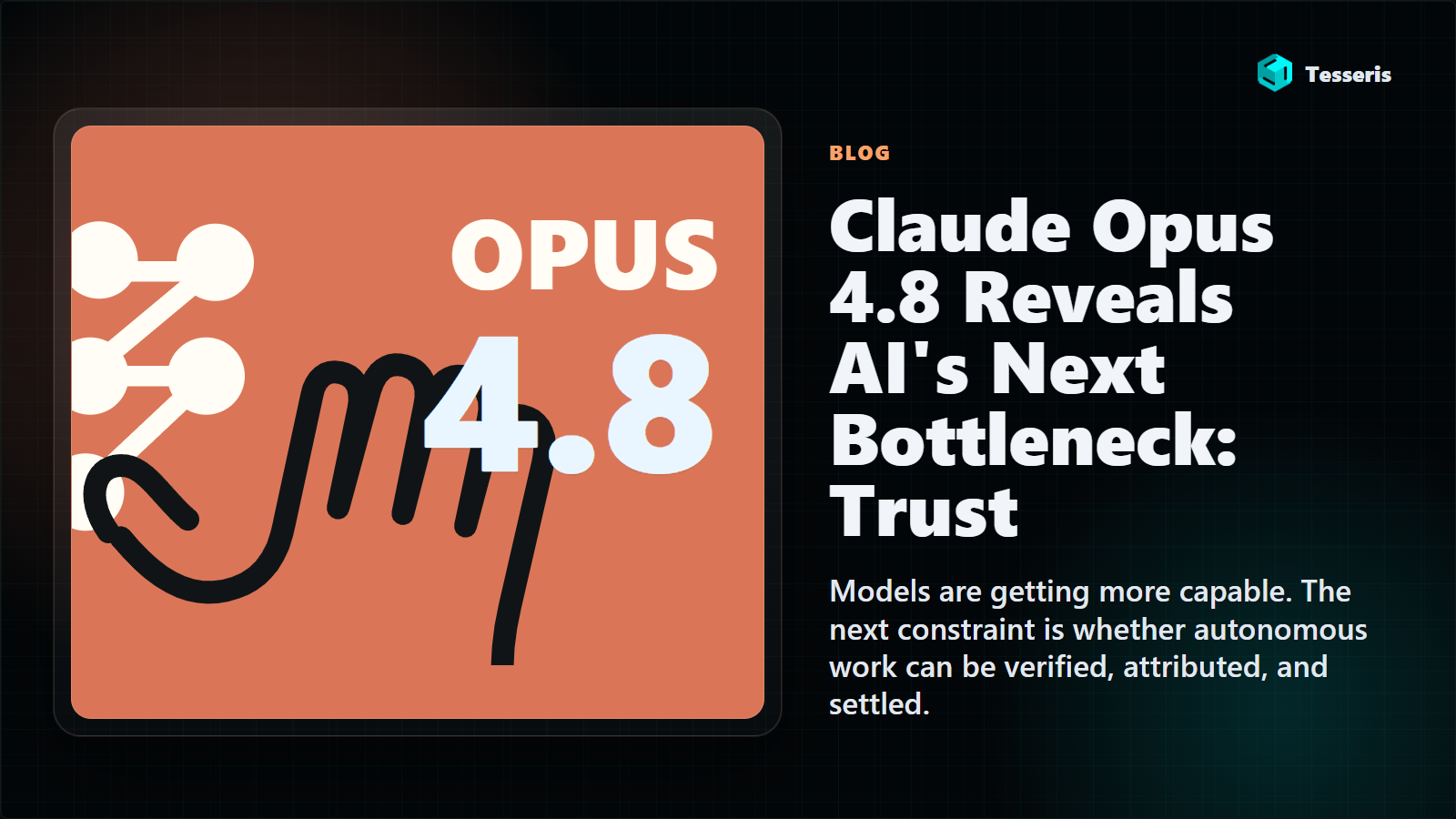
Claude Opus 4.8 Reveals AI's Next Bottleneck: Trust
Anthropic's Claude Opus 4.8 highlights a critical shift in AI: from intelligence to autonomous execution. As AI agents take actions, trust infrastructure becomes the next bottleneck.
How Anthropic's latest model highlights the growing need for trust infrastructure in the agent economy
Anthropic's announcement of Claude Opus 4.8 is widely being interpreted as another milestone in AI model capability. While the performance improvements are noteworthy, the more important signal lies elsewhere.
The announcement reflects a broader shift taking place across the AI industry. AI is no longer limited to generating information. AI increasingly executes tasks, coordinates workflows, interacts with tools, and produces outcomes in the real world.
For years, the industry focused on making AI more intelligent. Models became better at reasoning, coding, planning, and understanding context. That progress continues. However, intelligence is no longer the only challenge that matters.
As AI systems become more autonomous, a different challenge emerges: trust.
Claude Opus 4.8 Signals the Rise of Autonomous AI Agents
To understand why Claude Opus 4.8 matters, it is important to understand the evolution of AI itself.
AI agents are software systems capable of perceiving context, making decisions, interacting with tools, and executing tasks on behalf of users or organizations. Unlike traditional chatbots, AI agents are designed to perform actions rather than simply generate responses.
This evolution is visible across the industry. We move from chatbots that answer questions, to copilots that assist users, to autonomous AI agents that perform work on behalf of users. The objective is no longer to tell people what to do. The objective is to do it.
An AI system that explains how to book a flight is useful. An AI system that books the flight is more valuable. An AI system that coordinates multiple services, completes transactions, manages exceptions, and delivers the intended outcome represents the next stage of that evolution.
Anthropic's Claude Opus 4.8 highlights this transition. The company emphasizes long-horizon execution, dynamic workflows, multi-agent coordination, and extended autonomous operation. These are not characteristics of a traditional chatbot. They are characteristics of autonomous AI agents capable of carrying out increasingly sophisticated tasks with limited human intervention.
The significance extends beyond a single model release.
Claude Opus 4.8 reflects a broader industry transition toward what is increasingly becoming the agent economy.
The agent economy describes an economic environment in which autonomous AI agents perform work, coordinate services, exchange information, make decisions, execute transactions, and participate in commercial activities on behalf of individuals and organizations.
At the center of this transformation is agentic AI.
Agentic AI refers to AI systems that can plan, reason, make decisions, and execute actions with varying degrees of autonomy. The emergence of agentic AI represents a shift from AI as an information tool to AI as an execution layer.
The industry is crossing an important boundary.
AI is no longer defined solely by its ability to generate outputs. It is increasingly measured by its ability to generate outcomes.
The Shift from Intelligence to Execution
Historically, the primary challenge was whether AI could understand, reason, and produce useful responses. Today, the challenge increasingly revolves around whether AI can reliably execute actions in real-world environments.
As AI systems gain autonomy, they begin interacting with business processes, digital services, financial systems, enterprise workflows, and other AI agents. Execution becomes the defining capability.
This shift fundamentally changes the risk landscape.
When AI provides information, mistakes can often be reviewed and corrected by humans. When AI executes actions, the consequences become immediate and measurable. Actions create commitments. Decisions create outcomes. Transactions create obligations.
As autonomous AI agents become more capable, trust becomes a prerequisite for adoption.
The central question is no longer whether AI can act.
The central question is whether AI can be trusted to act.
Why Autonomous Execution Creates a Trust Problem
As AI crosses the boundary from intelligence to execution, the questions that matter begin to change.
If an AI agent negotiates an agreement, who authorized it?
If an AI agent initiates a payment, how is authority verified?
If multiple autonomous agents collaborate on a workflow, how does a counterparty know which agent performed which action?
If an autonomous system makes a decision with economic consequences, where does accountability reside?
These are not intelligence problems.
They are AI trust problems.
The moment AI begins executing actions in the real world, trust becomes a foundational requirement rather than a desirable feature.
This challenge becomes even more significant in multi-agent environments. As autonomous agents increasingly collaborate with one another, trust can no longer rely on assumptions about the behavior of a model. Trust must be established through verifiable systems that allow counterparties to understand who acted, what was authorized, what occurred, and what evidence exists to support those actions.
This emerging disconnect between agent capability and trusted execution creates what we call the Trust Gap.
The Trust Gap is the growing difference between what autonomous AI agents are capable of doing and what individuals, businesses, and institutions can confidently trust them to do.
The rapid progress represented by Claude Opus 4.8 makes this gap increasingly visible.
Why Model Alignment Alone Is Not Enough
Much of the industry's current approach focuses on improving model behavior. Anthropic's emphasis on honesty, uncertainty awareness, and safer operation reflects this effort. These advancements are important and necessary. Better alignment produces more reliable systems and improves trust in AI.
However, AI trust cannot depend solely on behavior.
Human commerce does not function because participants are perfectly trustworthy. It functions because trust is embedded into infrastructure. Identity systems establish who participants are. Contracts define authority and obligations. Audit trails provide evidence. Settlement systems enable the exchange of value. Trust emerges because actions can be verified.
The same principle applies to autonomous AI agents.
Even highly capable and well-aligned agents raise fundamental questions. Can their identity be verified? Can their authority be proven? Can their actions be independently validated? Can counterparties trust the outcome of an interaction without relying on assumptions about the underlying model?
Model alignment improves confidence.
Infrastructure creates trust.
The distinction is critical.
A trustworthy AI ecosystem requires more than intelligent models. It requires systems that make autonomous actions verifiable, accountable, and enforceable.
Trust Infrastructure Is Becoming Critical for the Agent Economy
As the agent economy expands, trust infrastructure becomes increasingly important.
AI trust infrastructure is the collection of systems, protocols, and mechanisms that make autonomous agent actions verifiable, accountable, governable, and trustworthy.
For autonomous agents to participate safely in the agent economy, three capabilities become critical: verifiable identity, verifiable execution, and verifiable settlement.
Verifiable identity establishes who an agent is, who it represents, and what authority it possesses.
Verifiable execution establishes what actions occurred, when they occurred, and whether those actions were authorized.
Verifiable settlement establishes how value, obligations, commitments, and outcomes are exchanged between participants.
Together, these capabilities create the foundation for trusted interactions between autonomous agents, organizations, and individuals.
Trust infrastructure serves a similar role to the institutions and infrastructure that enable modern commerce. It establishes confidence between participants who may never directly know or trust one another.
Without trust infrastructure, autonomous execution remains difficult to scale beyond controlled environments.
With trust infrastructure, autonomous AI agents can operate within systems where actions are transparent, authority is verifiable, outcomes are auditable, and value can be exchanged with confidence.
This becomes increasingly important as agents begin interacting not only with humans, but also with other agents.
The future agent economy depends on trusted interactions between autonomous participants operating across organizations, platforms, and jurisdictions. In such an environment, verification becomes as important as intelligence.
The Next Phase of AI Requires Verifiable Trust
Every advancement in agent capability expands the need for trust infrastructure.
The more decisions agents make, the more important verification becomes.
The more value agents control, the more important accountability becomes.
The more agents interact with one another, the more important trusted coordination becomes.
This is why we believe the next phase of AI is not defined solely by intelligence.
The industry has spent years building increasingly capable AI agents. Today, the challenge is ensuring those agents can operate within systems that are verifiable, accountable, governed, and trusted.
As autonomous AI agents become more capable, the industry's challenge shifts from building intelligence to building trust infrastructure. The future of agentic AI depends not only on what autonomous agents can do, but also on whether their actions can be verified, governed, and trusted by counterparties.
Claude Opus 4.8 provides another signal that this transition is already underway.
The announcement is not simply about better models. It reflects the emergence of autonomous systems that increasingly execute actions rather than generate recommendations.
As this shift accelerates, trust becomes infrastructure.
The future of AI is not determined only by what agents can do. It is determined by whether the people, businesses, and systems interacting with those agents can trust what they do.
Intelligence is becoming abundant.
Trust remains the missing layer.
Frequently Asked Questions
What is an AI agent?
An AI agent is a software system that can perceive context, make decisions, interact with tools, and execute tasks on behalf of a user or organization. Unlike traditional chatbots, AI agents are designed to perform actions rather than simply generate responses.
What is agentic AI?
Agentic AI refers to AI systems capable of planning, reasoning, decision-making, and autonomous execution. Agentic AI represents a shift from AI as an information tool to AI as an execution layer.
What is the agent economy?
The agent economy is an emerging economic environment where autonomous AI agents perform work, coordinate services, exchange information, make decisions, execute transactions, and participate in commercial activities on behalf of individuals and organizations.
Why do autonomous AI agents need trust infrastructure?
Autonomous AI agents need trust infrastructure because execution requires accountability. As agents perform actions with operational and economic consequences, participants need mechanisms for verification, authorization, governance, auditability, and settlement.
What is AI trust infrastructure?
AI trust infrastructure is the collection of systems, protocols, and mechanisms that make autonomous agent actions verifiable, accountable, governable, and trustworthy. It enables trusted interactions between agents, organizations, and individuals.
How does Claude Opus 4.8 relate to AI trust?
Claude Opus 4.8 highlights the industry's shift toward autonomous execution, multi-agent workflows, and long-horizon task completion. As AI systems become more autonomous, the need for AI trust infrastructure increases. The challenge shifts from building intelligence to enabling trusted execution.