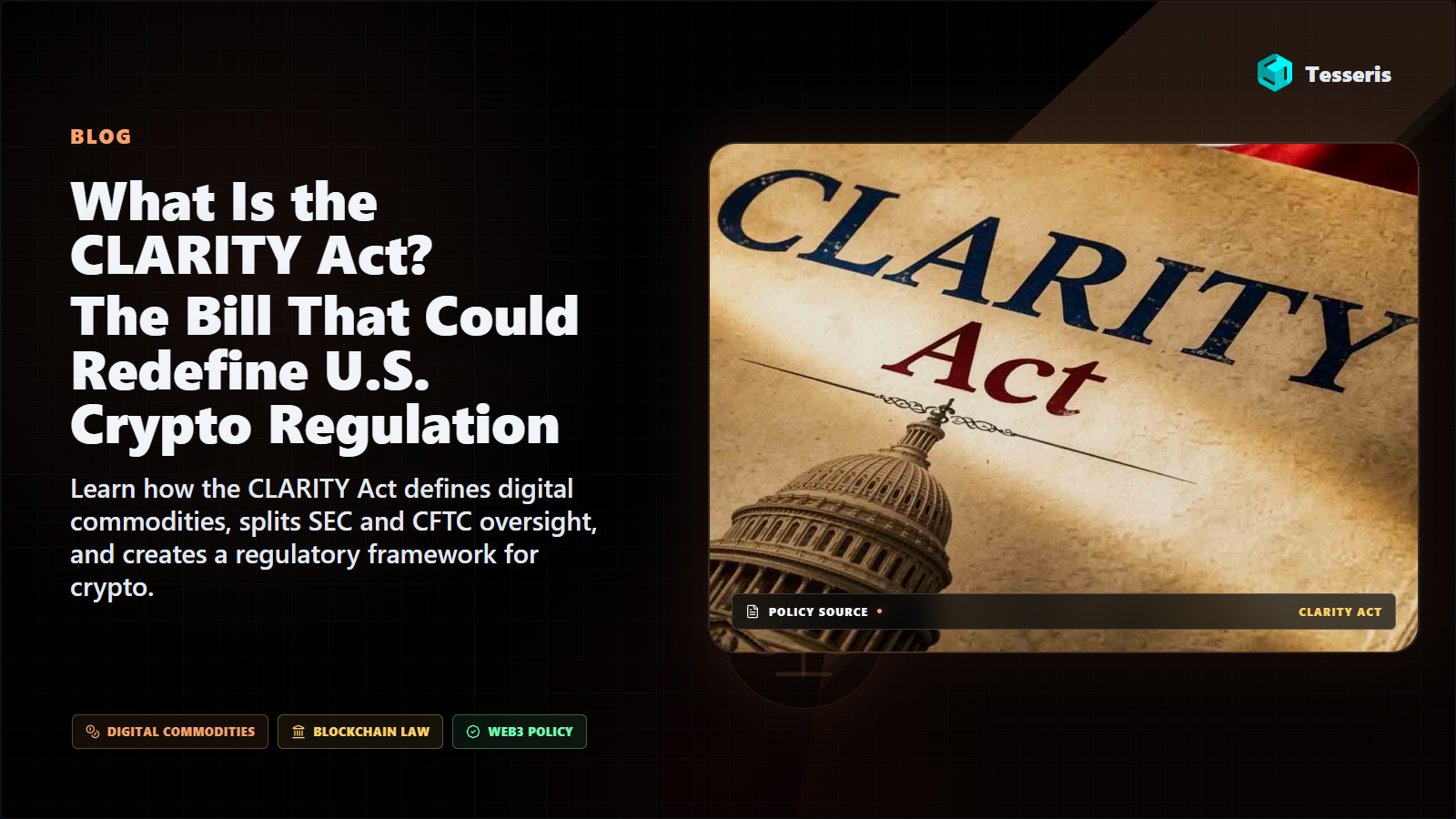
What Is the CLARITY Act? The Bill That Could Redefine U.S. Crypto Regulation
The U.S. finally has a roadmap for regulating digital assets. Here's what the CLARITY Act means for crypto projects, investors, exchanges, and the future of Web3.
The U.S. finally has a roadmap for regulating digital assets. Here's what the CLARITY Act means for crypto projects, investors, exchanges, and the future of Web3.
For years, one question has dominated the crypto industry in the United States:
Is a cryptocurrency a security or a commodity?
The lack of a clear answer has resulted in lawsuits, regulatory uncertainty, delayed innovation, and hesitation from institutional investors. Crypto companies often found themselves navigating overlapping jurisdictions between the SEC and CFTC without a consistent legal framework.
The Digital Asset Market CLARITY Act, also known as the CLARITY Act, is designed to change that.
The bill establishes a comprehensive regulatory framework for digital assets by defining which regulator oversees different parts of the market, creating rules for digital asset issuers and intermediaries, and introducing objective standards for determining when a blockchain network is sufficiently decentralized. Its goal is simple: replace regulation by enforcement with regulation by legislation.
If enacted, the CLARITY Act could become one of the most important pieces of crypto legislation in U.S. history.
Why Was the CLARITY Act Needed?
Despite crypto becoming a trillion-dollar industry, U.S. regulation has remained fragmented.
Projects launching tokens often struggled to determine whether their assets would later be classified as securities. Exchanges faced uncertainty over which assets they could legally list. Developers operated under the constant risk of enforcement actions despite the absence of clear statutory guidance.
This uncertainty created several challenges:
- Slower innovation
- Higher legal and compliance costs
- Reduced institutional participation
- Companies relocating outside the United States
- Conflicting interpretations between regulators
Rather than creating new technology rules, the CLARITY Act aims to establish predictable market structure rules so innovators, investors, and regulators operate under the same framework.
The Core Objective of the CLARITY Act
At its core, the legislation seeks to answer three fundamental questions:
- Who regulates digital assets?
- When does a token stop being treated like a security?
- What compliance requirements apply to crypto businesses?
Instead of treating every digital asset identically, the bill recognizes that blockchain networks evolve over time. A token initially distributed by a project may later become sufficiently decentralized, requiring a different regulatory treatment.
SEC vs. CFTC: Who Regulates What?
One of the biggest contributions of the CLARITY Act is defining regulatory responsibilities.
The SEC continues to regulate digital assets that function as securities, particularly during fundraising and primary issuance.
This generally includes:
- Initial token offerings
- Capital raising activities
- Investor disclosure requirements
- Securities law compliance
Once a qualifying blockchain network reaches sufficient decentralization, eligible digital assets may be regulated primarily as digital commodities, bringing them under the CFTC's oversight.
The CFTC would oversee:
- Digital commodity exchanges
- Brokers
- Dealers
- Spot market regulation
- Trading infrastructure
This division is intended to eliminate years of regulatory ambiguity between the two agencies.
What Is a Digital Commodity?
The bill introduces the concept of a digital commodity.
In simple terms, a digital commodity is a blockchain-based digital asset that satisfies specific legal requirements regarding decentralization or reporting obligations.
Rather than relying solely on how a token was originally issued, the CLARITY Act evaluates the current state of the underlying blockchain network.
This represents a significant shift from static classification toward an evolving regulatory model.
The Importance of Blockchain Maturity
A major concept introduced by the legislation is blockchain maturity.
Instead of assuming every blockchain remains under centralized control forever, the bill recognizes that networks can gradually become decentralized.
A mature blockchain generally exhibits characteristics such as:
- No single controlling entity
- Distributed governance
- Broad validator participation
- Independent network operation
- Open participation
When these conditions are met, qualifying digital assets may transition into digital commodities rather than remaining securities indefinitely.
What Changes for Crypto Projects?
For blockchain builders, the CLARITY Act creates a more predictable regulatory pathway.
Projects launching new networks would receive greater clarity regarding:
- Disclosure obligations
- Fundraising requirements
- Compliance expectations
- Transition toward decentralization
- Long-term regulatory treatment
Instead of operating in legal uncertainty, founders gain a roadmap for progressing from token issuance to decentralized network operation.
What Changes for Crypto Exchanges?
Crypto exchanges, brokers, and dealers would receive a formal regulatory framework.
The legislation introduces requirements around:
- Registration
- Customer asset protection
- Recordkeeping
- Market surveillance
- Operational compliance
Many of these intermediaries would also become subject to Bank Secrecy Act obligations, including anti-money laundering and compliance requirements.
What Does the CLARITY Act Mean for Investors?
For investors, regulatory certainty often matters more than regulatory leniency.
Clear rules can help:
- Improve investor confidence
- Reduce legal uncertainty
- Encourage institutional participation
- Improve market transparency
- Create more predictable digital asset markets
While the Act does not eliminate investment risk, it aims to reduce regulatory uncertainty, which has historically been one of the largest risks facing the crypto industry.
Potential Benefits of the CLARITY Act
If implemented successfully, the legislation could reshape the U.S. digital asset ecosystem.
Potential benefits include:
- Clear regulatory responsibilities
- Reduced jurisdictional conflicts
- More predictable compliance standards
- Greater institutional adoption
- Increased investment in blockchain innovation
- Stronger consumer protections
- Improved market transparency
- Long-term regulatory certainty
For many industry participants, clarity itself becomes an innovation catalyst.
Challenges and Criticism
Like any major financial legislation, the CLARITY Act has attracted criticism.
Some policymakers and experts argue that:
- Certain decentralization standards may prove difficult to measure consistently.
- The balance of authority between the SEC and CFTC could still create gray areas.
- Some provisions may not fully address emerging sectors such as DeFi or rapidly evolving tokenized financial products.
- Consumer protection and financial stability safeguards may require further refinement as the market evolves.
These debates are common for legislation governing fast-moving technologies. Even if amendments occur over time, the Act represents a significant shift toward a dedicated legal framework for digital assets.
Why the CLARITY Act Matters Beyond the United States
The United States remains one of the world's largest financial markets.
A comprehensive crypto regulatory framework could influence:
- Global blockchain regulation
- Institutional adoption
- Venture capital investment
- Cross-border digital asset markets
- International policy development
Many jurisdictions have already introduced crypto-specific regulations. The CLARITY Act represents the United States' effort to establish a comparable market structure framework while balancing innovation and investor protection.
Final Thoughts
For over a decade, crypto has grown faster than the laws designed to govern it.
The CLARITY Act represents an effort to close that gap by defining how digital assets are regulated, clarifying the roles of the SEC and CFTC, and establishing objective rules for blockchain-based markets.
Whether every provision remains unchanged or evolves during the legislative process, the broader direction is clear: the crypto industry is moving from regulatory uncertainty toward structured oversight.
For developers, investors, exchanges, institutions, and policymakers, that shift could prove as important as the technology itself.
Call to Action
The future of crypto depends on more than innovation. It depends on trust, regulation, and infrastructure.
At Tesseris, we're building the trust infrastructure for the agent economy, enabling verifiable identity, execution, and settlement for autonomous AI agents. As regulatory frameworks like the CLARITY Act mature, trust-native infrastructure will become increasingly critical for compliant, scalable, and autonomous digital ecosystems.
Explore how Tesseris is building the foundation for trusted agentic commerce.
Frequently Asked Questions
What is the CLARITY Act?
The Digital Asset Market CLARITY Act is proposed U.S. legislation that establishes a regulatory framework for digital assets by defining how cryptocurrencies, blockchain networks, exchanges, and other market participants are regulated.
What does CLARITY stand for?
CLARITY refers to the Digital Asset Market CLARITY Act, legislation intended to provide legal clarity for digital asset markets in the United States.
What problem does the CLARITY Act solve?
The Act addresses regulatory uncertainty by clarifying the roles of the SEC and CFTC, defining digital commodities, and creating a predictable framework for blockchain projects and crypto businesses.
How does the CLARITY Act distinguish between securities and commodities?
The legislation recognizes that some blockchain-based assets may transition from securities-related fundraising into digital commodities once statutory criteria, including decentralization or reporting requirements, are met.
Who regulates digital commodities under the CLARITY Act?
The Commodity Futures Trading Commission would generally oversee digital commodities and related exchanges, brokers, and dealers, while the SEC retains authority over securities-related activities.
What is a digital commodity?
A digital commodity is a blockchain-based digital asset that satisfies the legal requirements established under the Act, allowing it to fall primarily under CFTC oversight.
What is a mature blockchain under the CLARITY Act?
A mature blockchain is one that meets statutory standards for decentralization or other qualifying conditions defined in the legislation, enabling eligible digital assets to be treated as digital commodities.
Does the CLARITY Act regulate crypto exchanges?
Yes. The Act establishes registration, compliance, customer protection, recordkeeping, and operational requirements for digital asset exchanges, brokers, and dealers.
Does the CLARITY Act include AML requirements?
Yes. Covered digital commodity intermediaries would generally be subject to Bank Secrecy Act obligations, including anti-money laundering compliance.
Is the CLARITY Act already law?
As of July 9, 2026, the bill has progressed through the U.S. legislative process but has not completed all steps required to become law. Its final form may change before enactment.
How could the CLARITY Act affect institutional crypto adoption?
Greater regulatory clarity may encourage more financial institutions, asset managers, and enterprises to participate in digital asset markets by reducing legal uncertainty.
Why is the CLARITY Act important for Web3?
Web3 applications rely on blockchain infrastructure, tokenized assets, and decentralized networks. A clear regulatory framework can provide greater certainty for builders, users, investors, and institutions operating in this ecosystem.