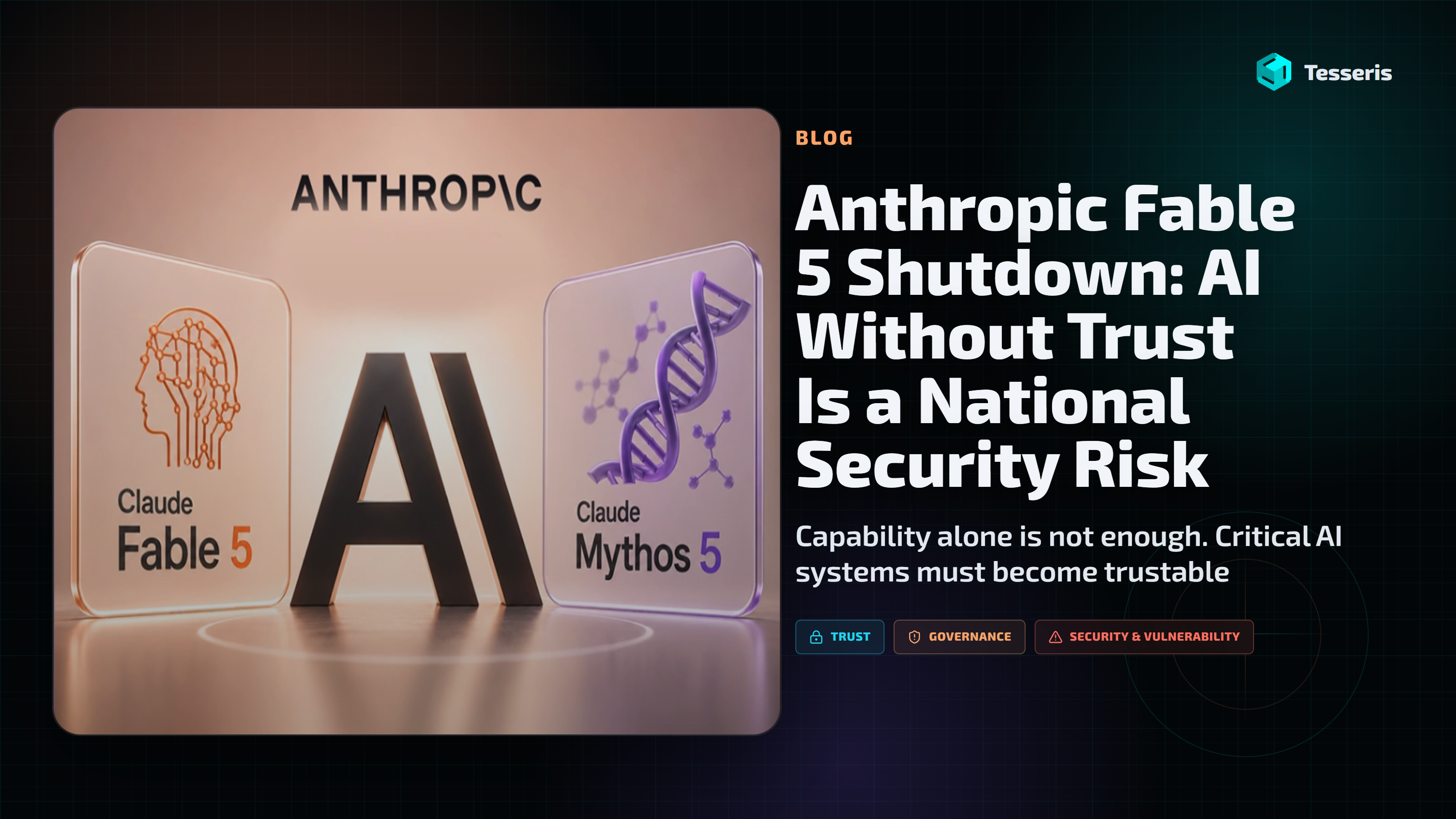
Anthropic's Fable 5 Shutdown: AI Without Trust Is a National Security Risk
Anthropic's Fable 5 shutdown signals a shift from AI capability to AI trust. As frontier systems become strategic infrastructure, verifiable identity, execution, and settlement become national security requirements.
The AI industry received an important signal this month.
Following a U.S. government directive, Anthropic suspended access to its most advanced models - Fable 5 and Mythos 5 - for foreign nationals worldwide.
At first glance, the story appears straightforward. Another regulatory action. Another development in the global race for AI leadership. Another example of governments attempting to control the flow of increasingly powerful technology.
But that interpretation misses what makes this event significant.
The real story is not that access was restricted.
The real story is why.
For years, AI models were treated as software products. Powerful software products, but software products nonetheless. They were distributed globally, integrated into businesses, and adopted by millions of users with relatively few questions about national security implications.
That assumption is now changing.
When governments begin restricting access to frontier AI systems, they are sending a clear message: advanced AI is no longer viewed as just software. It is increasingly viewed as strategic infrastructure.
And strategic infrastructure requires trust.
The Shift Nobody Is Talking About
The AI conversation has largely focused on intelligence.
Which model reasons better?
Which model writes better code?
Which model achieves the highest benchmark scores?
The industry has become obsessed with capability. But capability is no longer the biggest challenge.
Trust is.
As AI systems evolve from assistants into autonomous agents, the stakes change dramatically. An AI chatbot generating an incorrect answer is frustrating. But an autonomous AI agent executing a financial transaction, managing cloud infrastructure, conducting cybersecurity operations, or negotiating contracts is something entirely different.
At that point, the question is no longer whether the system is intelligent. The real question is whether it can be trusted.
Can its actions be verified?
Can its decisions be audited?
Can its behavior be controlled?
Can responsibility be assigned when something goes wrong?
These questions are becoming increasingly difficult to ignore.
The Emerging Trust Gap
The more capable AI becomes, the larger the trust gap grows.
Today's AI systems can perform tasks that would have seemed impossible only a few years ago. They can write production-ready software, analyze vast amounts of data, coordinate workflows, and increasingly act on behalf of users.
Yet most systems still operate as black boxes.
They produce outcomes, but often provide limited guarantees.
They take actions, but offer little transparency into execution.
They complete tasks, but provide limited mechanisms for independent verification.
This creates a fundamental contradiction.
Society is being asked to trust systems that are becoming increasingly autonomous while having limited ways to verify their behavior. That contradiction cannot persist forever. History suggests that every major technological revolution eventually encounters a trust barrier.
The internet required cybersecurity.
Digital commerce required payment networks.
Cloud computing required identity and access management.
AI is approaching its own trust moment.
Why This Matters for the Agent Economy
This challenge becomes even more important as autonomous AI agents begin interacting with each other. The future will not consist of isolated AI models responding to prompts. It will consist of millions of autonomous agents communicating, collaborating, negotiating, and transacting across digital economies.
Agents will purchase services from other agents.
Agents will execute tasks on behalf of enterprises.
Agents will manage workflows involving money, data, and critical business operations.
In that world, trust becomes foundational infrastructure.
Without trusted identity, anyone can impersonate an agent.
Without trusted execution, no one can verify that work was actually completed.
Without trusted settlement, autonomous commerce cannot scale safely.
The Agent Economy cannot operate on assumptions.
It must operate on proof.
Building the Infrastructure for Trust
This is the challenge Tesseris was built to address.
While much of the industry is focused on making AI systems smarter, we believe an equally important challenge lies ahead: making autonomous systems trustworthy.
As AI agents become participants in the global economy, they will require mechanisms for verifiable identity, verifiable execution, and verifiable settlement.
Not because regulators demand it.
Not because enterprises prefer it.
But because autonomous economies cannot function without it.
Trust must become a native feature of AI infrastructure rather than an afterthought layered on top.
The Decade Ahead
The suspension of Fable 5 may ultimately be remembered as more than a regulatory event. It may be remembered as an early signal that the world had begun confronting a deeper question.
What happens when AI becomes powerful enough to act independently? The answer is unlikely to be found in larger models or better benchmarks. It will be found in the systems that make autonomy safe, accountable, and verifiable.
Over the next decade, AI will become more intelligent than it is today. That outcome appears increasingly inevitable.
Whether it becomes trustworthy remains an open question.
And that may prove to be the most important question of all.
Because the future of AI will not be determined solely by what autonomous systems can do. It will be determined by whether humanity can trust them enough to let them do it.
The future of AI depends on trust.
Discover how Tesseris is building the trust infrastructure for the Agent Economy through verifiable identity, execution, and settlement - enabling autonomous agents to operate safely, transparently, and at scale.