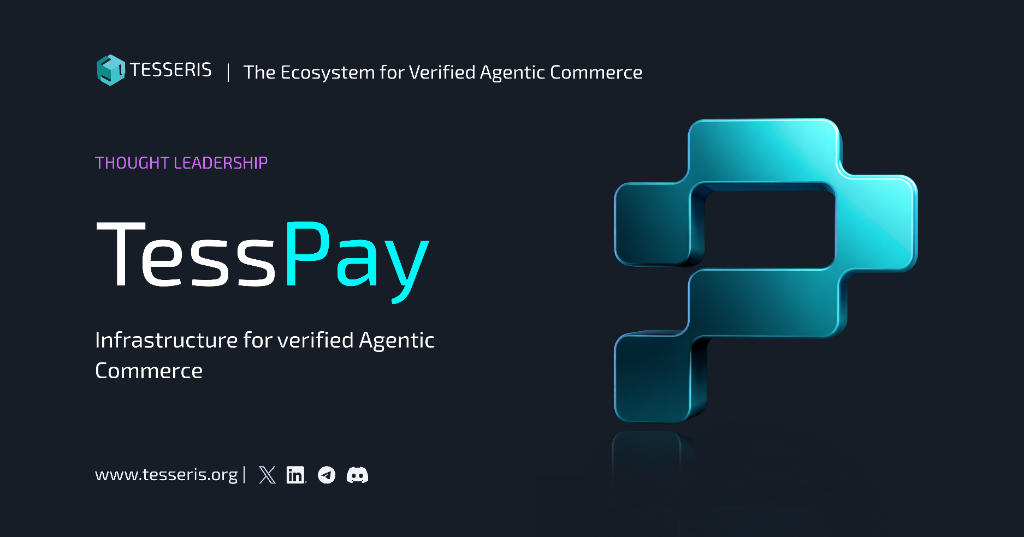
TessPay: The Verify-then-Pay Payment Layer for Trusted Agentic Commerce
TessPay flips the trust model of agentic commerce from assumption to verification, ensuring payments are only released when execution is provably completed.
Agentic commerce has a trust problem.
Not because AI agents can’t execute tasks, but because no one can prove what was executed, verify that it met expectations, or audit how value actually flowed afterward. In practice, this gap is the single biggest reason adoption of agent-driven services remains far below its potential.
Today, service providers are asked to expose powerful agents without any native guarantee that they will be paid only for verified execution. Merchants are expected to trust black-box workflows where payments are triggered before outcomes are validated, and where post-transaction disputes are resolved manually, if at all. The result is predictable: friction, hesitation, and stalled adoption.
Most payment systems still follow a pay-then-hope model.
You pay first. You trust logs later. You reconcile after the fact. That model works when humans are in the loop. It fails completely when autonomous agents are transacting at machine speed.
This is where TessPay fundamentally changes the equation.
Later update: For the proposed architecture and technical details, read the TessPay research paper in Tesseris Research.
TessPay is built on a Verify-then-Pay principle. Payments are not released because a request was made, but because execution was provably completed. Agent actions are validated against predefined criteria, execution evidence is captured, and only then is settlement triggered. This flips the trust model from assumption to verification.
For service providers, this removes the biggest barrier to participation: payment risk. They no longer need to rely on off-chain logs, platform trust, or manual dispute resolution to prove that their agents delivered value. Every unit of execution is verifiable, every payment is justified, and monetization becomes enforceable by design.
For merchants, Verify-then-Pay eliminates blind spend. Payments are no longer detached from outcomes. They are directly tied to what the agent actually did, not what it claimed to do. This enables confident experimentation with agentic workflows, knowing that cost is aligned with verified execution rather than promises.
But verification alone is not enough. Without auditability, trust still degrades over time.
TessPay introduces end-to-end auditability and traceability across the entire payment lifecycle. Every transaction is linked to execution proofs, workflow context, and settlement logic, creating a transparent and inspectable trail of value flow. This is not just about compliance — it is about operational clarity.
Service providers gain a defensible record of performance. Merchants gain full visibility into where money went, why it moved, and what outcome it produced. Ecosystem partners can reason about costs, margins, and incentives without relying on opaque intermediaries or manual reconciliation.
The absence of these primitives today is quietly killing adoption. Enterprises hesitate. Platforms restrict scope. Service providers limit exposure. Not because agentic commerce lacks potential, but because its economic layer is not trustworthy by default.
TessPay fixes that at the root.
By combining Verify-then-Pay with native auditability, TessPay turns payments from a leap of faith into a deterministic outcome. It creates an environment where agents can transact autonomously without eroding trust, where value exchange is provable, and where scale does not introduce opacity.
Agentic commerce does not fail because agents are unreliable. It fails when payments are. TessPay ensures they aren’t.