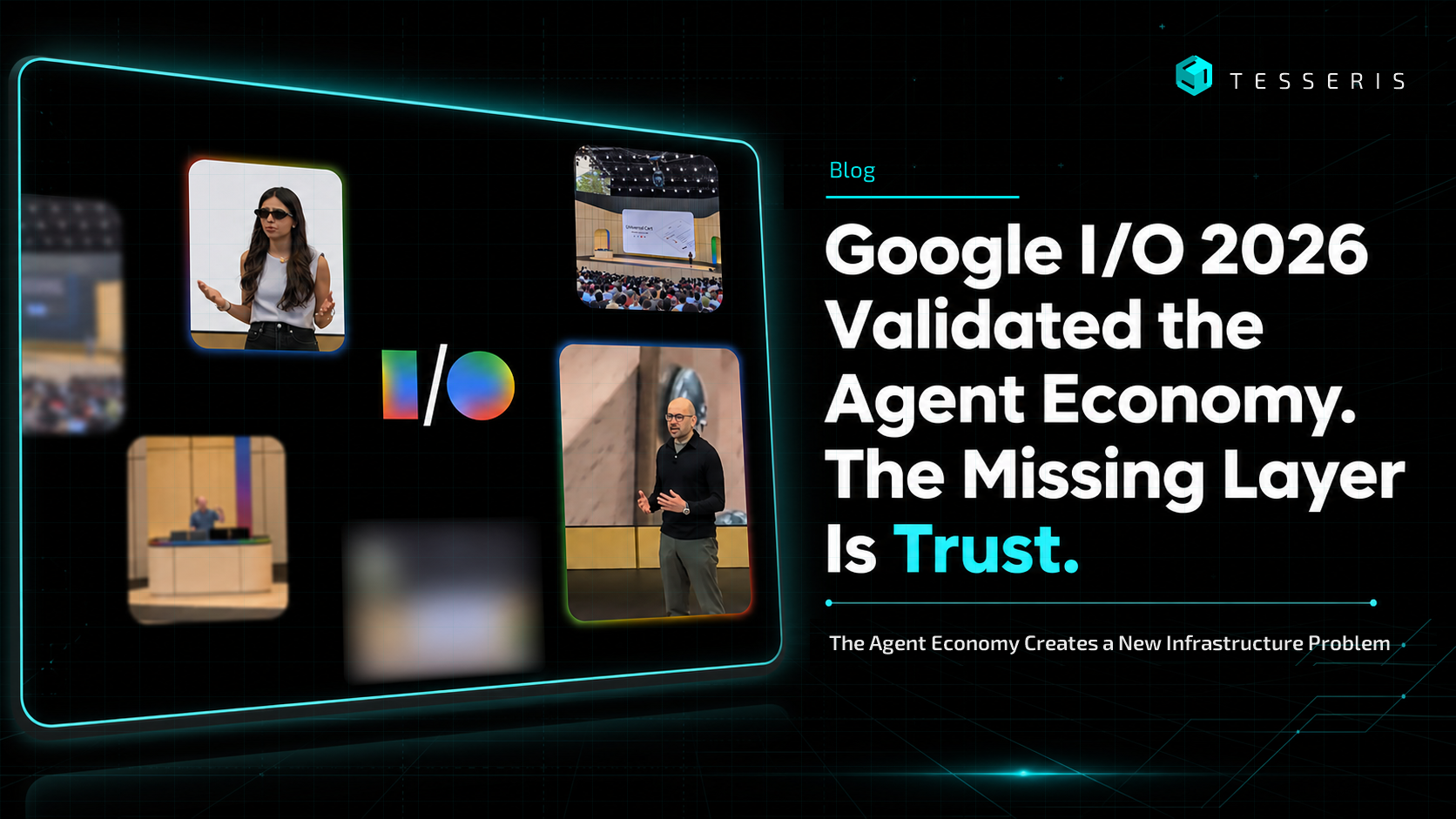
Google I/O 2026 Validated the Agent Economy. The Missing Layer Is Trust.
Google I/O 2026 showed AI systems moving from assistance to execution. The agent economy is arriving, but trusted execution still needs programmable infrastructure.
Google I/O 2026 was presented as an AI event. In reality, it may be remembered as something more consequential: the moment one of the world's largest technology companies publicly validated the transition from AI assistance to AI execution.
The headlines focused on Gemini upgrades, AI-native Search, persistent assistants, and multimodal experiences. Yet the deeper story sat beneath the demos.
Google did not simply unveil smarter AI. It showcased software beginning to act. This distinction matters because it changes the role of artificial intelligence itself.
For years, AI systems operated primarily as copilots. They helped users write emails, summarize documents, retrieve information, generate code, and accelerate decisions. Human users remained responsible for authority and action. AI assisted, but humans executed.
Google I/O suggested that this boundary is beginning to dissolve.
Across Search, Gemini, commerce, and developer tooling, Google revealed an increasingly consistent direction of travel. AI systems are moving beyond conversation and toward execution. Search is becoming goal-oriented rather than query-oriented. Assistants are becoming persistent rather than reactive. Shopping experiences are becoming transactional rather than merely recommendational.
This is not simply product evolution.
It is the emergence of the agent economy.
Google I/O Was About Agency, Not Just Intelligence
Much of the post-I/O conversation framed the event as another milestone in the AI model race. Which system is more capable? Which company leads frontier intelligence? Which assistant reasons more effectively?
Those questions matter, but they miss the larger market signal. Google was not merely competing on intelligence. It was normalizing agency. Consider what was announced.
AI-powered Search increasingly moves beyond retrieving links and toward completing outcomes. Gemini and persistent AI assistants maintain context and coordinate workflows across environments. Universal Cart and commerce experiences hint at AI systems participating directly in purchasing and transactional flows. Developer tooling is increasingly oriented around building AI agents capable of orchestrating actions rather than simply generating outputs.
Individually, these may appear as feature upgrades. Collectively, they reveal a shift in software architecture. The browser era optimized for discovery. The emerging AI agent era optimizes for execution. That shift is more than technical. It is economic.
When AI Agents Execute, Commerce Changes
The difference between an AI assistant and an AI agent is not semantic. It is operational. A conversational assistant helps users make decisions. An autonomous AI agent increasingly acts toward outcomes. That distinction changes everything. The moment AI agents begin managing subscriptions, coordinating vendors, comparing suppliers, negotiating purchases, or executing transactions, software moves beyond productivity and into economic participation.
This is the foundation of agentic commerce. Agentic commerce refers to an emerging model of AI commerce where autonomous AI agents increasingly discover, negotiate, coordinate, and transact on behalf of users or organizations. The implications are difficult to overstate.
Friction declines. Decision cycles compress. Transactions become increasingly personalized and automated. But commerce introduces requirements that traditional software never had to solve. Commerce is not merely information exchange. Commerce is commitment. And commitments depend on trust. This is where the significance of Google I/O becomes much larger than product announcements. Because once AI agents move into execution, intelligence alone becomes insufficient.
The Infrastructure Problem Beneath the AI Boom
One of the defining misconceptions of the current AI cycle is the assumption that intelligence and trust are interchangeable. They are not. A model may reason effectively. Autonomous AI agents may complete increasingly sophisticated workflows. Yet neither capability guarantees verified identity, authorized execution, accountable permissions, or secure settlement.
Intelligence describes capability. Trust describes assurance. The distinction is foundational. The moment AI agents participate inside economic systems, entirely new questions emerge. Which AI agent initiated an action? Was authority verified? Did execution occur within approved permissions? Can outcomes be audited? How are autonomous transactions governed? Who becomes accountable when AI agents transact with one another?
These are not model questions. They are infrastructure questions. And infrastructure questions have historically shaped technology markets. The internet required communication protocols and encryption. Digital commerce required payment rails and settlement systems. Cloud computing required identity and access infrastructure.
The agent economy will require trust infrastructure. Without it, autonomous execution remains powerful but economically fragile. This is precisely why Google's announcements around provenance and authenticity deserve attention beyond media verification alone. The industry is beginning to recognize a broader truth: execution without trust does not scale. The more autonomous AI becomes, the more urgent machine trust becomes.
The Missing Layer Between AI and Commerce
This is the infrastructure challenge that Google I/O indirectly exposed. AI agents are moving beyond conversation. Search is becoming delegated execution. Software is becoming increasingly autonomous. Commerce is becoming agent-mediated. Yet one critical layer remains unfinished.
Trust.
Not trust as policy. Not trust as marketing language. Trust as infrastructure.
The emerging agent economy requires a programmable trust layer capable of enabling verified identity, verified execution, programmable permissions, accountable interaction, and secure settlement between autonomous systems. This is not an application problem. It is an infrastructure problem.
Just as the internet required communication protocols and digital commerce required financial rails, the agent economy requires economic rails for trusted execution.
This is the infrastructure category Tesseris is building toward. Tesseris was founded around a premise that is becoming increasingly difficult to ignore: AI agents will not remain confined to communication and assistance. They will transact, coordinate, and increasingly participate inside economic systems. And once autonomous systems transact, trust cannot remain assumed. It must become programmable.
This is why Tesseris focuses on programmable trust and trust infrastructure for agentic commerce. The objective is not merely to support smarter AI systems, but to enable verified execution, accountable interaction, and secure settlement between autonomous actors operating at machine speed.
The future of AI does not require only intelligence.
It requires trusted execution.
Google Validated the Destination. The Infrastructure Race Starts Now.
Google I/O 2026 validated something important. The question is no longer whether AI agents will act. Increasingly, they already do. The more consequential question is whether their actions can be trusted at economic scale.
That challenge extends beyond model performance or interface design. It reaches into the foundations of how autonomous systems participate in commerce itself. The next generation of AI companies will not be defined solely by who builds the smartest models. They will be defined by who builds the infrastructure that makes autonomous execution trustworthy.
Google validated the future of agentic commerce.
What remains unfinished is the trust layer beneath it.
AI agents are moving into execution. The infrastructure for trusted execution comes next.
That is the future Tesseris is building for.