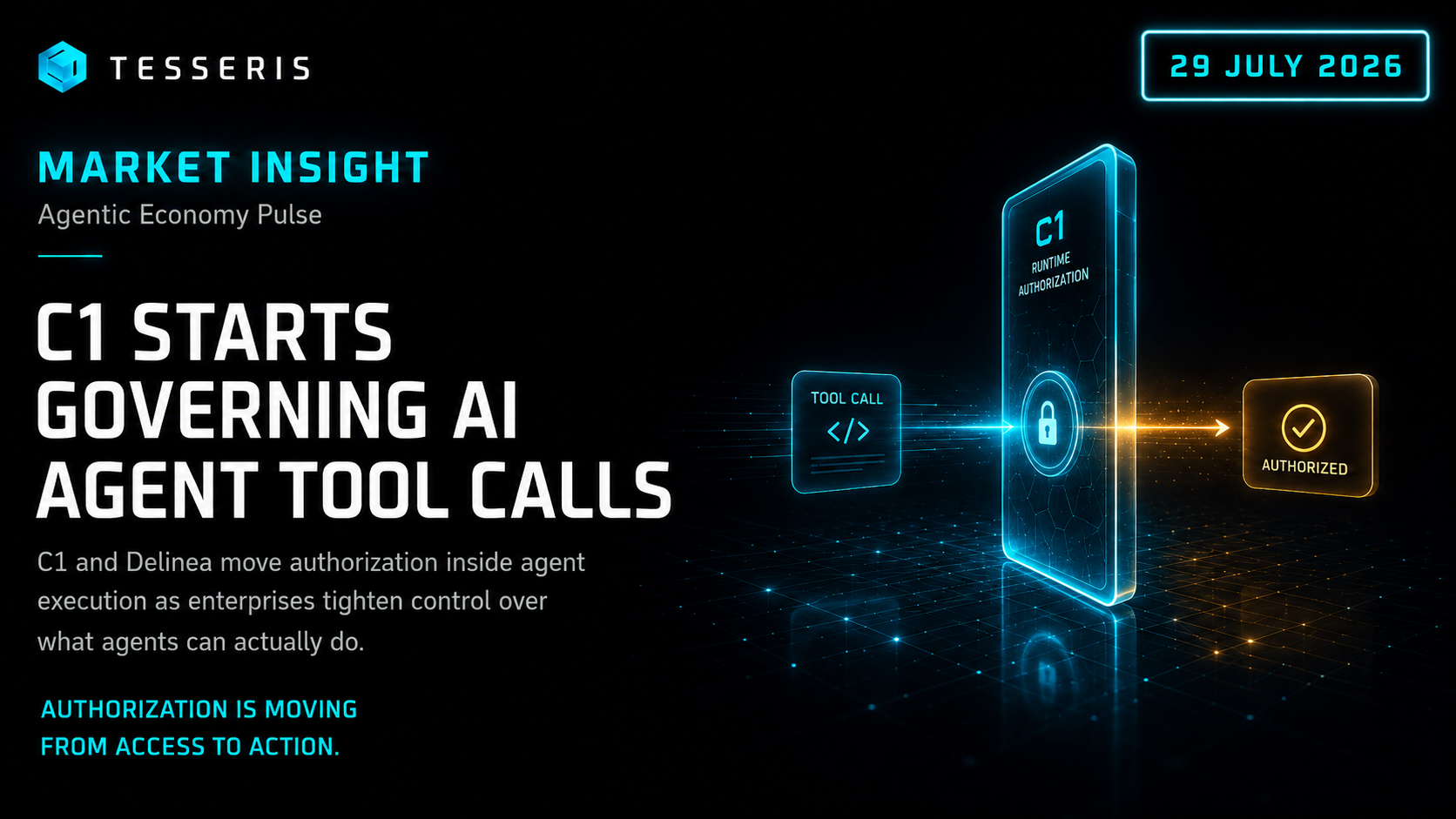
C1 Starts Governing AI Agent Tool Calls in Real Time
C1 and Delinea move authorization inside agent execution as Google expands enterprise agent controls and Okta finds fewer than half of security leaders can govern what their agents actually do.
Today in 90 Seconds
-
C1 now evaluates every agent tool call before it runs, with options to allow, block, hold or redact.
-
Delinea launched action level authorization across MCP, databases, SSH, Kubernetes and cloud environments.
-
Google expanded Gemini Enterprise Agent Platform, including Agent Identity, Gateway, Registry, memory and long running agent infrastructure.
-
Only 45 percent of surveyed security leaders say they can authorize what individual agents do.
-
GoKwik and PayU brought multi brand shopping into ChatGPT, connecting product discovery directly to checkout and payment.
The Signal
Authorization Is Moving Inside the Agent Runtime
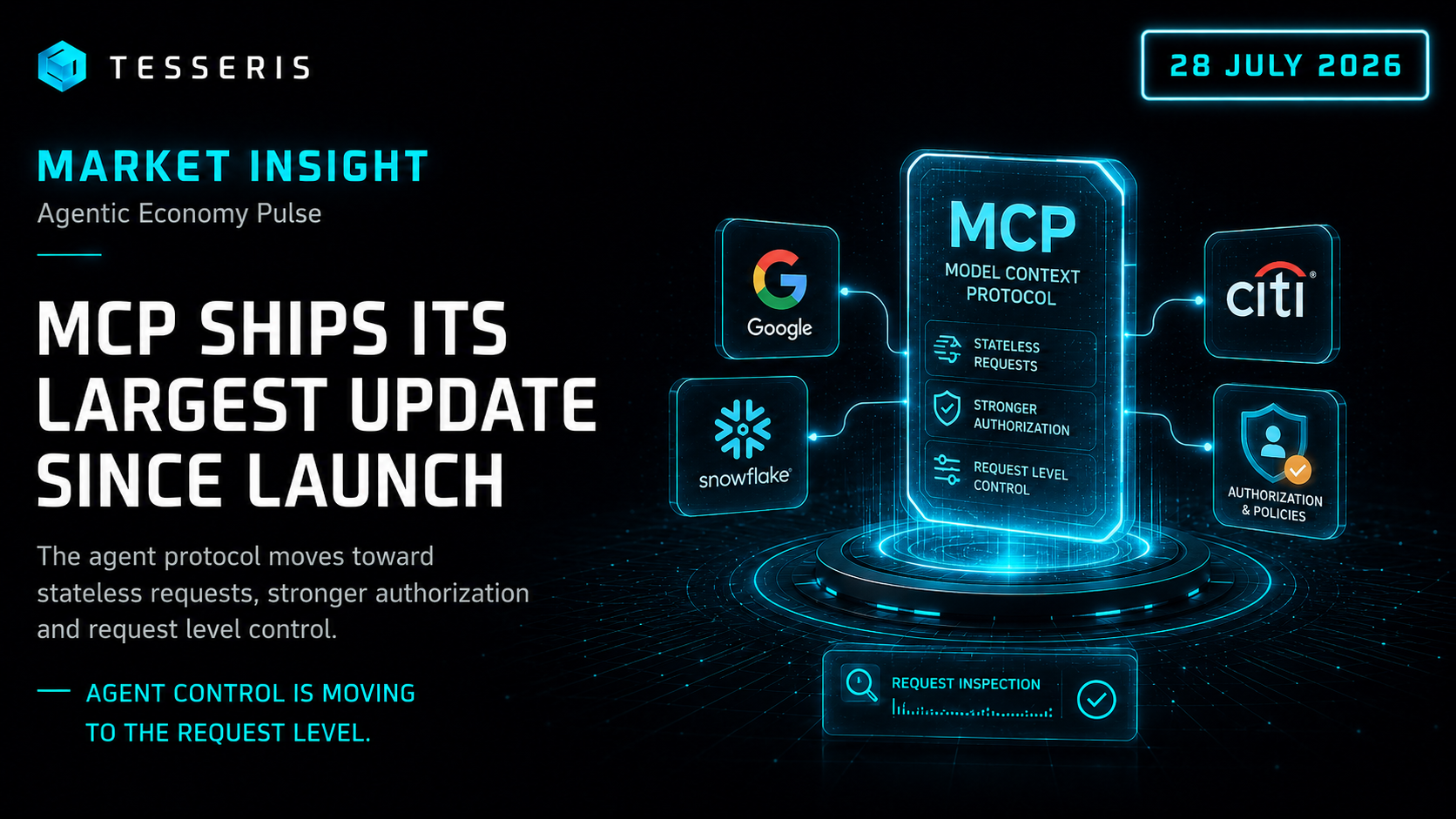
July 28 made individual agent requests easier to identify and govern through the new MCP architecture.
July 29 moves enforcement one step deeper.
C1 launched runtime governance that evaluates each agent tool call against policy before execution. The system can block the call, require human approval or remove sensitive information from the response. Delinea independently launched runtime authorization that evaluates individual tool calls, database queries and commands after an agent has already connected to a system.
This is an important transition.
Traditional access control asks whether an identity may enter a system.
Agentic access control increasingly needs to ask:
Is this particular action permitted, for this task, at this moment, under this authority?
The control boundary is moving from connection time to action time.
Tesseris Read
An authenticated agent can still perform an unauthorized action.
That distinction becomes critical when one session may contain dozens of tool calls with very different consequences.
Runtime authorization is therefore beginning to connect identity with intent and action. But a complete trust chain must also preserve whose authority the agent represents and why the action was permitted.
The accountable sequence becomes:
principal → mandate → agent → tool request → authorization decision → execution → evidence → outcome
Identity establishes which actor is present.
Runtime policy determines whether an action may proceed.
The missing layer is durable proof that the resulting execution remained inside the authority originally delegated to the agent.
1. C1 Puts Policy in Front of Every Agent Tool Call
Source: C1 runtime governance announcement
C1 launched intent based access control for AI agents on July 29.
Every tool call passes through an identity aware gateway. Agents receive access only to tools required for their assigned job, while each request remains linked to the agent, its owner and the policy authorizing the action.
C1 also evaluates contextual risk before execution. Depending on that assessment, the system can block a request, hold it for human approval or redact sensitive information from the result. If the policy check itself fails, C1 says the system becomes more restrictive rather than allowing the action automatically.
The important shift is from governing which tools an agent can reach to governing what the agent is trying to do with them.
2. Delinea Moves Authorization Beyond the Login
Source: Delinea runtime authorization announcement
Delinea released runtime authorization for agents operating across MCP servers, databases, SSH hosts, Kubernetes environments and cloud consoles.
Instead of treating an approved connection as permission for everything that follows, Delinea evaluates individual actions inside the session. Each can be allowed, blocked or escalated to a human before execution.
The platform also records individual tool calls, queries and commands against a named identity so activity can be reconstructed afterward.
C1 and Delinea arriving at similar architectures on the same day is notable.
The security market is beginning to converge on a principle that ordinary access systems were not designed around:
an agent may remain authenticated while its next action becomes unacceptable.
3. Google Expands the Full Production Agent Stack
Source: Google Gemini Enterprise Agent Platform update
Google expanded Gemini Enterprise Agent Platform on July 29 with broader availability across the agent lifecycle.
Agent Runtime can support asynchronous processes lasting as long as seven days. Agent Memory Bank preserves structured context across extended workflows. Agent Identity creates a native identity type with lifecycle controls and least privilege access. Agent Gateway centralizes policy enforcement, while Agent Registry gives administrators visibility into agents, servers and connections across an organization.
Google is also connecting governance with production evidence through Agent Observability and Agent Evaluation.
The significance is the integration.
Identity, memory, runtime, access control, discovery and execution visibility are increasingly becoming parts of one operating platform rather than separate developer utilities.
4. Okta Finds Most Enterprises Still Cannot Govern Agent Actions
Source: Okta Global CISO Insights 2026
Okta published a survey of 306 CISOs and senior security executives measuring how much visibility organizations actually have into their agent populations.
Only 47 percent said they were confident they could identify all agents in their environment.
Only 46 percent said they could centrally control what those agents access.
And only 45 percent said they could authorize what individual agents do using context and intent.
The credential layer is also immature. Twenty one percent of surveyed organizations still use shared credentials or broadly permissioned service accounts for agent access.
This gives quantitative evidence for the infrastructure appearing elsewhere today.
Agent deployment is advancing faster than agent authority management.
5. GoKwik and PayU Bring Multi Brand Shopping Into ChatGPT
Source: Business Today coverage of the GoKwik and PayU launch
GoKwik and PayU introduced a shopping experience that allows Indian consumers to discover, compare and purchase products from multiple D2C brands through a ChatGPT conversation.
Initial participating brands include Hyphen, Beardo and Kilrr. GoKwik provides commerce and checkout infrastructure while PayU handles payment methods including UPI, cards, net banking and wallets.
This matters because the consequence of agent authorization is becoming economic.
If a conversational agent can move from recommendation to cart creation and payment, runtime governance eventually needs to extend beyond enterprise tools to purchasing authority.
The same question appears again:
Was this specific action inside the authority the user actually granted?
Since Yesterday
Yesterday's watchlist: 1 moved clearly, 1 moved partially, 1 remains open.
July 28 asked whether enterprises would begin enforcing agent policy directly at gateways.
That moved decisively.
C1 now routes tool calls through an identity aware gateway, while Delinea is applying policy at the individual action level across several protocols and infrastructure environments.
The question of task scoped permissions moving across providers remains open. Google is strengthening native agent identity and policy infrastructure, but there is still no universal portable mandate that follows an agent across independent platforms.
The payments question moved partially. GoKwik and PayU are making conversational checkout real, but the public architecture still does not establish a universal way to bind every machine initiated transaction to portable agent identity and delegated authority.
Yesterday made requests individually governable.
Today makes the action itself the authorization decision.
Agent Economy Pulse
Runtime Governance: Accelerating, unchanged. Enforcement is moving directly into live agent execution.
Delegated Authority: Accelerating, upgraded from Building. Tool access is increasingly being narrowed according to task, context and intent.
Agent Identity: Accelerating, unchanged. Google, C1, Delinea and Okta are connecting identity directly to agent action and lifecycle.
Agent Security: Critical, unchanged. Enterprise controls are advancing rapidly because access without action level governance remains a major risk.
Agentic Commerce: Accelerating, upgraded from Building. Conversational systems are beginning to connect discovery, selection and payment inside one interface.
What We Are Watching Tomorrow
Question 1: Will runtime authorization begin carrying the original user's mandate directly into each tool decision?
Question 2: Will agent identity standards distinguish the agent, owner, principal and active task rather than collapsing them into one identity?
Question 3: Will commerce platforms expose machine readable spending authority that merchants and payment providers can independently verify?
If those pieces converge, the industry moves from simply controlling agent access toward proving that autonomous actions were legitimately authorized.
Frequently Asked Questions
What is AI agent runtime authorization?
AI agent runtime authorization is the process of evaluating an agent's specific tool call, command, query or transaction before it executes, rather than treating login or connection access as blanket permission.
Why does runtime authorization matter for AI agents?
Runtime authorization matters because an authenticated agent can still attempt an action outside its task, mandate or risk boundary. Action level policy helps enterprises allow, block, escalate or redact agent activity in real time.
How is agent runtime authorization different from traditional access control?
Traditional access control usually decides whether a user or service can enter a system. Agent runtime authorization decides whether a particular autonomous action is allowed for the current task, context and delegated authority.
What role do C1, Delinea and Google play in agent governance?
C1 and Delinea are moving policy enforcement directly into agent tool calls and infrastructure actions. Google is expanding agent identity, gateway, registry, memory and observability capabilities across the Gemini Enterprise Agent Platform.
What is the core trust problem in agentic commerce?
The core trust problem is proving that an autonomous purchase, checkout action or payment was authorized by the right user, stayed inside the user's mandate and produced an auditable execution record.
Research Note and Sources
C1 and Delinea capabilities are vendor reported product releases from July 29. Google's Gemini Enterprise Agent Platform capabilities are based on Google's July 29 product announcement. Okta's figures come from a survey of 306 senior security leaders conducted with Apprize360 Intelligence, with data finalized in June 2026. The GoKwik and PayU commerce experience launched on July 28 and is included because it became a significant part of the July 29 coverage window.
Reported product claims, survey findings and Tesseris interpretation are kept separate.